Showing posts with label What I did on my Holidays. Show all posts

Thursday, June 7, 2018

The Wildlife about Us

We saw a fox this morning, golden-brown, a long tail bushy at the end,  loping along through the low green wheat, bound who-knows-where.

There are many wild boar. They aren’t easy to see, as they hide in the hills during the day and come out mostly at night, but they are there. You can see the fresh marks every morning where they have been digging up the fields looking for roots and worms. They add a certain rugged glamour to the place, but they also do a lot of damage in large numbers and so the season has just been opened on them. Hunting wild boar in the mountains involves sitting up for hours at night at specific spots where you know they come through, without moving, smoking or making noise, until, if you’re lucky, you might get one shot. Miss, and that’s that. It’s a solitary, apparently dreary business, like fishing, I suppose, suitable for misanthropes and poets.

There are great bustards about. They are, I believe, the biggest of all flying birds, and we get a lot of them here in the summer. A couple flew languidly, with surprising elegance, across my path yesterday. When you come upon a group in a field, suddenly, close by, as when you come out of trees or over a rise, and they turn to look before deciding whether to take flight or just to walk away disdainfully as though they were going to anyway, they are startlingly big. For a moment you think you’ve scattered a herd of ostrich.

A lot of lizards about, too. The green and blue ones, very bright, sparkling colours, about a foot long, sometimes more, regularly cross the paths in front of you. We have two living in a crevice under a broken stone jar adorning a parterre just outside our door. They take the sun near us as we read or write (or paint, in the case of Mrs Hickory) in the garden, and sometimes gaze at us quizzically, wondering of we’ll drop any more bits of cured meat.

There are many crows at the end of the driveway, why just there I’m not sure, but they fly away as you approach and return when you go. There’s probably a reason for that which would spoil the tenor of the tale, so let’s just assume they like meeting there. Such a group is called a parliament, after all.

And the eagles, lazily circling above, pinging out a regular cry. And the smaller hawks, always flying about, looking for food on the wing. And the little owls that nest up on the roof and sing from the chimney pots every evening.

Tuesday, June 5, 2018

The Beauty of Water

I mentioned in passing that the lakes are full and the animals fairly chipper. It occurs to me that I should now expand on those remarks, as they are things which mark very vividly the character of the area, and so greatly affect the ascetic enjoyment of those of us lucky enough to be idle in the midst of it.

The lakes come and go over an irregular cycle lasting some years, as they are fed by an underground aquifer that collects water mainly from the mountains well to the east. When it doesn’t rain there for some time, and it doesn’t rain much in this part of the world, the lakes begin to dry up. Some of them disappear completely, others shrink to a pool or a channel near the middle, and huge expanses of dried mud, which people use as beaches, and the many feet of karstic formations are completely revealed. This is interesting but not attractive, and it means the usual bathing areas become unusable, and the people whose livelihood depends on selling beer to the tourists begin to contemplate the sacrifice of their first born.

Then it rains, and it all begins to change. This spring it has rained a lot, on and on it went, week after week. We love rain here, because it’s an agricultural region (wheat, barley, olives, grapes mostly) and the ground can become barren very quickly without it, and even drinking water can get scarce at times, but there’s only so much rejoicing you can do when you’re beginning to wonder why you bothered leaving England.

Anyhow, it rained a lot this spring (we don’t usually have spring as such, it just shifts from winter to summer over the course of a few days), and when we arrived here, expecting to see some improvement on last year, we found flowing waterfalls, brimming lakes teeming with fish, crystalline currents rushing, turning into crashing white-foamed arcs digging out holes in other great swirling pools. All bathed in bright sunlight (until the evening when storms arrive) and full of people, of course. I ask again the eternal tourist's question, ‘Do other people have to enjoy this, too?’

The land is green. There is a short period of the year, that very short spring, when the land is green, not quite the bright green of northern Europe, or even northern Spain, the green of places that have a lot of rain, and vegetation that can make the most of that rain, but definitely green. Spotted, in places carpeted, with red poppies, blue rosemary, purple lavender, and yellow things of various kinds. It’s as varied and as colourful as it ever gets here, and you learn to enjoy it until it all goes dry and brown again in a few weeks.

Friday, August 2, 2013

At Orëbro

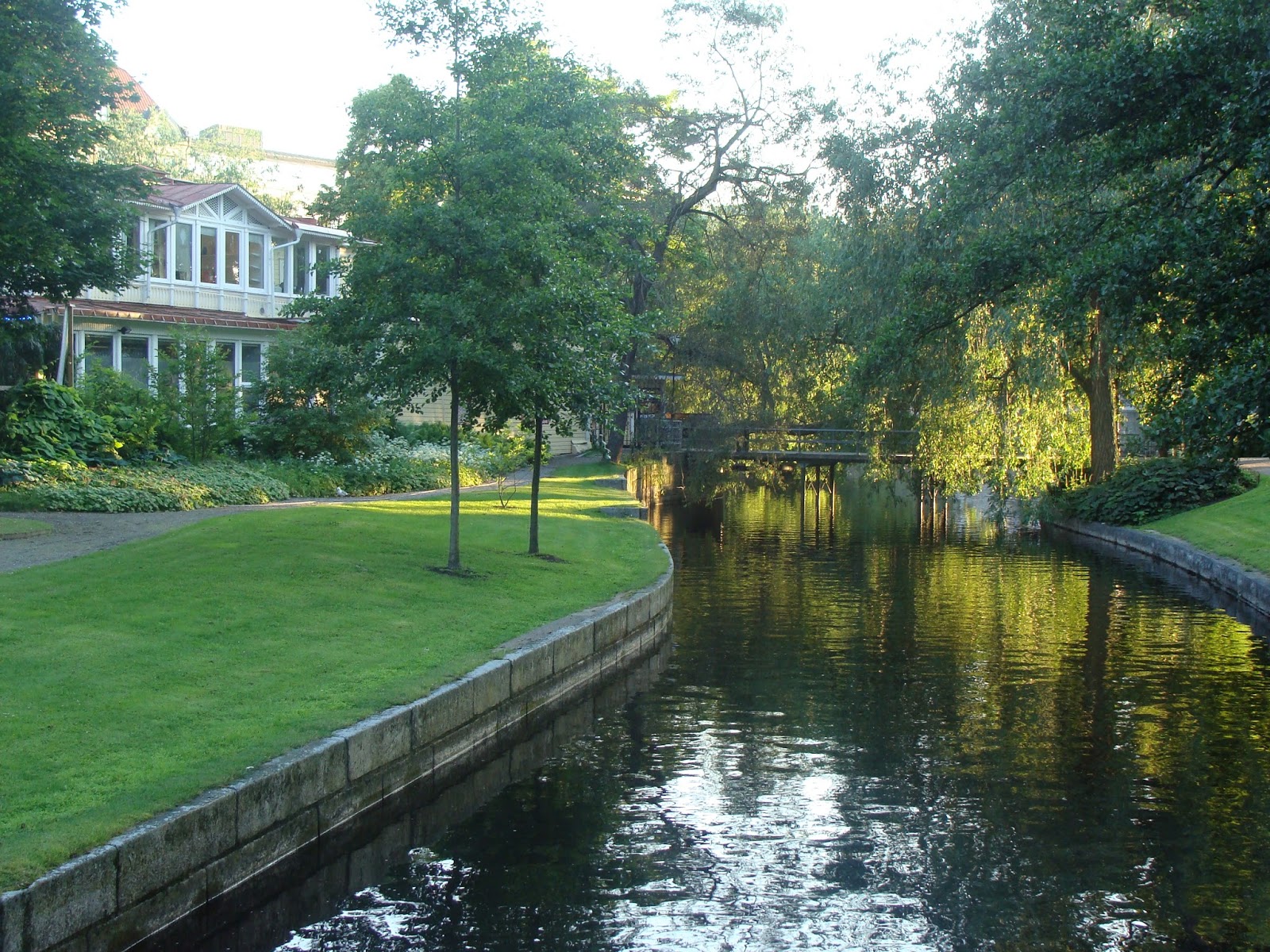
Mrs Hickory came across this area by chance when she was looking for somewhere we could go walking well away from Stockholm. There is a large and beautiful system of lakes nearby, a lot of people have wooden cabins there for holidays, and so we went for a couple of days to walk around. Cue photographs of water and birds.

The river runs through the centre of what is only a small town, really, and it divided and rejoins itself again to form a small island called Large Island. It’s a matter of perspective, I suppose. The island and the neighbouring banks are a park, a very green and pleasant one full of unnecessary bridges and playgrounds and peculiar objects that were part of an art exhibition. There is a castle on another little island next to it and this was the view we had from our hotel room, which was across the river. It’s a conference centre now and inside it looks like one, but it has an impressive presence from without. A marauding band of brigands or disgruntled thane of lands to the North would think twice about trying to take Orëbro.


And bicycles. There are a bicycles everywhere. Huge numbers of bicycles. Just as in the other cities we saw, but in such a small place the quantities are exaggeratedly large. Everywhere there are people riding bikes, but also there are banks and hoards and rows and columns of bikes parked by the dozen or the hundred on almost every corner and every widening of every street, in racks intended for the purpose. The bikes are old-fashioned and in most cases just old, with high wide handlebars, the people are not dressed for cycling, they often look as though they are doing it for transport, not pleasure, and despite the numbers on the streets, many of the parked bikes have clearly not been moved for months or years.

Monday, July 22, 2013

Impressions of Swedish Churches

Scandinavia in general seems to have a distinctive style of ecclesiastical architecture. Partly because they are not us, and partly, mostly I think, because they didn't built much with stone until the late 19thC. The result is that many of the older churches which still stand are either made of wood or, if ma
de of stone, look as though they would be happier if they were made of wood. They tend to have very high, thin, metal spires, usually black,


which give them great vertical presence. Inside they seem to be similar to southern churches. The frescoes are fresher, there is more wood, but the ceilings and the columns look familiar and the design and distribution of high altars, side altars and choir stalls is, too.

We saw an old German church on the water near the railway station at Stockholm. It is said to be the oldest building in Stockholm, with a wrought iron latticed spire. A remarkable piece of work, and rather beautiful. You had to pay to see the inside and it didn't look worth it. The Cathedral was much more interesting, with a mahogany and silver reredos and skulls on the tombstones on the floor, and simple frescoes on some of the roof vaults. The pianist was practicing for a concert on a piano in front of the altar. The sound carried beautifully. We saw another Church with a lot of wood all around, simply but well-carved, and with many paintings of bucolic scenes and the lives of saints on the wood.
 
We walked down to the river and up to the Cathedral at Uppsala. The service was starting. As churches mostly are here, it was tall and thin, and in this case very large, the biggest in Scaninavia we were told. The spires are thin tall and black, the body is good brick, there are weell-executed frescoes on the walls of biblical scenes and sparing designs on the vaults of the ceiling. See the photos as usual. There is great variety of styles among the altars, tombs, gravestones and statues in the place. The high altar was curious, with a simple grey cross and no reredos,but a further space behind. Behind this part was a waxwork of a beggar, very lifelike. There were two organs, one a magnificent old set of pipes over the front door, and another more modern one to one side of the high altar.

100 yards away there was another church, this time a more Romanic type, simpler but also quite interesting in its way. Service was also going on, so I assume it was another denomination, as neither was full. It's a difficult question to ask, of course, 'Why don't you all worship the one God and love your neighbour together?' The answer probably contains the phrase 'spawn of Satan...'


The Church of St Nicholas in Orëbro has its own unusual frescoes and a reredos consisting mostly of a painted Calvary scene surrounded by sculpted apostles making up the rest. Also two organs, one grand and old, one smaller and newer and more accessible. And again a grand piano near the altar. They certainly like their keyboard music in this country.

And then there is the 'Frälsarkransen', which I saw in a number of places. It appears that an old bishop, called Martin Lönnebo, having given up playing pool because his cue arm wasn't as straight as it once was, decided to string his balls together and use them for devotion (I may have misunderstood part of the story). In any case, he created a Rosary in which the beads have the following symbolism:


Schematic Presentation of the Wreath of Christ
1. The bead of God 
2. The bead of Silence 
3. The I-bead 
4. The bead of Baptism 
5. The Desert bead 
6. The Carefree bead 
7. The bead of Love 
8. The bead of Secret 
9. The bead of Darkness 
10. The bead of Resurrection


I found this very interesting, and I offer it for what it's worth. It could be a very comforting thing to hold and to pass through your fingers and your mind at times when life is getting unnecessarily complex.

Saturday, July 20, 2013

Of Sweden, Water and Elk

Work has continued to follow me around this week, but it seems to have stopped (I’ll say it very quietly), and I have time to do things, including blogging.

We are now in the country, by the lakes, but we spent ten days in England, in the old home town, and before that a few days in Sweden (for no particular reason, we just thought we’d go and see the place).

It’s a beautiful country, green and wet. When you live in the semi-desert of southern Spain that’s the first thing that strikes you about anywhere that has water. You breathe more deeply, your flesh seems to fill with life, you feel a freshness about everything, and as I hadn’t been there before and had no particular expectations, I could see it with fresh eyes as well.

Stockholm is built on somewhere between 1,000 and 30,000 islands, depending on who you ask. The casual visitor only sees a couple of dozen, but you are constantly reminded that it is city built on waterways. Everywhere you go is on sth-holm, and across sth-bron. In the tourist’s part of the city you are nearly always looking out over water, walking beside water, crossing over water, smelling water. You get the idea.

There are, of course, boats everywhere.

At the weekend, at the port at Kungsholm and along by Scheppsholm there was some kind of boating festival going on. It looked like a big one, with people from all over and major sponsors. There were many yachts being prepared for a race around the islands. There was talk of an inshore and an offshore race, and smaller, motorized craft were being prepared too. There was a Red Bull 'build a silly machine and throw yourself into the water' competition, which unfortunately didn't start until the next day, but everything was ready and some of the machines were already there. A bit odd they were, not surprisingly. There were outdoor bars and sponsors’ tents and announcers and the whole weekend looked like a lot of fun.

We saw the hat shop where Greta Garbo used to work, we walked up a steep hill and out over a narrow metal bridge about 150 feet up that didn’t seem to be standing on anything so we could see the whole of the old city below us across the water, set in its context against the waterways and the other nearby islands.

We went on an evening ‘safari’, a looking-at-the-wildlife safari, rather than an is-this-lunch-or-do-I-hang-it-on-the-wall safari. A girl with a minibus drove us around a nature reserve to the west of city, mostly around a lake and through woods, and stopped whenever we saw anything with the right number of legs. The first thing we saw was an elk with a young baby, about 70 yards from where we were standing. This, we were told, is very unusual, (she probably tells everyone that). We saw quite a few more elk, including another young one, some from about 40 yards. They have no predators and hunting is banned in the reserve so they don’t worry about anything much beyond the quality of the grass they are munching. At one point the mother and child walked up just behind a hut we were standing the other side of. We all tried to rush round the side and had to be restrained by the young lady who pointed out that an elk is a big thing to have on the other side of you from its baby.

We also came across a number of wild boar- which there are a lot of where I live, too, though you don’t see them often unless you go out at night or very early in the morning- roe deer, a dancing, nervous creature that never seems to like being where it is, and a couple of badgers. Although the area I grew up in is supposed to be full of them, I don’t think I have ever seen a badger before.

All of this as the sun went down over the lake.

Sunday, April 7, 2013

Sigüenza

Sigüenza is a city in the north of Guadalajara, on the banks of the Henares.  A strange city.

Guadalajara itself is a strange kind of place. The eponymous provincial capital is the sort of place that no one has ever been to, or comes from, and the province is now a part of the Autonomous Community of Castilla-La Mancha, despite having no historical connection to it. When Spain was carved up into Autonomous Communities with their own parliaments and the rest of it, in the late 70’s, the motivation was to recognise the historical identity of Galicia, Catalonia and the Basque Country. The rest of Spain wasn’t so easy to partition. Andalucia was fairly clear, and so was Valencia, I suppose, but there were lots of areas that didn’t have any obvious boundaries, or that appear to fit anywhere in particular.
 
León was put into Old Castille, Murcia and Cantabria were given their own identity, and no one had any idea what to do with the Alcarria. It would have been ridiculous to make it a community in its own right, Old Castille was quite big enough, and Madrid’s dignity required that it not be lumped in with another area, even though they are more closely linked historically speaking. On the other hand, the Alcarria is defined to a certain extent by not being Madrid. So the least absurd solution turned out to be to put it with Castilla-La Mancha. That, in any case, is what was done.

So I found myself last week in a city of only 3,000 inhabitants with a monumental Gothic Cathedral of a size and grandeur that comes quite a surprise, with a dozen or so side chapels and an impressive structure in the centre bounded by a rectangle of carved stone to the ceiling and panelled with sculpted wood, contained the barred high altar and the facing choir stalls, in the high mediaeval tradition. And this, despite being central to the history of Castille, is politically part of the same Community that I live in, 300 miles to the south.
 
The city/village of Sigënza has a castle on the top of the hill, a walled mass of mediaeval streets jus


t below it, and a complex of rundown Baroque streets nearer the river. It has five churches of varying age and architectural interest, two convents, one of which makes and sells excellent chocolate, and a modern area which is still growing. It also has a railway station because, in the late 19thC, it seemed that it was still a place that mattered.
 
Everything worth seeing there can be seen in a day, and our intention was to spend another couple of days walking in the hills and through the surrounding villages. There are several villages within a few miles, and I do mean villages, where only a few dozen people live, with castles and one with a mediaeval wall 20 feet high, for no apparent reason, as there’s really nothing to protect.

And a river valley with a burbling stream, with spring colours, overhanging rocks and eagles and vultures circling overhead. We were chased by dogs at one point, and if they ever get together with the birds there could be trouble.

A pleasant few days. It rained a bit, in fact it hailed twice, once just after we lost the dogs, but as I say to Mrs Hickory at such times, ‘Rain is a state of mind.’ She doesn’t always look convinced. Anyhow, photos.

Saturday, August 4, 2012

Notes from the Road- Santoña and the Marismas


Laredo is a seaside town that consists almost entirely of a spit extending almost all the way across the estuary to Santoña. On one side is a very serviceable beach, much of the rest is grass-covered sand, and wherever possible there are houses for tourists. It has, as far as I know, no history, and the population trebles in the summer. In the winter those that are left just mooch about waiting for the sun to come out. Not somewhere you’d want to live.

It is, on the other hand, a very good place to start walking from (to leave, if you like). As you walk west you come immediately to the marismas, the expanse of the estuary, with shallow water, and highly fertile mud just below or just above the surface. If that doesn’t sound especially inviting (and it does smell a bit) the reason I like it is that it attracts a lot of birds.

Most people associate the marisma with shellfish, and there are indeed some very good mussels and clams produced there, as well as sardines, for which the bay is famous, but for the eye and the spirit the interest is provided by the birds.

We walked along and beside the mudflats for several miles, through the port of Colindres* and then through a eucalyptus forest where we got caught in a rainstorm. The road is wet at times. It doesn’t matter; you cover yourself and the rucksack as best you can and later you dry out again.

Then you join the road and walk across a series of bridges that cross the flats. The road is mostly bridge from then on, and you have a clear view of the whole estuary and the sea beyond. The greens and blues and greys rise and fall across the water and the nearby hills and the birds swim and fly lazily across your path. The pictures don’t really do it justice and I think the words don’t either.

Monday, July 30, 2012

Notes from the Road- Santander


We left Noja one morning and started along the clifftops to Santander. The path I had found takes you through Ajo and over the hill paths to Galizano. The route took us into valleys and up mountains and past farms with sheep, goats, cows of different colours (mostly Asturian) some with small and medium calves, horses with foals, donkeys with baby donkeys, and we were followed by a group of kites that swooped and circled and generally had fun.

It rained much of the first few miles, on and off but we kept everything covered. Sometimes we could see the sea beside or behind us, and always the hills and the woods and the fields with things in them and the houses and the little collections of houses which may or may not be villages.

In Galizano we stopped and rested briefly, and we asked for the path through Langre and Loredo to Somo. We saw many farms and flowers and fruits and animals and curious houses, some attractive. There has traditionally been a lot of wood used in building here (there) and many modern houses in rural areas try to maintain something of the style. In Galizano there are many fine stone houses, including some modern ones.

Loredo is a little place on an eminence across the bay from Santander, mainly a holiday place. You need to go down to Somo to catch the boat to the city.

I took that boat sometimes when I lived there. It didn’t strike me then but almost certainly the best way to arrive in Santander is coming down the hill to Somo and crossing in the boat. You can see the city below you for miles as you go down, its position in the bay, the Palace of the Madelena on a headland and the Hotel Real standing out high above the other buildings on the ridge that forms a backbone to the city. As you reach the landing stage and wait for the ferry you can look at the nearby bridge to Pedreña and then turn to look more closely at Santander across the water.

The port area is divided between the international ferry port, the cargo port, the fishing port and the pleasure port, all along one stretch of the bay that was the historical focus of the city, and still is to some extent. The most popular place for strolling is the promenade by the marina, wide and airy, and with sufficient cafés to content the civilized man.

You can see the theatre, a curious structure with a green copper oxide roof and supposedly the largest stage in Europe. It is also highly unusual, if not unique, in that at the back of the stage is a picture window, so the audience can enjoy the view over the bay before the performance starts. The need for curtains and scenery and the fact that plays are usually performed at night means that rarely do you get the chance to see it but the idea was a good one and when it does work it must be quite spectacular.

As you approach the jetty you start to pick out buildings and streets and your favourite shops and cafés and you can identify the characters walking up and down by there demeanour and their clothing and their gait.

Moments later you arrive, and as I say, I think that is the only way to do it.

Friday, January 13, 2012

Things I Noticed on the Beach

There is always somewhere people gather to relax, a place associated with exercise, hobbies, activities of great and surprising variety and strangeness. In the centre of Madrid it’s El Retiro; in my little retreat it’s the old railway line; and in Málaga it’s the seafront.

There you will find the usual collection- a large collection, even on a cool January morning- of runners, skaters, walkers, strollers, cyclists, and old people not exactly moving but not exactly keeping still. And among them, and on the beach itself, the more unusual collection; people you weren’t expecting to see but you register without surprise. The sand sculptor who has created a little zoo of flattened animals, a lion painted yellow, a giraffe with darker spots, an unhappy looking elephant, a fat rhino and a rather terrifying crocodile.

There was a girl who appeared to be testing her abseiling kit. She had stretched the belts between two trees and was repeatedly pulling it as tight as possible and checking some aspect of it which I might have been able to define more precisely if I knew anything about abseiling. I hoped that when she’d got it all set up and working she would run into it and do a kind of human catapult thing, but it turned out that that was not the purpose of the exercise.

There was a pair of middle-aged tramps who were trying to work out how to have sex on the beach without attracting attention. If they’d simply got their kit off they’d have had the entire shore to themselves in a matter of seconds but they didn’t think of that. I assume they found a solution in the end.

After the 6th Jan, the front was also full of children on new bicycles and rollerskates, and skateboards and other, more modern forms of locomotion which passed this hedgehog by some time ago. It’s a standard post-Reyes scene, in which parents with hangovers have to take the kiddies out to play with their new presents. Imagine how her eyes will light up when she sees it, they said to each other with joy both paternal and maternal as they bought the new wheels. And they were probably right, but their own eyes did not open with joy, or anything much at all, at six in the morning when they were dragged out of bed to go and watch it being ridden. Such, I imagine, is parenthood. Ups and downs

A great swarm of cotorras- a kind of small parrot, this one I think- flew around in rough formation for a while as we sat eating fish. About thirty of them, a colony formed as a result of a pair escaping from captivity some years ago. They flock, and seem to obey either a leader or a collective, sheep-like instinct to avoid being seen to stand out. As the leader of a flock of sheep at any moment is the one most recently frightened by its own shadow, so these birds seemed to go where the most nervous one was taken by its fear of noise and movement. They are emerald green and strangely compelling to watch. The photo was taken on the phone from a distance and doesn’t do them justice at all.

The fish and the prawns were excellent, too.

Now I’m back at home, working and battling the frost that covers the trees every night. Not everything in life can be selfish pleasure (well, in theory it can, of course, but I’ve never got it properly worked out).

Sunday, January 8, 2012

In the Hills Again


Just a couple of miles north of Marbella lies the Sierra de Las Nieves, a mountain range like many in the south of Spain, imposing from the coast, beautiful when you’re up in it and, despite the name, not actually high enough to be snow-covered, even in winter. It covers a wide area which is crossed by a network of what, for want of a better word, I shall call ‘paths’. They are walkable, indeed they were made by walkers and are intended to be walked, but they are not easy. Mrs Hickory, despite her many merits, is not a mountain goat, and needs a little persuading to get her to join me on these jaunts, but in the end she always comes, and  afterwards when we’re sitting comfortably in a bar at ground level, she claims to enjoy them.

We found a strawberry tree covered with fruit. Some of it was ripe and edible. I don’t know if it’s common for January, you don’t see many of them in my part of the world, but they provided a bit of colour beyond the shades of green and blue.

From the top you can see Marbella, the other mountain ranges which undulate along the coast, Gibraltar (I think), the Mediterranean, and the coast of Africa in the distance. The full effect is made up of the combinations of colours and the physical feeling of being surrounded not only on all sides but also above and below, by the beauty and power of nature, the sensations in the body from the effort of getting up there, and the knowledge that you have to get down again and that it won’t be easy. Photographs don’t give any sense of what it is likely to be there.

There’s nothing particularly special or unusual about those mountains. There are many like them, but they are all worth seeing. Little by little, one by one, we’re getting there.

Tuesday, November 1, 2011

Las Tablas de Daimiel


There is a system of water meadows about 20 miles NW of the town, locally, and perhaps nationally famous, for the birds that live on the water and among the reeds.
It’s not comparable in natural beauty to the system of lakes where I spend the summer (and which I write about repeatedly), but the wildlife is more varied, more copious, and more interesting. It makes a good day out for the kind of person who likes wandering in the country seeking new forms of beauty.

Apart from a failed attempt to walk there from the nearest town, many years ago, when we misread the map in some way I have never understood and got lost in the middle of nowhere without water, and a couple of times when I have reached the lakes on the bike but not explored anything, neither of us had ever been there. It’s a strange thing not to have seen in 12 years but now we have made up for it.

The water is not interesting, at least, not in autumn. In spring it’s probably much more colourful and fresh. Now it consists mostly of mad and dried rushes. But there are birds everywhere, and that’s what you go to see.

There are several miles of wooden walkways out across the water to the small islands in the middle, and they take you through the main nesting areas without disturbing the birds. At least, they don’t look disturbed by the people constantly wandering past, and taking photos of them. There were storks, nesting in the higher tress, and occasionally stretching their wings to take a turn around the lake. Last week I went to a place that is full of storks’ nests, and they had already left for Africa to spend the winter. I don’t know why these were still here. There were colonies of brilliant white heron-type birds, ducks of various kinds, flamingos, mostly white, and a large group of younger birds mottled with black. Only one was genuinely pink. They don’t get enough carotene in their diet to get a good flamingo colour. There were geese by the mill and a small water snake trying to hide from something that hadn’t noticed it was there. A beaver rolled around on its back, disappearing under the water and popping up again at regular intervals.
 
There are many mills on this part of the river, most of them ruined, but one is well conserved and used as a museum of all things milly. The floor is mostly glass so you can see the water channels and the sluices that drove the wheels, and a collection of equipment from different periods is exhibited and explained.

But it’s the outdoors which is fun, watching the birds do their thing on a sunny autumn day, as though they were alone, or do they take an interest in their public, watching us watching them?

Calatrava La Nueva


This weekend I have been mostly visiting places I’d never been to before. On Friday it was Calatrava la Nueva. The defense of this region against the Arab hordes was entrusted to the Knights of Caltrava (the whole area is known as the Campo de Calatrava and many villages are called X de Calatrava). The original fortress still stands beside the river a few miles north of the town, and we have often walked or ridden out there to see it. It shows the history of the area in the mix of Moorish and Christian elements, where it changed hands several times.

But that fortress was abandoned at the beginning of the 13th C, because of the constant fevers caused by the marshes, and because they found a better position to defend. The new castle was on the top of a hill, rising about 800ft above the surrounding plains. Barely accessible, impossible to take, you would think, and an extraordinary feat of construction.

The keep is built right into the limestone slabs that the hill is made of, and which lie partly exposed at various points. They provide anchorage, and saved some work on building, which would have been very welcome. Every stone, every brick, every tool had to be hauled up the steep slope that is the only access route. Outside the keep there is a surrounding wall, within which are bakeries, mills, ovens and a little street of craftsmen’s workshops. Lower down a second wall skirts the hill protecting what was effectively a village of maybe 200 people, who lived and walked in the safety of the castle, growing crops and tending cattle on the plain, and returning within the walls at night, or in case of danger.

The keep itself is high and thick, the chapel is high, Gothic, simple, elegant and atmospheric. Wind whistles and there is little light. It was probably always like that. The battlements give spectacular views of the surrounding countryside and hills. You can see the castle of Salvatierra across the road, but it is little more than ruins now. And you could have seen the Arabs coming from a long way off. Just like  at Alarcos, it was probably a good job, working for the Order, becoming a Knight, living in a great castle with everything provided, walking the battlements when you were on duty, enjoying the landscape and the sense of power that comes from being high up and near impregnable, chatting and joking with the other Knights, year after year, until the day when you saw, a long way off, the Arab army approaching, and everything went quiet, and you knew that now was when you earned your money.

You tell the kids today and they don't believe life could ever have been anything but safe and comfortable.

Thursday, August 25, 2011

Peñarroya Castle


In the year 1198, Alonso Pérez de Sanabria, Captain of the forces of Alfonso VIII, took (in that wonderfully graphic mediaeval sense of the verb ‘to take’) the Castle of Peñarroya. While debating with himself at precisely which angle a particular prisoner’s head should be parted from his shoulders, this prisoner, known to history as Allen Ilec, revealed that he knew of a secret treasure and suggested they might do a deal. He turned out to be telling the truth, the deal was struck, Ilec kept his head, at least until the next battle, and in the roof of the castle the treasure was found. It included the lost image of Our Lady of Peñarroya, a dark Virgin venerated in the area since before that time.

A shrine was built within the castle for it, and there it has been ever since. It’s taken annually to the nearest village so it can be carried back again to the shrine, accompanied by a large crowd of people. Then everybody fries sausages and gets drunk. That’s how these things usually work around here.

In 1959 Franco decided to build a dam at that exact spot. The castle stands on an eminence commanding a spectacular, and strategic, view of the valley in both directions, and of the surrounding hills. This position, just where the valley narrows for a moment, and with rocks on either side, was perfect for the head of a reservoir. So the Generalissimo thought, and he was probably right.

It’s an ugly dam, and clearly some damage was done to the castle in order to build it, but the land must be irrigated, people need to drink, and if we lost some of the beauty of the castle we gained the beauty of the lake.

This is, of course, mostly an excuse to publish some photos. Considering I cycled over 40 miles with the express purpose of taking them, I’m not very happy with the results, but here they are anyway. I’ll just have to go back one day.

Saturday, August 6, 2011

Two Books I Shan't be Finishing

My summer reading list is very long, consisting mostly of my as usual very backed up 'to read' list and a few extra things I liked the look of thrown in, plus some detailed background reading on some of the things I'm interested in now that I've got more time to concentrate. I'll be lucky to get through half of them by mid-September, but that's normal. It never does get much shorter.
In fact, my reading list is not so much long as high. It exists, physically, as a pile almost as tall as I am, in the corner of the bedroom on my side of the bed (which Mrs Hickory now pretends not to notice). She has been known to ask, casually as it were, why they can't be on the shelves, you know, the bookshelves, which are called that for a reason. The answer, of course, is that I like to have the things I might need at short notice to hand. There are an awful lot of things I might need at short notice, and not all of them are books, but Mrs Hickory has decided to pretend not to notice that, either.

I now have most of my reading, current, future, potential, and 'you-never-know', in the Kindle, which saves a great deal of space. So here on the farm the pile of books on my desk and beside the bed is much smaller than it used to be, and consists mainly of reference books and books that you can't get in e-form, or that I already had in print but haven't read yet.

You get the picture. A lot of books are planned for the holidays. There is a sort of idea of which are more important, but it often depends on how I feel. The Kindle is great for that as well, you just flick from one to another without leaving your chair.

If you've got this far, you'll be wondering when I'm going to get to the subject of the title; what, you are thinking, are these two books that I have decided are not worth finishing?

The first (in no particular order) is Conan Doyle's 'The White Company'. A student of mine, a highly intelligent university lecturer with a very good command of English, mentioned that he was reading it and was finding it very hard to understand. That's odd, I thought. Conan Doyle shouldn't be especially difficult. I use him with high school students, although only scenes, and they are slightly abridged, but this chap, I thought, should have no trouble with a few Sherlock Holmes stories.

The title wasn't familiar so I dug it up on the ether and took a quick look. Nothing Holmsian at all, but a mediaeval lad brought up in a monastery who goes out into the world to seek his fortune and ends up buckling his swash with the best of them all over France and Spain. Hugely exaggerated tales of bravado, gallantry and derring-do, from a time when people conversed in entire paragraphs and waited until the other chap had finished speaking before deciding whether he had expressed himself like a gentleman or like a blackguard, and therefore whether you would embrace him and treat him to mead and porter, or slice his head off.

Fun, in other words. It should have been a film with Burt Lancaster or Errol Flynn(perhaps it was). It is also incomprehensible. It is full, not just on every page but almost on every line, with words that normal people simply do not use, and probably didn't even in the 13thC. Characters do not drink, they 'tope' or 'quaff' from 'flaggons of hardy stout', they are not employed, but 'fiefed in soccage to the laird', they do not live anywhere, they 'dwelleth o'er yonder', they don't wear yellow and blue coats, they are 'swathed/clad in azure vert bar sinister crossed with jules puissant'. This is, I repeat, on every line, and those are the easy ones, the ones I understand, even if my student doesn't. If you tried to take it seriously, you would need a very thick dictionary beside you.

Not that you can take it seriously. It is great fun, as I said, but absurdly over the top. I don't know if the writer knew what all the words meant and used them properly or just picked them by the dozen from the right semantic field and sprinkled them, broadcast, to flower where they may. In any case, I got about halfway through before realizing that there was no point continuing. You have known for a long time who will win, who will live, who will die, who will show courage and who will marry whom, and how they will pass the time until those things happen (see 'quaffing', 'carousing', tourneying', 'wenching', and competitive verbosity). The rest is inconsequential. I'll wait for the film.

The other book I shall not finish is Nietzsche's 'Also Sprach Zarathustra.' I shouldn't have started it, I know. It's exactly what I thought it would be, an endless series of cynical and rather obvious aphorisms, held together by a story that is not a story, and in the mouth of a character who could have been some bloke down the pub, except that Nietzsche took himself far too seriously to put his words into the mouth of someone who wasn't a prophet of God. It wouldn't have sold so well, either. You could analyse and criticise every verse in some detail, but is it worth it? There is no depth, no coherence, no thread except the person of Zarathustra- the disciples are just dummies, foils if you like. Is it possible that the whole thing is a joke?

That, anyhow, is my impression. I am about a quarter of the way through and, unless someone can give me a good reason to continue, I shall consign it to the 'waste of time' file on the Kindle.*

*I don't suppose I'm the only one who keeps books he doesn't intend to read on the Kindle. It's no different from keeping them on the shelves, I suppose. You don't like to throw them away.