Sunday, August 11, 2013

The Land of the Blessed Virgin

While I was reading 'Of Human Bondage', I also had a look at Somerset Maugham's 'The Land of the Blessed Virgin'

I wondered how the discerning observer and fine stylist would have seen the southern Spain of a hundred years ago. I was a little disappointed, as it is very much the opinions of a man who stayed outside everything around him.

It is very well observed in places, but there are too many statements glorifying, exaggerating the exotic which he thinks he has seen or should have seen. Generalized descriptions that cannot possibly be true.  I suspect he has not seen much of what he claims to have seen, and much of what he has he has not understood. A lot of the time he seems to be quoting guidebooks, adding literary embellishment of his own, sometimes good, often not. He has clearly had almost no contact with real people, he has not got to know anyone, except one woman, Rosarito, who I strongly suspect was not real anyway. Everyone else is described in the ignorant terms of the armchair anthropologist,.

He generalizes from a lazy interpretation of a single instance.  He has little curiosity about people, he is more concerned with finding a pretty phrase or a making an extreme pronouncement. Even the individuals he is forced into direct contact with, a doctor, a bullfighter, a watchman, etc, are described in terms of how he expects them to be, rather than how he has found them to be. On the other hand, some things he does describe well and in considerable detail, as though he had paid real attention. The Cathedral, the bullfight, the rain on the fields. It's not a book that will tell you anything much about the Spain of 100 years ago. At least, it won't tell you what you thought it was going to tell you. It will tell you how one man experienced a journey through Spain at that time. As such, it is a story well told, just not at all the one I was expecting.

Saturday, August 10, 2013

San Pedra

I walked today along the route of one of the many dry or almost dry streams in the area. The map is full of blue lines, some full, some broken, with the words ‘non-permanent water-course’ next to the symbol in the legend. Many of them have not had water for many years. Some, in fact, are barely visible on the ground, but are perfectly clear from satellite photographs, and you wonder where the water has gone that once created these great channels.

The stream I took today does have water this year, and when it doesn’t you can still see where it flows. I particularly like this path because it takes you between bright red hills covered with bright green vegetation. The water may be barely visible, but the plants know it’s there. There is a freshness to it which is very rare here.

But there is a lot more to the path than a feeling. There are little stone bridges where it winds back and forth across the water. There are little cottages used by the men who have gardens there, as sheds are in England, but some are bigger and become a place of refuge, especially during the summer. Some are proper houses, two floors and whitewashed walls, and once families would have lived there all year round, with the chickens and the dogs and the pig in the corral. Now they are just summer dwellings, quiet, solitary places which appeal to the owners who still grow crops on the old riverbed.

There is a ruined Moorish castle, little more than a square turret, rising through the trees on a small hill near where you pick up the main road again. I saw it once after very heavy rain had turned the hill into an island, and you see the castle as it was intended to be, unreachable by stealth, a safe place from which to keep an eye on the surrounding country. There are a lot of them here.

From that point you pass a forlorn and empty campsite, unable for some reason to attract more than a handful of campers, even when at the other campsites downstream they are queuing to get in the doors.


And from there you are beside the lakes. You pass an attractive hotel, tumbling down the rocks to the waterfront, dressed always in freshly laundered white, accessorized tastefully in well-kept wood, and adorned with dabs of red and green and gold in just the right places. You are back among people, and can then choose to swim, row, take the sun or contemplate the world at any point along the banks where you can find room.


Friday, August 9, 2013

La Familia de Pascual Duarte

Camilo José Cela won a Nobel Prize back in the 80's, and was awarded a Marquesate some time later by the King. He is known in Spain for these things and for swearing a lot. It's some years since he pronounced his last swearword, having gone to sit at the great writing desk in the sky, doubtless in front of a window through which can be seen far more interesting things than the ones he's now trying to write about (Perhaps that's just me, and might explain why his success was rather greater than mine. I wrote about 'La Colmena' a couple of years ago, I think, but the holotype, as it were, of his work, is generally considered to be 'La Familia de Pascual Duarte', which I had never quite got round to reading.


It was written in the early 1940's, and set during the preceding decades, as it describes most of the life of the title character. It sets the scene at such length, and is at first so pleased with the conceit of its own narrative framework, that you begin to wonder if there is any story to be told at all. But there is, it develops rhythm and power, and it gains a sense of its own surroundings, almost accidentally in the end, having tried so hard to do it deliberately, which makes it matter. It is not clear why Duarte does, or does not do, the central acts of the story. It is never explained why he didn't kill his sister's lover, why his brother died as he did, how his wife died, why he left his home and his wife, why his sister became a tart, why he killed his mother… His story is a series of  disconnected and unexplained actions.

The story is told, effectively, in his own words, supposedly in a manuscript found by the prison governor. he explains little, he only states, describes, sometimes justifies, often omits. He seems to care for nothing; fair enough. The family is not the story, the house is not the story, although that might have been the original idea. It is a combination of all these things, a mood created by them collectively, that is the story, and what makes the book worth reading.

Thursday, August 8, 2013

Otis tarda

It could be the name of death metal band (perhaps it is), but I'm referring here to the great bustard, a large bird which has traditionally nested in the south of Spain, and over the last few years is back in increasing numbers. As I cover a lot of ground on my travels, I have seen a few of them this year. They seem to like some of the farmland near the lakes. They nest on the ground, and they congregate near the centres of large fields (fields are large here because the land is poor and you need a lot of it to grow a worthwhile crop). They avoid the paths where people and vehicles might go. I don’t imagine they can conceive the purpose of paths, of course, but by constantly moving away from any people they do see, they will end up with a preference for a spot in the centre, where they will only be bothered at ploughing, sowing and harvest time (or by the occasional lost wanderer who, having given up hope of finding a path that actually goes somewhere near his goal, and wondering vaguely whether he will be missed at lunchtime, or they’ll have kept his beer on ice, decides to walk straight across on the off-chance that on the other side of the field there is something that is of use to him). There are rather beautiful birds. Light earth brown on the wings, bordered and finished below in white, they look at first sight a little like emus. They vary greatly in size. Some are like turkeys, but I came across a small group the other day that were around four feet tall. They were only 50 yards when they too flight, and for a moment when I saw them I genuinely couldn’t work out what they were, so impressive was there size. They fly little, but with an elegant, efficient grace which is a pleasure to watch. They are, it is said, the biggest flying things on Earth, and yet they have none of the clumsiness of many ground-nesting birds (watching a partridge fly you wonder if the chap in the workshop in Switzerland who put it together had lunched rather too well). Whole families stay together until the chicks are hard to tell apart from the adults, so you might suddenly see a dozen of them rise from the corn in front of you are argue briefly about the best direction to take before splitting up and reuniting somewhere beyond the next copse. It is a remarkable sight to see them fly, and they give a different scale to the skies. They make the eagle owls look small and clumsy.

Tuesday, August 6, 2013

Of Human Bondage

Attentive readers will have noticed that Mrs Hickory and I have been in Sweden, enjoying it with all the open-mouthed wonder of a farmboy taking his cabbages to the local market town for the first time. Which is how I think most things in life should be lived, even though I am prone to forget this and give in to world-weary cynicism at the first opportunity. Anyhow, we are now on the farm, and have been for a while, so now it is summer things: books I am reading, places I am walking through, curious things that happen, stray thoughts that strike me as I wander through this now familiar land

 I have just read Somerset Maugham's 'Of Human Bondage'. Many sources seem to consider it his masterpiece I really can't agree. It is in not a masterpiece, and Maugham himself has written better books. 'The Moon and Sixpence' is much better, in the literary sense, and a better read, and some of his short stories are innovative and compelling, which this isn't. It seems a bit unpolished to me. There are good and interesting characters, some well-painted scenes, some sections are genuinely captivating, but the whole doesn't work. The beginning, the childhood and school, is dull and might well have been left out. It would have some purpose if it created the character of Philip from the details that he experiences, but it doesn't do that. When we need to learn something about his character the narrator simply tells us what he is like. The end is predictable in part; it is obvious he is being set up for settling down with a specific girl, and obvious he is going to get on with the crusty old doctor. I wonder if it for moral reasons that the narrator doesn't let Philip travel as he wished once he is qualified. It seems strange in Maugham to care about that, but I don't see any other reason, unless he was just tired of the whole thing and wanted to finish it.

I wish we had been able to follow Paul's travels in Spain and the East before he was sacrificed to the demands of normality and maturity. But it is Maugham's book, not mine, and he conceived it that way. The central relationship is very powerfully created and the tension is maintained throughout. I repeatedly experienced an empty feeling in my stomach when I feared he was going to fall for Mildred once again. That is a sign of good storytelling, when it has you shouting at the character not to be a bloody fool.

Saturday, August 3, 2013

Public Art in Sweden

Public art appears to be less subject to any constraints of quality or taste or return on taxpayers money than even in England. The place, the country, is dotted with abysmal creations that I am sure no one has paid for willingly. There are big display cases with pointless, as in having neither purpose nor anything to say, stuff in them, there is a poorly made figure of a pink giant urinating into the river. There was, in a nearby square, a great structure of wires strung with bathroom furniture and other objects in a meaningless parade of tat. Someone is laughing as they take the money. In front of the castle in the river there are three figures of businessmen standing in shopping trolleys. There is at least a touch of humour in this, probably Marxist humour of course.


It turns out that these piles ofuninspiring junk  are part of a festival called OpenArt. The woman in the tourist office encouraged us to do a tour of all the pieces. We shan't be doing that. What we have seen of it captures everything that is wrong with taxpayer-funded artists. It is lazy and dull. There is never more than a single idea, usually trite and poorly executed. There is no attempt at doing real work or conceiving a more complex idea, something worth expressing, and working on the best way to express it. For 'public' artists it is always and only about money. Other people's money. The art itself doesn't matter, as they are not communicating with anyone, not even themselves.

It was a pity to have to navigate all this stuff in order to see the simple beauty of the town.

Friday, August 2, 2013

At Orëbro

Mrs Hickory came across this area by chance when she was looking for somewhere we could go walking well away from Stockholm. There is a large and beautiful system of lakes nearby, a lot of people have wooden cabins there for holidays, and so we went for a couple of days to walk around. Cue photographs of water and birds.

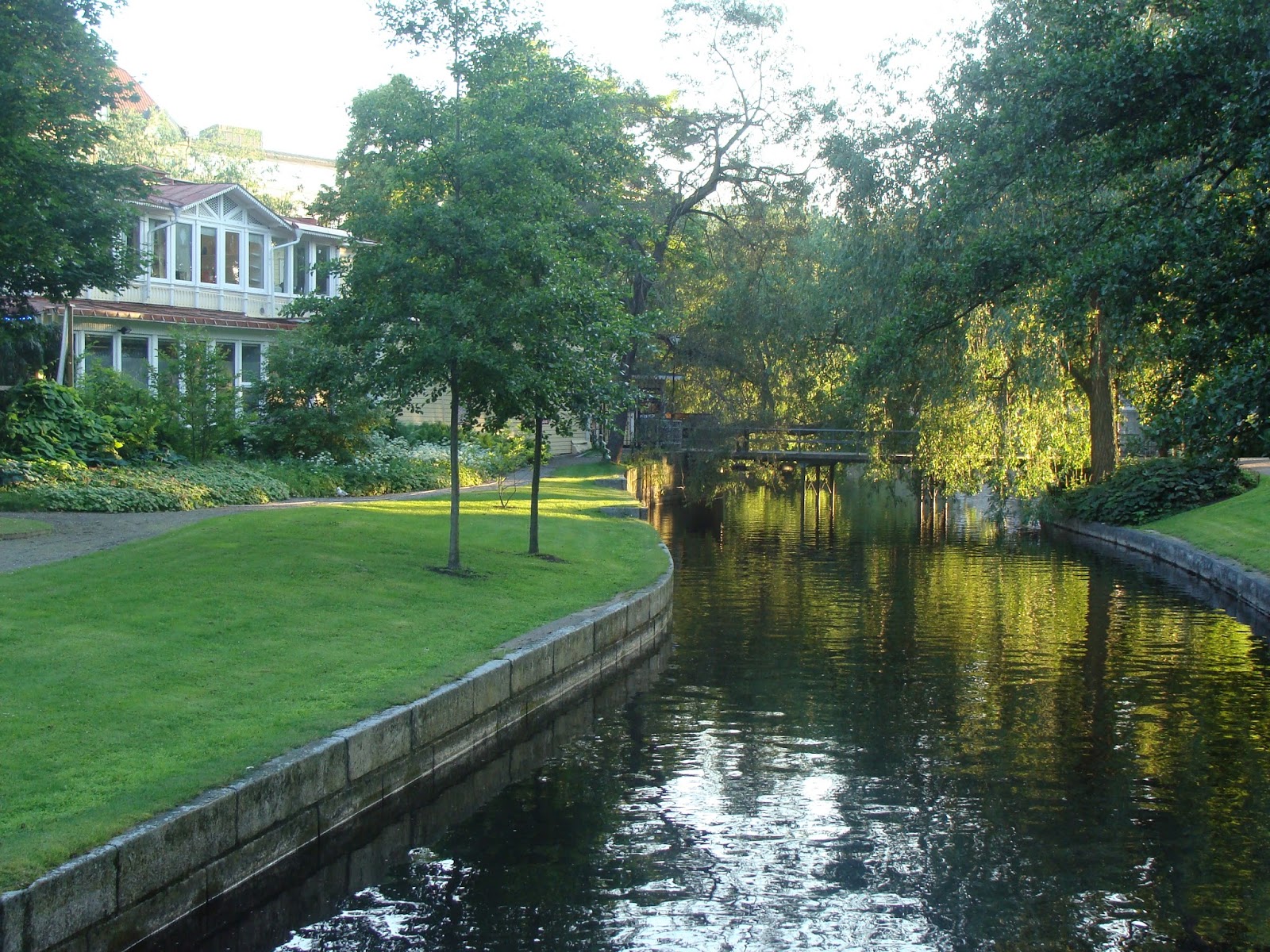
The river runs through the centre of what is only a small town, really, and it divided and rejoins itself again to form a small island called Large Island. It’s a matter of perspective, I suppose. The island and the neighbouring banks are a park, a very green and pleasant one full of unnecessary bridges and playgrounds and peculiar objects that were part of an art exhibition. There is a castle on another little island next to it and this was the view we had from our hotel room, which was across the river. It’s a conference centre now and inside it looks like one, but it has an impressive presence from without. A marauding band of brigands or disgruntled thane of lands to the North would think twice about trying to take Orëbro.


And bicycles. There are a bicycles everywhere. Huge numbers of bicycles. Just as in the other cities we saw, but in such a small place the quantities are exaggeratedly large. Everywhere there are people riding bikes, but also there are banks and hoards and rows and columns of bikes parked by the dozen or the hundred on almost every corner and every widening of every street, in racks intended for the purpose. The bikes are old-fashioned and in most cases just old, with high wide handlebars, the people are not dressed for cycling, they often look as though they are doing it for transport, not pleasure, and despite the numbers on the streets, many of the parked bikes have clearly not been moved for months or years.