Tuesday, December 21, 2010

Don't Shock a Flat-liner

I used to play golf with a cardiologist. A specialist in pediatric cardiology, recognised as an expert in his field. This was more than 15 years ago and he was over 50 then. A great chap and a fine doctor, but he wasn't in the best of form physically, and when he felt any kind of weakness in his general state, or an irregularity in his palpitations, he would gasp, grab me intensely by the arm and say, 'you don't think it's my heart, do you?'*

The point of which anecdote is to illustrate how we can lose all grasp of objective reañlity when we feel a powerful emotion like fear.

One thing I remember learning from him was the title of this post. He didn't put it that way, and he wasn't complaining about the TV (actually he was using it as a metaphor for some philosophical argument, the details of which I have forgotten). Anyhow, when the monitor goes 'beeeeeeeeeeeeeeeeep' in a medical drama, everyone rushes for the defibrillator, shouts things like 'charge to 360', 'stand back' and the patient bounces up and down like a dying halibut, this, though very dramatic, does not, apparently, reflect reality.

Here and here someone who knows about these things explains why not, and what really happens, and here someone else explains the conflict between the search for two different forms of dramatic tension, and how it might be resolved.


*I did try to answer him on occasions, but it didn't matter much what I said. The point is that a man who is frightened wants a friend to tell him he's at his side and there's no problem. It doesn't matter that the subject is an expert on hearts and the friend knows nothing about them.

Sunday, December 19, 2010

On Contempt for Office Boys (and Girls)

Every time I have anything to do with civil servants I feel a primitive urge to lay about me with something sharp in one hand and something blunt in the other. It's not simply that most of the paperwork they require you to do is unnecessarily complicated and time-consuming; it's not just that governments both local and national absolutely love to make you ask permission for every little thing, and pay through the nose even if they refuse to give it to you; these things are not directly the fault of the people you actually deal with, as the ones who create these systems are hiding in mediaeval palaces bought with public money and with armed guards on the doors.

No, what brings out the Viking in me is the laziness, incompetence, incivility and contempt with which people who do trivial bits of paperwork for a living treat the public which pays them and that they are there to serve. They have absolutely no idea of what it means to earn a living, of what it is to have your work assessed by someone who is wondering whether you are worth paying any more, to attend to clients who are paying for a service and expect to be satisfied, to have to turn up on time, leave late and work through your coffee break because there are things to be done, to see income depend on the time, effort, quality and quantity of the work you do. In short, they have no idea what it means to work in the productive economy. And they have absolutely no concept of the value of other people's time. If you try to explain any of this they look at you strangely, completely mystified. Most of them are socialists, obviously, because for them money really does appear to grow on trees.

I'm speaking of Spain, and on this occasion of the office for foreigners, but my experience in other deparments, and in England, has been very similar. I paid someone to do the paperwork for me, and only turned up for one part of the process for which they insist you come in person. Since it consists of stamping a piece of paper I have no idea why but they like to make you waste as much time as possible. In my case a couple of hours.

Most of the people who need to get or renew papers are economic migrants who can't pay an adviser and have to do it themselves. There was a group of Rumanians who clearly worked in the fields or on building sites and had spent the entire morning waiting to be called and 'processed'. There was some kind of computer problem, but no one was trying to solve it, no one was taking responsibility for it, no one was keeping the waiting public informed, no one was apologising. They just exchanged looks and snide remarks, not always sotto voce, about how people had no patience and how stressful it all was. And then they dismissed the Rumanians with 'you'll have to come back on Monday'. It's not the paperpushers who have lost a day's pay which they can ill afford, travelled to the city to be ignored for hours, and now have to convince the boss to let them lose another day's pay so they can try again next week. They don't care, because they do not understand service or money. And as I say, you can't explain these things. A lifetime in the civil service leaves you unable to understand what work really is.

Wednesday, December 15, 2010

You Know you Want One


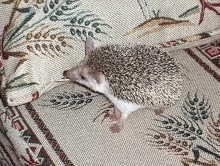
Since the need to earn a living has been getting in the way of blogging these last few days, I offer you this gratuitously cute picture of a young cousin to keep the thing ticking over. Picture dangled by its paws with cries of 'ooo' and 'aaaah' from here.

Update: Since some people need convincing, here is another image. I WANT ONE OF THOSE, AND I AM ONE OF THOSE

Wednesday, December 8, 2010

The Colours of Snow

Note: this was written on Sunday night.

It snowed on Thursday night and Friday morning. The farm when we arrived was 6 inches deep in snow, which I had never seen before (the house is very cold in winter and we don't come much). The country looks beautiful under thick, untouched snow. The sky was blue and bright, there was no wind and there was a brilliance and stillness about everything you rarely experience. The country isn't silent, as some people fondly imagine; it's filled with the calls and flappings of birds, the chirpings of innumerable insects, the bangings and scrapings of rabbits, hares, foxes, wildcats, wild boar and others careering through the undergrowth, the wind in the trees, even the hum of electricity in the wires. I never take music or a radio when I go out walking (unless the Athletic are playing, of course) because you miss half the fun; you're not really there.

The snow showed up clearly the furrows in the fields, and even the cross patterns, with one set made by the plough and another by the sowing machine, and also the wobbly bits where the tractor driver was in a hurry to finish and get home. Snow-covered and with the low sun, they are much clearer than in high summer.

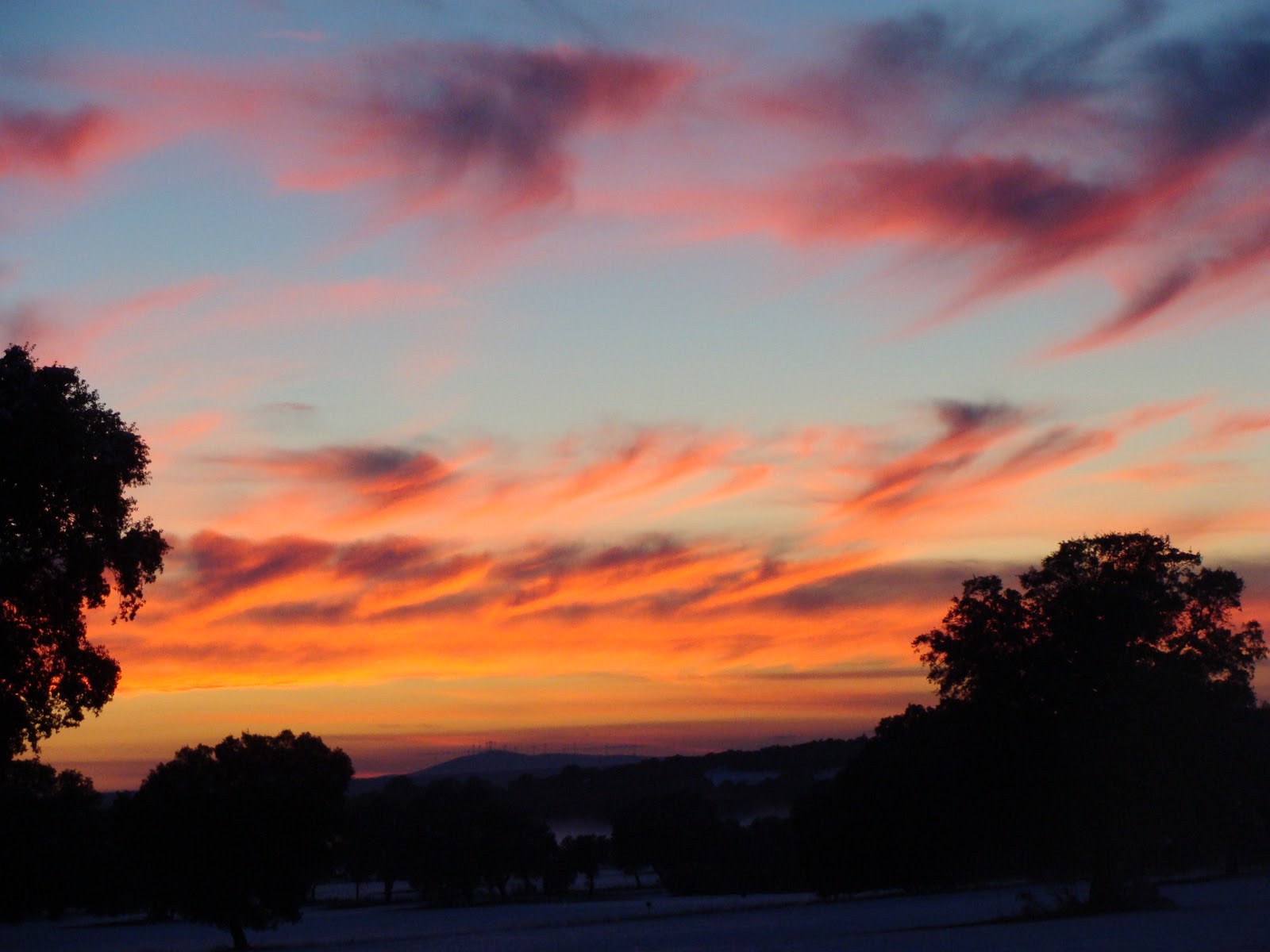
The sunset on Friday was magnificent, a swirling mix of blood reds, flame oranges, sizzling yellows and the shade of pink that can walk into a bar without being laughed at. All set near the horizon between a deep blue sky adn a pure white landscape. The photo is a poor reflection of the reality as we saw it, and if you painted it no one would believe you.

By Sunday morning most of the snow had gone, and only little patches of ice were left where some weight had compacted the snow; on the paths, tyre marks from the farm vehicles; in the fields and the hills, our own footmarks; and everywhere trails of little white dots that were the frozen pawprints of rabbits.


It's all gone now, and we just have cloud, wind and a bit of rain. Mud on the paths makes it difficult to walk. We are sitting by the fire, which seems the only thing to do. The logs are damp, so they spit from time to time, and the gamekeeper and I have differing views about how to build and maintain a fire, but it's burning, and later we'll cook dinner on it.

Tuesday, December 7, 2010

Under Martial Law

Rabbit tracks in the snow
Note: this was written on Sunday evening and is unamended (in other words I haven't done any research, or even read the papers).

Anyone who came here looking for enlightened and enlightening comment on the Spanish air traffic controllers' strike will, I fear, be disappointed.  I have beenb deep in the country these last few days and have no internet access, and little interest in the real world. I only found out about it by chance as I took a radio to listen to the football.

Don't believe anything you read in the British press, by the way; I guarantee they will know even less than I do about it.

The facts appear to be as follows: the air traffic controllers' union called, for Saturday, an illegal and abusive strike, deliberately causing utter chaos at the start of what is for many people a five-day holiday here. The (socialist) government responded by declaring a state of alarm, as set out in the Constitution, for the first time in democracy. It's a rung or two below a state of emergency, and in this case involved pacing Spanish airspace under martial law, and the controllers under military discipline and at the orders of the military high command. By refusing to work they would be liable to court-martial. They quickly scuttled back to work, but the state of martial law will last for two weeks, and they may ask permission of parliament to extend it over Christmas and New Year, in case the union gets ideas again.

Those who didn't work on Saturday, the majority, will be investigated and may be disciplined or charged and they could be held personally liable for the losses they have caused to the airports, airlines and passengers.

The opposition, centre-right, Popular Party has expressed its support for the decisions the government has taken, although it reserves the right to slag them off about it later when it's all over.

So much for the facts. The rest of this post is speculation, unless I can be bothered to do some research.

I don't know what the controllers were complaining about, but since they earn a lot of money and are almost impossible to sack they don't have much to complain about, and they don't have the sympathy of the public, 90% of whom would kill to have their problems. I couldn't say whether the threat to law and order or to the economic activity of the country was really great enouh to justify placing civilians, even greedy, irresponsible civilians, under martial law, but it seems an extreme reaction.

The opposition was quite right to support the government now, but they will make great political capital out of it later. Among other things because a home office minister said that it was the dutry of an opposition to stand by the government, forgetting that when Spain went to war in Iraq, and was later attacked by Islamic terrorists, his party and himself, then in opposition, did not support the gover4nment but played a nasty game of politics with national security.

The current opposition is genuinely centre-right, not remotely extreme, but it has inherited a little DNA from the Falange, which it is not allowed to forget. The governing socialist party has democratic roots, but it has some Marxist DNA, including recent intromission, and still has extreme factions within it. Even so the Popular Party, had it taken this decision to impose martial law, would have been called fascists and tyrants, and would have faced calls for civil unrest from the very people who have, in fact, taken that decision themselves. This will be pointed out at length later on by the opposition leader when it can no longer be construed as frivolity or disloyalty.

Btw, the prime minister, Zapatero, has disappeared. He hasn't been seen from start to, well, to whatever point we are now at. The party leaders, the real leaders, have clearly told him to stay indoors and to keep his mouth shut. It could not be clearer. He's barely competent at reading scripts, shaking hands and wearing suits for the cameras; when the time comes for real government they lock him in with his toys and tell him to leave it to the grown-ups.

The Ashes

If the purpose of life is cricket, then the purpose of cricket is to win the Ashes. To beat Australia is the summum of human activity. It is why we are bipedal, it's why god gave us opposable thumbs and an open glenoid process.

Life is a metaphor for cricket. Life is something the cricket lover does during the off-season, which happily has all but ceased to exist now. The true cricket fan, it is said, ias the man who notices in October that his wife left him in May. nowadays, unless there is simultaneous civil war in half a dozen countries, he will never notice at all.

The first Test at Brisbane was inconclusive, but it was the Aussies in the end who had to fight out the draw, in a game they had a good chance of winning at one point. Both batting sides looked good; both bowling attacks looked weak. By the time I can post this you will know the result of the Adelaide Test and so will I*, but whatever happens, England will have started it the happier, more confident side.

*Just found out. Now that is what cricket is all about; reminding Australian cricketers they are human. Nice one the chaps. Btw, I checked, and my wife hasn't left me, though I sometimes wonder why not.

Thursday, December 2, 2010

The Truth in Philosophy

Truth is always constrained by its field of application. The purpose if science, if not always of scientists, is to tell us something about the science itself. It may also be used, with extreme caution, to suggest to us something about the world.

Mathematics tells us nothing about the world. It tells us only about mathematics. When we say that something is true in mathematics we mean that it has satisfied a large number of conditions, all of which relate only to the mathematics itself: it is derived from the axioms; it makes transparent use of rigorously manipulated assumptions to go from one step to another; it is general is scope, or defines the limits of its scope if it isn’t general; it subjects itself to rigorous criticism, and openly allows others to analyse and criticise it...  then we call it true, but only in the context in which it has validity.

It is logically consistent in its own terms- which it sets out and defines unambiguously- and within its limits of application- likewise described and defined unambiguously.

This what all good science does, but in mathematics it is relatively easy to satisfy the conditions in the previous sentence (or at least it is relatively easy for others to see if we haven’t, which keeps us honest). There is also very little motivation (though it is non-zero) for doing bad mathematics. It many fields it is not so easy to spot the errors, and there can be much greater motivation to unilaterally, and discreetly, relax the conditions.

The soft sciences, the humanities, and philosophy would be taken much more seriously if they applied these conditions to their own research, but sadly, too many of the practitioners in these fields are not even aware that they need to define truth in a way that can have meaning in the field and be consistently used as a test of whether they have in fact discovered anything new, and what it actually tells us, as opposed, for example, to spouting meaningless waffle.

Truth in philosophy can only be absolute, or perhaps it can only exist at all, if its terms are rigidly defined, those definitions are respected at all times, the logic that is used to analyse those terms in terms of one another is both coherent and transparent, and the scope of the results, the limits within which they can be said to be true, are clearly identified. This is perfectly possible, but only a very good philosopher can do it and still produce anything new and interesting.

Spinoza got himself in a terrible mess because, by choosing definitions of his terms which appealed to him at the outset, he had to reduce so much the range of applicability of his results that they tell us nothing useful about God or man as most of us understand him.

Kant did a better job of it, which shows it can be done. But these days it doesn’t make you money, or bring you fame. So most ‘philosophers’, ‘intellectuals’, and ‘thinkers’ that become known are nothing of the kind. People have very little idea of what an intellectual really is, because they don’t appear on television.