Showing posts with label Life and How She is Lived. Show all posts

Monday, June 4, 2018

On Attempting to Smuggle Hedgehogs


Thursday was rather fraught, or rather, the morning was. It's a holiday here and we've taken a long weekend, so we're at the farm.

It's warm and quiet and the lakes are nearby, and I looked forward to some cycling around them and possibly some swimming in them. Also some eating  involving barbecues and cake, and the drinking of beer.

If you think all that sounds highly relaxing and generally free of fraughtness, you are, of course, quite right.

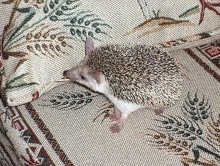
The problem was the hedgehog. We were going by train and were concerned that the x-ray machines at the station would either fry her or, at least, detect her. There's a certain greyness surrounding the laws on hedgehog transportation, so we didn't want to just say 'look, she's a hedgehog, and not even a sharp one'. And transporting animals in general tends to be a complicated business involving conditions and paperwork and other bureaucratic headaches. You have to put bags and coats through the machine, but there are no metal detectors for the person. All of which suggests that they don’t really care, and know there is no threat, but there is a kind of gleeful inertia about making people’ lives more difficult, and these pointless nuisances never seem to go away.  In all, it seemed best just to slip her into Mrs. Hickory’s trouser pocket and look relaxed and nonchalant.

I don’t know if you’ve tried looking relaxed and nonchalant with a hedgehog in the pocket of your trousers, but it isn’t easy. Especially when you know that getting caught will mean, at the very least, having to find some other way to make the journey, and possibly having to give explanations to people in uniform who might decide that they needed to confiscate the spiny stowaway.

It was with considerable relief that we discovered there is no security control for that kind of train, and so our possibly ill-conceived plan to distract the security men with the sheer strength of our nonchalance was never put into practice. The fraughtness of the morning thus ending, we were able to proceed to the country, where we are now enjoying all the things we usually do here.

The lakes are full, after all the rain in the mountains this spring, the waterfalls are gushing playfully, and wildlife seems fairly happy about it all, there are two large green lizards in the garden who have already learnt that we are a reliable source of cured meats, and now I am idly wondering whether I shall be able to avoid burning the barbecue this evening. Sometimes I do, sometimes I don’t. It doesn’t seem to matter much. The hedgehog is safely transported, we’re not going to worry about the sausages.

Friday, June 27, 2014

On The Road Again...

Yesterday we arrived at San Vicente de La Barquera, a pretty fishing village on the coast of Cantabria, on the Bay of Biscay, and one of favourite places anywhere. The old castle is high on a rock between the two arms of the river,closing and dominating the oldest, walled part of the town. Below is the old port, now with as many small pleasure boats as fishing craft. They come in a great variety of colours, but bright blues, greens and reds are popular, and they are moored not just in the port, but along the seawall, off the bridge and into the estuary. This, and the habit of painting houses in similar colours, those that are'n t made of stone and wood, give a slightly chsotic brilliance to the scene. Behind the port the main street has stone collonades all along it and the buildings are mostly attractive and powerful, looking as though they have always been there and always will be. Apart from the beauty of the village itself, iit has a long wide beach bounded by high green cliffs, good for swimming and surfing, across the estuary, a short walk over the bridge, and many paths along the river and through other villages or into the hills. By walking beyond the beach up and over the headland you can, in a couple of hours of pathswith beautiful views and details of evrything that makes the area woryh seeing, reach Comillas, where Gaudí has a number of curious structures and Alfonso XII had his holiday palace. Not too far away are Santillana del Mar, a village that is as it was in the late middle ages, bright and lively in the sun, and still lived-in, the Caves of Altamira, some if the oldest and best preserved of all cave paintings, and the caves of El Soplao, also fascinating to anyone with imagination and an interest in what we once were. We swam at the beach to refresh the limbs from the journey, then had dinner in the Boga Boga, which is the best place to eat if the reader ever finds himself there. The percebes were caught that morning, the nécora, a kind of crab, was grilled to perfection and the turbot, which had also been happily swimming that same morning before it was suddenly interrupted by a fisherman, was also perfectly done. It seemed a shame to leave this morning, but we had come to walk, to continue where we stopped two years ago, and so we hoiked on our rucksacks and set off. The route I had planned took us over the cliffs, through a handful of small villages, past fields of orange and purple cows, horses, donkeys, sheep and very small goats (you don't tend to think of goats as pretty, but these are, especially the kids). When I say fields, I mean any patch of hillside without too many trees that can be fenced off and where a sufficiently expert driver can handle a tractor without sliding backwards into the sea. This is not the broad, flat, dry landscape of Castille. The village we are in now, in a small and comfortable rural hotel specially built to look as though it has been here forever, is called Pechón and is high on a headland between two of the estuaries which break upthe cliffs every few miles all along this coast. You reach it by walking a couple of miles up a steep road that climbs beside one estuary, and going halfway across the headland. You could also get there by doing something exactly symmetrical from the other side. It is one of the things I like about, pleasing to the mathematical mind. From the balcony we can see the village below and the see, and the showers sweeping in one agter the other from the north. Green places are green for a reason. Where the road crosses the ría, before the climb begins, you can look to the left and see, within a hundred yards, the old road bridge, still used for some reason, the bridge where the narrow-gauge railway crosses, and the little station beside it, and high above it, the new bridge where the motorway crosses and buries itself in a tunnel through the hills. And the coloured boats on the water, of course. A living vignette of human movement and ingenuity through the centuries. It should have been a photo, not just a memory, but it started raining at that moment and I got distracted. Mrs Hickory is always determined to swim, especially on a new beach, whatever the weather and the attendant circumstances. I approve of thishabit in general. This afternoon that meant walking down- down being the significamt word- through a light drizzle to a rocky brach with a dangerous undertow to stroll bravely into the chilly water, do a few strokes back and forth to make it worthwhile, and then trying to get dry in the rain before climbing back up again to the village. This is fun, really it is. The beach is characterful and atmospheric, small and shut in by tough looking rocks, giving you the sense of being alone against the Atlantic and the whole of nature. That's why it's fun. Blogging by phone, apologies for typos etc

Wednesday, January 1, 2014

New Year Hedgehog

Galatea and Hickory wish readers a very Happy New Year, for your own value of happiness.

The Holy Family, for some reason, are not amused by baby hedgehogs, but they'll get used to her in time for next Christmas.

Tuesday, August 27, 2013

Under Western Eyes

My summer reading continues. I have just crossed Joseph conrad's 'Under Western Eyes' off my list.

A curious work- very unusual in its narrative structure, but it is handled with mastery- which tells the story of a student in Czarist Russia who is caught up against his will in a violent conspiracy, tries and fails to extricate himself, becomes an exile, and is forced to assume, and finally reject, his role in the movement. It is told through the memoirs of Razumov, the young man, but indirectly, through a series of multi-layered narrators, and it is always, ultimately, Western eyes that try to see and understand circumstances, motivations and actions which, we are repeatedly told, only a Russian can understand.

It inevitably reminds you of Dostoievski, as the story of a man caught up in events beyond his control, partially digested by a system which had no interest in him, but had picked him up like a grain of sand in a clam and had to find the right way of spitting him out. Or perhaps he was more like a fly which you have accidentally let into your bedroom. It makes no difference to you if it flies out of the window before you can swat it, as long as it ceases to annoy you. Or again, like a leaf caught in the gears of a printing press, some way must be found of working  it through, by pulling, scraping, pushing, charring, releasing, different levers and parts, until it can no longer damage the working of the machine or the quality of the product. Or … insert metaphor of choice here…

But, though he has some luck, and makes mistakes at the beginning, he does try to take control of his new situation from the very start. And he is quite successful, shrewdly manipulating everyone to his advantage, which at first is merely to avoid association with the event, then to stay alive, but later to exploit those who have come to believe in him. It would perhaps be wrong to describe him as cynical. He is a man of limited and weakly-held morality, interested mainly in his studies and some personal idea of his own well-being. He is forced to become something he has no wish to be and he finds that to do that he must in fact become something else again, until in the end he effectively chooses to give in to the fate that he has come to believe he cannot escape.


Having said roughly the same thing in three different ways, I think it’s time to stop. I enjoyed it. You probably will, too.

Tuesday, July 16, 2013

A few predictions for the next decades

When the mind is not busy with professional obligations, it starts thinking about other things. Mine has not settled down yet to anything specific but it's floating around looking for things to attach itself too. These are some idle thoughts it has had about the future:

The whole concept of 'carcinogen' will be completely reconceived. The current understanding of how specific substances cause uncontrolled cell growth will turn out to be so completely misunderstood that we might as well have ignored everything said about the subject (cause, not treatment, which is understood rather better).

Abortion will go the way of slavery, which it resembles in many ways, in terms of the arguments used to defend it. This will not be because of anything new discovered about the neurophysiology of the foetus, but as a result of changes in orthodox  thinking. In other words, it will be 'liberals' who reject it.

The red Indians will turn out not to be the first humans in the Americas and there will be a social revolution  of some kind in the USA as people realize they owe them nothing that they don't owe to others. In S America it is harder to say, given the politics of the region.

There will be a revolution of some kind in professional sport. People will lose interest in the sports which are constantly being exposed as corrupt. This will affect the Olympics as well as politicians distance themselves from those sports that have become unpopular and stop funding them.

Speaking of politics, stability and prosperity will appear in unexpected areas of the world, and in some of the most stable countries the governments will take one too many liberties with the freedom and patience of their electorates. Specifically, the EU will collapse and some governments will not survive it.

And more immediately, England will win the Ashes.

Saturday, May 4, 2013

An Englishman's Trousers


This morning I went to a gentlemen’s clothes shop I patronise- because they have no truck with fashion, they just have good clothes that are always the same, I choose a colour and that’s that- to have the hem of a pair of trousers taken up. Mrs Hickory had given them to me some time ago and they had been forgotten in the wardrobe before I had had a chance to do it. I decided it was time to make them wearable. So I tucked them under my arm and strode forth.

It was a fine day, the sun was shining, children were playing, fresh-faced, full of energy, cats were lying in the shade and lizards in the sun. None of which is especially relevant, but it gives you an idea of how it felt to be preparing for a meeting with the tailor. 

"Morning", I said. "Morning, Mr Hickory", they said. This is a small place and I buy a lot of trousers.
"Trousers", I said. "I have these trousers... I have some trousers... I thought I'd look for some trousers..."
The sentence was less lucid than it might have been because somewhere in the middle of it I realized that the trousers in question were not in the bag in my hand, and neither was the bag. I later discovered they were both still at home on the chair by the door where I had put them so as not to forget them. For the moment, all I knew was that they were not in my hand.
I couldn't admit this, of course. To say, 'Sorry, I've made a mistake. I'll be back later', was, for some reason, beyond me at that moment. So with the word 'trousers' on my mind, and on my lips, repeatedly, I asked to see some. For half an hour I discussed trousers, tried on trousers, approved trousers, criticized trousers both constructively and otherwise, chatted idly of the past and present of trousers and the trends for a gentleman' summer wardrobe, before I finally had the presence of mind to say that I had better consult my wife, and left.
Now I am wondering whether, when I go back tomorrow, whether I shall have to buy the trousers we discussed today, or if I can successfully make a good excuse. I think I can swing it, but it will depend on how the conversation turns. In any case, a good pair of trousers never goes to waste.
Some good has come of it, however. It proves that, despite living the life of a Spaniard, looking and sounding like a Spaniard, in many ways thinking, feeling and remembering like a Spaniard, deep within me there still beats the heart of an Englishman,
for surely, only an Englishman could be that absurd.

Tuesday, April 30, 2013

(Very Nearly) Red in Tooth and Claw


There was beauty visible on the hill, and ugliness and strangeness and majesty, and life and colour and darkness, and terror. The valley was beautiful, the trees and the flowers were beautiful, the towering slopes in the distance were beautiful, the city that lay on their foothills was majestic, the factory below it was ugly, the sky was both light and dark, the birds and the insects made aesthetically neutral noises, and the barking of the dogs was terrifying.

Anywhere in the world, any place and any time, is like that, a mix, a mess of stimuli, of responses, of emotions, of sensations, of colours and shapes impossible to resolve beyond a certain level of detail, leaving a confused sense of peace or discomfort or depression, of uplift depending on the dominant tones. If there is a discernible beauty you may count yourself lucky, otherwise you try going somewhere else.

The barking of the dogs was terrifying because it was getting closer and there was still no sign of them. In a few seconds they would appear from over a ridge or behind a tree or a rock and only then would we know what their intentions were and which direction to run in and how long we had to do it. They appeared. There were two of them.

They were long and rangy, light-haired and damp-toothed. Their eyes were not evil, just business-like. They had a job to do, keeping the country free of creatures that smelt as though they didn’t belong. But their business involved fear, and possibly blood.

We kept walking. It would probably have been worse to run. We kept calm and a casual rhythm. They smell fear, it is said, so we tried to control our pheromones, tuning them to essence of confident mastery. The kind of thing you learn in primary school.

We wondered idly- we had nothing else to do, after all- whether they would remain a couple of feet behind us barking until we were far enough from their territory for them to relax a little, or would speed our departure in the primitive fashion of their kind. It was a question of some importance for a few seconds. When you’re 6’2”, you wish the dog behind you wasn’t exactly 3’1”.

I wish we’d been bitten. It would have made a better story. It would have had an ending. But the truth is that after 50 yards or so the dogs fell back, and their barking faded to the distant warning it had been when we first heard them. It was at that moment that a group of roe deer crossed the path twenty feet ahead of us, moving smoothly and silently as though projected on the forest background. The beauty had returned.

Monday, February 18, 2013

Down and Out in Paris and London

I had never really read this book, only sections of it quoted at length in other works. These are the notes I made during and after reading, slightly edited (the purpose of this series of posts is to give someone who only know 1984 and Animal Farm a reason to read his other works, which are, despite their deficiencies, much more human in the sense that you learn much about Orwell the man, more than he realized, I imagine, and also a sense of what they might find):


It is much better than The Road to Wigan Pier, much livelier, more characterful, more a collection of good stories than a tedious political tract as that is. I shall read it to the end, it is certainly worth it, but it suffers from the same problems as his other autobiographical works- a lack of self-awareness and of genuine insight.

He is not working class and he never could be. He works hard at the restaurants in Paris, very hard indeed when he can get a job, and he suffers hardship when he can't. But it's all a game to Orwell. It's a bit of fun to placate his existential boredom and his bourgeois guilt. At the very most it's a kind of research. When he decides he can take no more he writes to England and asks someone to find him a comfortable job as a private secretary to someone or other. And that's it. He's bored with the game and goes back to his real life. Just like in Spain when after a few months he's had enough of the war and just goes back to England and gets on with his life.

He deals almost entirely with people like himself, broken-down foreign bourgoisie. He never chooses the company of the French working class, who he is so despetately trying to pretend he is like and understands better than anyone else. He either sneers at them- the landlords trying to make ends meet, the cooks and waiters at the restaurant making a living, taking pride in doing their job well, are enemies in the parochial little world he doesn't realize he's retreated into- or he charicatures them through the people and behaviours he describes seeing in the bars.

I was reminded by a scene he describes in a bar on a Saturday, where a brief moment of timeless joy and power gives way to the inevitable maudlin drunkenness and hangover. He says it was probably worth it. It reminded me of a black character in Faulkner's 'The Rievers', who says, 'If you could only be a nigger one Saturday night, you wouldn't want to be a white man again as long as you live.'

He is particularly blind when wondering what the life of a plongeur is for. He compares it disfavourably with the work of a miner, whose product is needed by other people. He doesn't seem to realize that if restaurants weren't wanted they wouldn't exist (unlike coal which was mined for political reasons at public expense for decades after it had ceased to be wanted in any quantity. I wonder if Orwell would have agreed with that business, or if he would acknowledged it was happening). 

People like to eat well without having to cook or clean, when they can afford to do so. Working men need to earn a living. Competent businessmen, restaurateurs- and anyone who wants to take a chance can be one, after all- satisfy both of those needs at once, while benefitting themselves at the same time. It is silly to ask for what purpose a plongeur works 15 hours a day. The purpose is the same for which any man works, to fill his belly. It is even sillier to claim, as he does, that there is some kind of conspiracy of the wealthy to keep the poor toiling senselessly, for fear they might otherwise want to share in their wealth.

It's a good read, illuminating on many aspects of poverty that most of us have probably never known or even thought about.

Wednesday, January 30, 2013

How Spain Looks to me


Blogger Sackerson has suggested I might have some thoughts on the protests in Spain and on the circumstances that inspired them. I do have such thoughts, naturally, and the desire to express them. As a blogger and not very successful writer, I have an opinion to hand on anything you may care to name. Whether it is worth reading is another matter, of course.

I don’t follow the details of the political and economic situation very closely. The Spanish press is little better than the British, and most of what journalists and politicians have to say is partisan, ignorant and rather infantile. The reality behind it all is important, but it is very hard to uncover, and I don’t have the time, and I increasingly lack the inclination, to do it.

Nevertheless, I do have an insider’s view of it all, and it’s possible that my opinions are interesting if only because they are informed by a slightly different perspective. So here we are. It should be noted that since I cannot pretend to offer an informed, non-partisan view, it may become clear with whom I do or do not sympathize.

It might also be useful to know that I do not live the life of an ex-pat as it is usually understood. I live, in every important respect, the life of a Spaniard.

The 15-M ‘movement’, which started at the time of the local elections in 2011 (held on the 22nd of May) mainly consisted of the usual young, hairy types who like to think that they can change the world by shouting slogans. They began peacefully, and in most places they continued peacefully, and the arguments they made were, on the whole, valid criticisms of the cumbersome and opaque electoral system, which multiplies parliaments and civil servants at many different levels, which gives members of those parliaments no incentive to represent the people who vote for them, as they owe their position entirely to the often unknown party controllers, to whom they must be loyal. Parties are state-funded and you cannot choose, and sometimes do not know, who you are casting your vote for. That is decided by the party.

Some of their complaints were about the banks, and showed a certain ignorance of economics typical in the young and those who have not yet worked for anything of their own, but I found them to be approachable, peaceful, not stupid, and I wondered if the government would actually start to take them seriously at some point.

Noises were made, but nothing much happened. As usual. What tends to happen is that these protests, even when based on good ideas and conspicuously peaceful, are taken over by the usual suspects, or fade away to nothing. Both of these things happened. The Occupy movement was quiet different from the 15-M, and the original purpose and form was lost, and just fizzled out.

Once the government started to recognise the gravity of the situation and actually do something rather than make political noises, it started by doing the wrong things, then attempting the impossible. They decreed, back in 2009, a programme of digging holes and filling them in again, in an attempt to pretend unemployment was lower than it was. Some useful work was done, but much of was a waste of money. They raised VAT, in an attempt to bring in some very short term income, while depressing commerce and investment in the medium term. Only a politician would think that a good idea. They also got rid of as many contracted personnel as possible, in order to reduce their wage bill. Something they were, at the same time, trying to stop other organizations from doing.

Civil servants in Spain have jobs and pensions for life. They cannot be laid off if they become unnecessary, and they are extremely difficult to sack even for laziness and incompetence. Whenever I have to deal with the civil service the difference I see between them and similar workers in the productive economy is enormous. (I could go on about this for hours. Forces self back to point.) So there are two ways the government can reduce its wage bill. One is to terminate the contracted staff, that is those who are not full ‘funcionarios’, or who work for companies hired for specific projects. These are mainly building works working on roads and public buildings. The local and national governments here threw many thousands of them onto the dole when the money really, really ran out.

The second way is to reduce the salaries of the permanent workers. Incidentally, the idea of giving public employees unbreakable contracts for life comes from the 19thC and was intended to stop incoming governments from sacking most of the civil service and filling it with their friends. But a solution to a specific problem of corruption when the civil service consisted of only a few thousand people at most, has been allowed to continue until the present day, when there are over 4 million people whose wages are guaranteed with our money. There has never been the political will, or courage, to touch this system and there probably never will be. It is possible though that it will slowly be allowed to wither, at least by governments of the right, and most public employees will indeed be on contracts which can be ended when they have done what they were hired for. I am not too sanguine, however.

The early protests were led by the Civil Service unions, for this reason. They got little sympathy from the public because with 4 million unemployed (it’s nearer 5m now) and a similar number unable to reach the end of the month and with the possibility of losing everything at any moment, the public felt that people with a salary for life had little to complain about, even if that salary was a bit less than it used to be.

The unions see it as a good excuse to increase their standing with their members and attack the new, centre-right government. The new opposition suddenly claims to have all the answers it couldn’t find when it was in charge. Everybody complains, but everybody expects someone else to get them out of trouble. That is human nature, but it makes the problems worse, and more difficult to solve.

The trade unions regularly appear on the streets, waving flags and shouting slogans that express their grievances and suggest some solutions. They achieve nothing, of course, but it adds to the circus of life. They have not normally been violent except during the national strikes they called in May and November last year. These were poorly supported but in the larger cities the far left makes sure they are noticed and make the evening news, by giving their members permission to break things and attack people. This is for their own political ends, and is not going to solve any of the social problems that exist.

Beggars are also appearing on the streets. Not the usual drug addicts and gypsies, but ‘normal’ people were clearly once working families and who’ve tried every other way they can think of of making ends meet. This shows that, despite what I say in the next paragraph, there are problems much more serious than ‘the government isn’t giving me as much as I would like’, which you hear from most people.

People don’t realize or have forgotten what it is that makes an economy work. So many people now believe that government spending is the economy, and that banks are evil, that it will be hard to re-create a country where hard work, investment, successful businesses employing people, are recognised as good things, to be encouraged and aspired to. The Chinese immigrants are now doing what the Indian and Pakistani immigrants did in Britain forty years ago. They are taking over small shops in large numbers, working long hours seven days a week, offering people things they want, when they want them, at good prices, bothering no one and making sure their children study hard so they can be doctors and lawyers and won’t have to spend 12 hours a day in a little shop. The number of people who routinely moan about this as though it were a bad thing shows that the recovery will take a long time. It doesn’t occur to them that they could do it themselves. It’s too hard for them, so they want someone else to do it. They then seem to assume that they themselves should somehow earn more for not doing it than the people who do actually do it.

Similarly, there are many immigrants from South America and Eastern Europe (The non-gypsies and non-gangsters) who are working very hard at what the local people don’t want to do. Most domestic cleaners, carers for children and the elderly, and many agricultural workers and bar staff, for example, are now immigrants, and have been for some years. Some unemployed people would jump at the chance to look after the elderly or work long hours in a bar, but most wouldn’t, and anyone with any kind of qualification fails even to understand the question.

It’s going to be long, slow and messy.

Monday, November 12, 2012

In Which My Phone Forces me into Philosophy


Not the Answer, but a Nice Try

I found a note in my Google calendar this morning. It popped up as a reminder on the phone with today’s date and the words ‘Find Meaning of Life’. Between ‘Buy new socks’, and ‘Phone insurance about drain’, I had remotely prompted myself to resolve the mystery of our presence in the universe.

I was rather surprised by this. I have no memory of placing this reminder in the calendar, nor any idea why I should have chosen, presumably some time ago, this particular Monday morning to begin the search for purpose.

I am not nagged by the sense that my life is without meaning. In the end, it probably is, but I’m perfectly happy with it. So far the only sign of mid-life crisis I have observed in myself is the increasingly urgent desire for a microlight aircraft, which is likely to remain unfulfilled, because apart from the price of them, Mrs Hickory would have to take a bottle of Valium every time I went up in it.

My life is not empty, I barely have time to analyse the things I’m not doing because of everything I am doing, and I have no idea what the message refers to. Perhaps it was a book, or the Monty Python film, that I wanted to hunt up, or a reference to something I half-remembered reading or writing long ago. Or maybe Cupertino intervened. I shall probably never know.

But I have, as a result, spent the day distracted by the responsibility I had accidentally given myself. Until I finish the task, I can’t tap the screen to illuminate the green tick which decrees it done, and it will keep appearing, day after day. Tomorrow I shall try again. The answer must lie somewhere. If there is one, that is. I hope so. I have a green box to tick.

Thursday, August 2, 2012

On the Bathing of Mules


There is a place on the lakes, at the end of the lake known as the Tomilla (because of the thyme that grows on the hills there, I imagine- I haven’t noticed more there than in other places but someone must have done), there is a sort of swimming pool known as the Baño de las Mulas (the bath of the mules). It’s about 30 feet on a side, though one side is just the rest of the lake. The others are a natural shallow bank, easy to get into the water from, a low concrete wall, and a dam. The dam was built to control the flow of water into a channel that once powered a small hydroelectric plant. There were once a number of them along the string of lakes, but they are all long abandoned, as the local demand for electricity became much too great for their capacity. They are interesting relics of an age that thought we had come as far as we could go.

This dam happens, then, to create a kind of pool, about three feet deep everywhere, which was presumably, at one time, used for washing mules made dirty by toiling on the dry earth in the hot sun. It’s a nostalgically bucolic image, though whether anyone actually took mules there to swim I couldn’t say.

Nowadays people swim there. There are a couple of good bars on the water’s edge, it’s almost impossible for children to drown, and there’s an area for parking your hippy van, setting up your picnic table and sunshade, turning the radio up loud, and trying to find a free spot of water to splash about in. On summer days, especially at weekends, you can’t move there. I go past it often on my wanderings, and contemplate, slightly bemused, the human ability to have fun because that’s we came for, whatever the circumstances.

Out of season, but when it’s still warm, it’s a good place to cool off and to watch the pike that swim lazily out of the rushes upstream to do a lap or two of the pool. For the moment, I shall only see it in passing.

Wednesday, July 25, 2012

More Notes from the Road: Santillana del Mar


One of the great pleasures of the road is to arrive at a village on foot. You see it first at a greater or lesser distance depending on the terrain, and then you have reference to act as a form of target. You move towards it, as directly as the path will allow you, you begin to make out the spire of the church, the larger houses, the way it is set into the hills around it, the colours of the walls and roofs, the feel of the place, you begin to sense the activity that goes on there, and then to smell it, too, be it cows, fish, industry, machinery, powdered earth or humanity. Then you are in it, you have a look at anything that seems worth it, you stop for a drink or a bite, you take a few pictures, exchange a few words, and you set out again, leaving it behind as the road takes you onward. The road (the path, the track, it’s all one) dictates your movements. You go where it goes. On the road you move through places that those who live there think of as fixed. To them they are the centre of the world, at least for a time, but to the caminante it is the village that moves around him, through him, past him. It was before you, now it’s behind you, another spot on the horizon, another reason for wandering. One of the best places you can arrive at on foot is Santillana del Mar.* If you approach from the coast along the clifftops, which is the best way to do it, you climb into the hills, pass through Arroyo, an olde worlde collection of houses in a little dip with a stream running by (this time the name is quite true) you walk past the Japanese girls with blisters sprawled on the side of the road (I mention this because they’re probably still there; neither of them looked as though they would ever move again), and suddenly you look down on Santillana. Santillana is almost entirely mediaeval; the central part, which is most of it, consists of 15-16thC wood and stone houses, and cobbled streets, beautifully kept and with few modern intrusions. Cars don’t enter, many of the houses are used as shops and cafés, and the whole effect is of going back to a place from another time, not a museum, a real place that lives and breathes, but without the smell and the hunger. That’s what you see as you approach Santillana from above, an expanse of brown and black buildings, many like small palaces, the Colegiata, a kind of monastery, another church and cloister, and streets of more modest houses, all looking bright and charming, and on the edge, smallholdings in which cows of the same brown colour chew grass philosophically, all of this set in the beautiful hills of the Cantabrian coast. It’s worth pausing a moment to enjoy all of this before you enter the town. And that’s why I travel on foot. *It’s known as the town of the three lies because it is neither holy nor flat nor by the sea (which is what the name would suggest). It would be possible to argue that none of them is strictly false but in any case the place is named for St Juliana of the Sea, who did something Godly several centuries ago and is therefore now buried in a rather nice mediaeval church in the town, the Colegiata.

Saturday, June 23, 2012

The Future of Network Design is not (Quite) Dog's Vomit


When you come across an article about slime mould designing rail networks your attention is grabbed. Especially if you are, very tangentially, involved with designing railway networks. I work with a team that creates computational algorithms for routing rail and road systems. I’m just the translator, but the insight it gives me into the process is very interesting. The idea is striking and absurd, and whatever slime mould is (it’s this, apparently) it has the sort of name that fits well in absurd situations.

You might think that all the slime mould has done is, once it’s worked out the quickest way to get between the places where the food is, and how far apart they are and how much food is in each place, it’s quite easy just to go back over the short paths and everything just becomes a network of straight lines. But in fact it doesn’t. You can clearly see that the lines are more or less straight and regular, but it isn’t a question of joining every node to every other. That would be highly inefficient. The network created uses some existing nodes as waypoints to get to others, and creates new nodes when it is efficient to do so. This is what network designers do also.

If a collection of unicellular organisms with no nervous system, let alone sense organs or a brain, can do this, then, you might say, it can’t be too difficult, can it? Isambard Kingdom Brunel did it for most of the country with just a pencil and paper, and he seems to have done a pretty good job, but then he had a fully functioning brain and a team of similar organisms to work with, which always puts you ahead of the game.

The team I work with, and other teams that they work with, are busy creating new algorithms to make network design better. The problems are of unimaginable complexity, enormously greater than is generally realized. Huge quantities of data to do with terrain characteristics, land value, current demand, future demand (itself a function of the final design), and economic impact, have to be obtained to an acceptable degree of accuracy, and then analysed to find the most efficient solution. The really hard work, the clever bit where the computer engineers earn their money, is in designing algorithms that will enable you to find a good solution before the sun becomes a supernova and renders the whole exercise academic. The computational cost of these algorithms is truly astronomical, and getting it right, as opposed to nearly right, can cut millions off the cost of a project, and add many more millions to the economy of the area whose transportation it facilitates. This last factor is probably impossible to quantify, but it is undoubtedly true. Brunel had to play it by ear, and with hindsight, it could certainly have been done better.

I don’t see our road and rail networks being designed by slime mould in the future, but many heuristic algorithms are modelled on analogies with, or even direct observation of, natural processes. Experiments could easily incorporate topographical and geological features, as I imagine slime mould avoid steep hills and unsatisfactory environments the way most of us do, and a lot could be learned from observing them. Even if it only leads to the refinement of existing algorithms they will have done us a great service.

Next week: I am beaten at chess by a team of flagellate protozoa. Artificial intelligence may not be what we think it will be.

Wednesday, June 20, 2012

On Molybdomancy


Molybdomancy is something mediaeval Norwegians did when they weren’t looking for islets to bean each other with axes on (see Holmganga). It consists, as the name will suggest to classically educated readers, of divining the future through lead*. Molten lead, in this case, poured into water, and the shadow of the resulting solid shape observed by candlelight. These can then be interpreted according to the standard symbolisms, the inspiration of the diviner and, no doubt, the influence of strong liquor.

I don’t know what they call it in Scandinavia, as the Wiki article doesn’t say, and Mrs Hickory hasn’t achieved that level of competence in Old Norse yet, but I assume they have their own, Germanic, word for it.

There is almost no limit to the means by which man, in his desperation, has sort to peer into the future. From the flight of birds to the entrails of sacrificial victims, from the cryptic responses of aging women in temples to random selections of words from leather bound books, from teabags to playing cards to apple peelings, from the patterns of moss on tree trunks to the tracks of ants across the fields and of clouds across the sky, there are probably no patterns that have not been used at one time. The need to believe that we can control aspects of the world that are manifestly beyond our control is part of our humanity. The failure of all these methods to predict anything successfully doesn’t stop whole cultures believing in them.

I assume that when modern Norsemen sit around the fire at Christmas and cast lead in water they are having a bit of fun, but you wonder how many bad decisions their ancestors took because of the way the light fell on a lump of lead. On the other hand it’s probably as good a way of taking them as any other.


*The word μόλυβδος has an interesting history, made even more interesting by its obscurity. I leave this little taster for those who enjoy these things.

 Greek mólybdos as a Loanword from Lydian
H. Craig Melchert
University of North Carolina at Chapel Hill
Beekes (1999: 7-8) has established that the oldest form of the Greek word for ‘lead’ is Mycenaean mo-ri-wo-do (for attestations of the word see Aura Jorro 1985: 1:457-458). Beekes reads the Mycenaean as /moliwdos/, but one must also consider /molivdos/, as suggested by Chantraine (1968: 710 and 1972: 205-206).1 As per Beekes (1999: 10), all later variants of the word in Greek can be derived from the shape attested in Mycenaean.
The earliest Greek form /moliw/vdos/ precludes any connections of the word with Latin plumbum or Basque berun ‘lead’ (thus with Beekes 1999: 10-11). Beekes, who argues for Asia Minor as the source of the Greek word, cites in passing Lydian mariwda- after Furnée, but merely as an example of the sequence -wd- in a language of Asia Minor. He can do nothing further with the Lydian word attested as a divine name.

Tuesday, May 29, 2012

Jurando Bandera


There was a ceremony in the square last Sunday, a kind of 'Jura de Bandera' for civilians. I had never heard of such a thing before. They seemed to be mostly young people, and they made a weekend of it, as they were out in evening dress on Friday.

It turns out not to be such a new idea, though I don't know how old it is. The ceremony I am familiar with was carried out at the end of miltary service, and consisted of the soon-to-ex-soldiers parading around the barracks square, filing past and touching the national flag, listening to the colonel, the captain, the sergeant and some local politician droning on interminably about duty and country, and swearing to be eternally available to the nation in time of need before going off to get drunk and trying to forget the whole ghastly business.

In any case I assume it's for the young. But it looked just like the military ceremony it imitates, and there were soldiers there, a military band, and groups marching in formation with rifles and machine guns. One of them had a saw, rather than a gun, in a holster on his back. Why, I wonder? In fact I have just seen there was a whole group with tools- axes and picks- as well as the saw. From an engineering regiment, perhaps.

Military service was finally abolished in Spain about 12 years ago, so the patriotic youth no longer get the chance to swear allegiance to the flag while dressing up and having their photo taken for the local newspaper. The girls never did, of course, nor did those who were not suited or who found a way to slide out of it. I haven't found much on the origins of the civilian version, but I understand it is quite old. WHat surprises me it that there should be any demand at all for such a thing. But there is, and the human tapestry just got richer.

Monday, May 28, 2012

Mediaeval Market


I probably write about this every year, but it’s fun and provides good photos. There is an organization of market stallholders who dress up in gingham and funny hats and sandals and go around the country passing themselves off as mediaeval artisans. The result is a lot of fun for everyone, and presumably they make a living of some kind.

They were here at the weekend, just as the summer arrived (it’s been 95º for the last week, and I don’t think it’ll cool down again until October. These things look better in the sun. In fact, everything looks better in the sun.)*

Most of the traders make and sell things which you really could imagine seeing on a market stall in the 14thC. There was a smith, with arms like iron bands, who had a charcoal-fired forge and an anvil, and made horseshoes and other things which you might need at a moment’s notice. He really made them, and you could really use them. (Unlike the ‘Fair Trade’ tent set up in the square a couple of weeks ago where nearly all the stalls were filled with over-priced junk, since the product on sale was self-satisfaction rather than anything material, the craftsmen at the Mediaeval Market are genuine tradesmen, offering well-made articles at a sensible price to people who actually want them. It’s one of the reasons the right-winger in me enjoys it; it’s free trade as it used to be.)

It’s not often you see a tent full of birds of prey in shop window in the high street. Is there some law that forbids a man to keep hawks unless he wears a leathern dress and is surrounded by bunting of chivalric design? Well, I don’t know, but I do like to see an eagle owl lazily turning its head to frighten the life out of some child who hasn’t understood what he’s messing with. (If you’ve never seen one, they’re over three-four feet tall and they take an indiscriminating approach to anything smaller than themselves. They just call it all lunch. We see them on the farm occasionally).

A popular exhibit is the mediaeval instruments of torture. Pain is big, especially other people’s pain. I suspect many of them are invented, but they look good, unless you are a potential customer, of course.

There are stands selling imaginative wooden games and puzzles made of rope. And an area with activities and games made to look Victorian, if not exactly mediaeval.

Smelly food in tents is another thing that apparently characterized the middle ages. In any case we like smelly food here. Our sausages are supposed to be detectable from hundreds of yards away when you burn them a bit, and our cheese only needs to be taken out of the fridge to get the attention of passers-by. So a lot of people like to eat smelly burnt stuff in tents at this time of year, because it’s fun, and easy, and cheap.

There was a lot of food. Cheeses and cured meats and sausages made the way they have been made for centuries, and very good they are. We have the fridge stocked with stuff. Homemade cakes and breads, sweet and savoury pastries, and chewy sweets of many colours. A sort of Arab tea tent with a hookah and long tubes for filtering coffee, which was atmospheric and fun. There were stalls selling leatherwork, woodwork, glasswork, needlework and novelty soap (there is always novelty soap, everywhere). There was a fair amount of snake-oil on sale. I imagine the situation allowed them to make claims for their leaves and things which they could not otherwise do.

It’s a travelling circus of a particular kind. One day it will be no more, just because whoever is getting the thing going will run out of energy and no one else will feel inclined to carry on. Or someone will have a better idea, or the public will stop finding it fun, or some ambitious politician will get his place on the list by making a fuss about the quality control of the cured meats and the hygiene of leather overalls. While it lasts it is worth remembering how much fun it is, and what it consists of.

*I should have kept my mouth shut. My morning run was rudely interrupted by hail.