Showing posts with label The Good Times. Show all posts

Saturday, December 7, 2013

A Rey Muerto, Rey Puesto

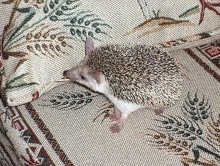
Hickory, the hedgehog who is the symbol of this blog and at times its inspiration, even a 'contributor' on occasions, has died. A week ago he suddenly started walking with difficulty, almost dragging his back legs. The next day he had trouble moving at all, and was clearly not a happy creature.  

We took him to the vet, who immediately realized, from the colour of his skin, that he was anaemic, probably because of liver trouble, and the smell of his urine indicated he had serious kidney trouble too.  There seemed to be no point doing analyses, waiting for the results, trying something that would almost certainly achieve nothing more than prolong his suffering. The poor lad was very ill and old and unhappy and was not going to recover. He could only continue to be scared and in pain. You wonder if it might have been worth a try, but it was surely not. So I gave the order to have him put down. They use the gas before the needle, and he will have felt nothing.

If we had been at the farm, or been able to go there, I would have buried him in one of the places where there are alot of those beetles he liked so much, a kind of dung beetle, but here there is nowhere to do it, so he will be 'recycled' organically.

'Hickory' was his bloggging pseudonym, by the way; he was known to us as Crispulito, and that's how he will remain in out memories.

I don't know if there is a Heaven for hedgehogs- on the whole I should think not- but in any case the point is moot as I'm sure the old lad isn't there. He had no time for asceticism and no concept of right and wrong, as far as I could tell.

He was nearly six years old, which is a respectable age, and he was in good form almost until the end., but still you don't expect it to be so sudden. We shall miss him for many reasons. As he prepared to eat a beetle, in the moment between seeing or smelling it, knowing it was under control, opening his mouth and finally crushing it with his jaws, his face expressed pure pleasure, glee in fact, There was a touch of evil in that look If he had had the right kind of larynx, I'm sure he would have cackled.

We shall never again hear his soft footfall, and the first crunch of the evening, as he came into the living room at about 9 o'clock, to run around our feet and begin the task of spending the night searching for food and drink. He never seemed surprised that it was always there, always varied, always the things he liked, always sufficiently spread around the house to make the hunt more fun. I think he just assumed that that was how things should be. He deserved no less. A hedgehog knows his place, and it's above you.

The title of the post means something like, 'The King is Dead, Long Live the King'. Mrs Hickory, unwilling to contemplate a life without hedgehogs, immediately contacted a breeder in Granada, and we have a baby female, who will be known for blogging purposes as Galatea. There will be photos.

Sunday, April 28, 2013

The Gentlemen are Speaking Well of the Gorgonzola


I have heard recently a number of people, who do things related to cultural psychology, literary studies and the artier bits of 'neuroscience', discuss the idea that we like reading or hearing stories because they help us to develop theory of mind. The lecturer in Spanish theatre said that this applied specifically to literary novels, and in a way defined them and set them apart from popular novels, because they expose the empathy between the characters and help us to share it. Thus we grow in an important social skill.

There are clearly other motives for telling and listening to stories.  Whether this is an important one will be determined only by a lot of work in neurobiology, serious anthropology and psycho-linguistics, and we won't have an answer quickly, but the idea has some promise. I cannot comment except to say that I await the results of research with interest.

I was explaining abstract art in 1ºA ESO this morning (12-year-olds). That class can be lively, and they were today at first. I spoke for nearly ten minutes about the distinction between representational and abstract painting, compared it with the use to which elements are more traditionally put in music, and illustrated it with just a couple of slides. Most of this was in English. In some classes I have done it all in English. There was not a sound. Wrapt, they were. It happens that way sometimes. In fact, I know how to exploit it, I've been doing this a long time. Sometimes I tell stories to 6-year-olds, in English, who respond in the same way.

It is clear that they do not understand the whole story. What I was telling them today was not even really a story, and I am by no means an expert in the history and psychology of art. They responded, however, as though a great drama was being played out before them, one so absorbing that they could only hold their collective breath and wait for the ending. And it was true. That drama was me.

More than the words of the story, the drama was my tone, the music of my voice, my body language, the atmosphere that they themselves were unconsciously involved in creating. It is a curious thing to be part of. There is much more to story-telling than stories.

Sunday, December 2, 2012

Panta Rhei


There is a bar in Córdoba which is like Heraclitus’ river. Or rather perhaps, like all rivers as described by Heraclitus. You can never, strictly speaking, visit it twice.

I live in a town not so far away, and I have been there many times. It’s not a disco or a jazz club. It isn’t filled with drunks with smelly armpits crying in their beer, or prostitutes pretending to be something else. It doesn’t smell of overused oil and there is never football on the television. It provides food but only symbolically, for show rather than nutrition. It serves coffee in the mornings, wine at midday and strong liquor in many colours at night. It always smells clean and slightly evocative. We might call it a cocktail bar. It is many things, but it is never any of the things you expect a bar to be.

You can hear the music, but you can hear yourself speak as well. You don’t have to dress up to go there, but you do anyway because if you didn’t it would be like going anywhere else. The lighting is sufficient to see the beauty of the women, but too dim to show their flaws. They serve beer, but only out of bottles, and no one would dare drink it after nine in the evening.

Despite being recognisably the same place, and retaining a very distinct feel, which is what takes me back again and again, every time you go there it has changed. The art discreetly hanging on the walls, the tone of the ceiling, the play of the lights on the walls, the nap of the light rugs, the refined shoots of Brazilian bamboo or bonsai behind the bar and in the alcoves, are different. The faces are not the ones you remember. Their clothing changes only slowly, with the seasons, with the fashions, but the people are never the same. The music is always exactly suited to your mood, but you only notice when you hear it that your mood has changed since you were last there, and so has the music.

The barman remembers you, of course, and he knows what you want before you order it. Which is odd, because I’d swear he’s not the same one as last time…

Thursday, October 25, 2012


On the fourth birthday of this blog, I raise a glass to the prickly chap who inspired it, and makes occasional contributions. I raise another glass to all those who have read it at some point, and a further glass (it’s ok, they’re only small ones), to everyone who has taken the trouble to comment.

Last year at this time I attempted to reflect on why I blog. I didn’t arrive at any firm conclusion, except that I like doing it. I can’t add much to what I said then. I sometimes wonder why I spent hours writing and re-writing a post intended to crystallise my thoughts on some more or less profound topic, when it might be read by fewer than a hundred people and not receive a single comment.

It’s my graffiti wall, I suppose. I can scrawl whatever I like here, I can choose my crayons freely and let the ideas flow, and I can choose whether or not to argue about what it means or if it was worth it.

So having little to add to last year’s musings, I raise yet another glass to some people who have played a role in shaping, in some way, my little sandbox:

I thank NickM, of Counting Cats, for teaching me not to be afraid of the recursive asterisk.*

I thank Vincent, the Wayfarer, for regularly pointing out my lapses into negativity and intellectual laziness. The lesson still isn’t entirely learnt, but I now construct posts with a greater awareness of who might be reading them. And a clearer idea of why I write them in the first place.

I thank Dr. Rao, who thinks I’m a Professor of Indology and still sends me updates on research into the Indus script which I am, to both his and my disappointment, not competent to evaluate.

I thank CNN, for linking to me about three years ago as a supposed expert on Bolivian politics and sending my readership numbers through the roof for a couple of days (all I’d done was read a selection of the Bolivian press and turn it into a report for the Anglo-Saxon public, something you would have imagined they would be doing themselves).

I thank an anonymous user of reddit for linking to my recent post on Heikegani and also sending the stats through the roof. (Note to self: find out what reddit is and how it works).

I thank Charles Crawford for accidentally getting me into the Independent in rather confused circumstances

I thank Mark Wadsworth for teaching me the little I know about money, and for patience in the face of stupid questions.

I thank Tim Worstall for taking the trouble to answer my economically innocent questions in an intellectually meaningful way.

I thank the world, for being interesting enough to think and write about

*I would also thank him for teaching me to write fun and interesting posts**, but he has been unequal to the- extremely difficult- task.

**Not that he knew he was trying to do it, of course.

Monday, March 12, 2012

Chilling Memories


Beautiful perhaps. A beauty experienced, not just observed. English beauty. Isolation. Flowers and trees blooming. The English country doing what it does . Outside time. Outside the rest of life. Green and lovely. Looking from the window- I liked a high room with a good view so I could see the woods as the sun came up in the morning. The trees shading the flowers beneath them, which gives them more colour and more contrast.

I startled a deer in the deepest part of the wood one morning. We startled each other. It vanished in a moment, crashing through the undergrowth.

They were ways of avoiding the things we were supposed to do. I took my axe and went off alone all day to chop up fallen trees into disposable lumps. I could do it. Alone among the fallen timber, and with the strength and energy to turn it into logs you could pick up with one hand. It felt good. Primitive. And it was very slow. Time didn’t matter then. 

I awoke each morning and looked out of the window. On occasions I saw women gathering herbs for the kitchen. There was a tennis court and a croquet lawn, which could have been used but it seemed wrong to use them, too civilized. It was meant to feel rough and wild.

The house was very old, very big, and designed for comfort and pleasure. All the beauty of the land was visible from the windows of the rooms, because if we can, we live in beauty, and the erstwhile owner could

Bells I was charged with ringing. They meant something that wasn't really anything. Post breakfast cigarette on the terrace. With chat and views of the park. Walking the paths through the wood, crossing a stream, hearing only insects and the chirping of birds. Thinking the thoughts that you can think at those moments. Outside life and outside time.

Wednesday, February 8, 2012

A Fuuny Old Game

I'm pretending the cricket doesn't exist at the moment, so here are a few words on the Spanish football. (You have been warned.)

A team from the Second Division B (about equivalent to the old English 4th Division, and mostly semi-pros with a day job) reached the semi-final of the Cup. They did it by winning through to the major stages where the top clubs join in (equivalent to the 3rd round of the FA Cup) and then beating three First Division teams, over two legs, coming from behind late on in two of the ties.

This team was Mirandés, from Miranda de Ebro, a pleasant little town in the north of Spain best known as a nexus on the rail network; you had to change there to get to Bilbao, Santander, San Sebastian etc, or going the other way, to head south. The captain of this team is a bald bank worker called Pablo Infantes who may well find a statue of himself erected in the main square before long.

Having beaten Villarreal and Racing, they were 2-0 up in the first leg at Espanyol when they conceded three goals in the last ten minutes. That should have been the end of it , and in the return leg, on their ground, they went a goal behind, meaning they needed to score two goals, in the last few minutes, and the team that was 5th in the League. They did. The winner was in injury time. Espanyol were distraught, but the rest of us had been sort of expecting it, which was when we realized that this team was not a norml ragbag bunch of minnows.

In the semi-finals they drew Athletic Club de Bilbao (the second great love of my life. I am too old and too well-educated to suffer with the fortunes of a football team, but these things know no logic). Do not fail to take them seriously, do not imagine that this is an easy tie, and do not imagine that they are just a low division team. They are not. They were, at that moment, a Cup team on a run, who had shown they could play with the best and beat them, and they knew it. Their belief in themselves was terrifying, and absolute.

The whole of Spain, except in Bilbao (and they say that we Bilbainos get born where we damn well feel like it) was behind Mirandés. Not just because they were the underdogs, but because they were playing football like no underdog I've ever seen. They never tired, they never gave up, they never lost their shape on the field. They were a very serious threat. On the other hand, we are, it is generally agreed, playing the best football in Spain at the moment, and we knew what we were facing.

The first leg was in Miranda last week. We scored two goals in the first half hour and had the game under control and the tie half won. Mirandés just kept on playing good football, atacking, trying everything, believing in themselves. They got one back in injurt time, which meant they still had a chance in Bilbao.

Yesterday they started badly. Out of position, not sharp enough. For the first time in months they looked like what they were. Only for about half an hour, but we took all our chances and after 20 mins we were 3-0 up. Mirandés needed to score four goals to win, and they weren't going to do it. The tie was over. Nobody told Mirandés, though. They got their game together, played the way they had planned to play, and kept coming at us. Like Bruce Willis in that film, they didn't know they were dead. They were as physically fit as any First Division team, and they had a plan, and they knew how to play football. They got a goal back, and celebrated as though their job were nearly done.

But there was no way back. In the end we beat them 6-2. They didn't deserve such a pounding, but they forced us to keep playing out hardest till the end. Those six goals are a tribute to the way they fought. We had to score six to feel safe. The last one was an own goal by Cesar Caneda, who was brought up in our youth team, and played a few games for us years ago, and who must have imagined a happier ending to his return to San Mamés. But he's a forward. In the 88th minute, losing 5-1, exhausted, he went back to help the defence. He hadn't given up. Amazing stuff. That's how you win games. And it's how you get on in life. It's how you do what you want to do, instead of whining from the sidelines about the unfairness of life. Yesterday the belief and the work and the plan and the fitness were not enough, but you can't win 'em all. Without all those things they would have got nowhere near the semi-final, and without them they would not have had the chance they had in Bilbao.

Mirandés are out of the Cup, and we play Barcelona in the final in May. So we Athleticos are happy. Mirandés, when they recover from the shock of losing, will have much to look back on and enjoy. They left the field to a standing ovation. It's something like cutting two ears in Las Ventas. San Mamés does not politely clap losers. It respects only courage, fight and very good football. We saw it yesterday, and acknowledged it freely.

This Mirandés will be remebered for many years, and may literally go down in legend and song. Someone will be working on a ballad even now. They deserve no less. Football is not war, it's entertainment. And yesterday we saw one hell of a show.

Saturday, January 28, 2012

A Memory of Peas

Peas produce a very strong memory reflex in me. Fresh peas, that is. Proust managed to write seven volumes after being set off by a Madeleine cake dipped in sugary coffee*. I don’t think I can manage such a monumental task, but peas remind me of my childhood in an unusually powerful way.

One reason for this is that there are no peas where I live. People sometimes buy tinned or frozen peas for putting with particular dishes, but fresh peas are almost unknown. The pleasure of biting into a newly shelled pea, from a pod you’ve just picked from the plant, and feeling it burst in your mouth, releasing a moist green taste with a tang of something or other I’ve never quite identified, is difficult to convey to those who’ve never experienced it.

Here, peas are grown, but of very poor quality, and they are harvested whole for animal fodder, or not harvested at all, but what is not eaten is left to dry up and die in the field, to add nutrients to the soil. It’s quite common in May and June to pass yellow fields which on inspection turn out to be a carpet of dead peas.

This is not, of course, really about peas. It’s about memories. My father grew vegetables in the garden (and on his allotment) for many years. AT certain times of year we were self-sufficient in peas, runner beans, tomatoes, carrots, Brussels sprouts, potatoes, radishes, lettuce, cabbage, beetroot, turnips and swedes. The beans were strung from a frame over which a kind of green plastic net was hung, and every spring (early spring, very cold) the process of turning over the whole garden with a fork, and ploughing in the contents of the compost heap, was carried out, mostly by my father, sometimes with the assistance of his more or less willing volunteers.

The Brussels sprouts were big plants, big enough to make a jungle for young boys to play in. The runner beans could be eaten fresh from the plant, crunching in a very satisfying manner in the mouth. And the peas were collected when the time was right and we sat around shelling them into a large bowl. The popping of pods and the taste and smell of the freshly shelled peas left a strong impression on my memory. So when I saw fresh peas in the market the other day, it was not so much the eating of peas that I was looking for, but the recovery of a memory of childhood.

It worked, up to a point. It was fun to shell them, and they were good to eat.


*I read the whole thing a few years ago, in a very good Spanish translation, the first two volumes by the poet Pedro Salinas. I even read part of the first volume in French. Whether it was worth it, I still couldn't say. Reflecting on my death bed, I don't think 'I can go in peace, I have read Proust', will be the main thought in my head. But you never know.

Sunday, January 22, 2012

'The Grapes of Wrath'

This is the review I wrote, the notes I jotted down, as soon as I had finished the book. I haven’t changed anything. It would probably have been better if I had, but this way it is authentic (and less work, which is the real reason for leaving it as it is):


I have finished The Grapes of Wrath. Although I know that Steinbeck writes wonderful books, full of dramatic truth and sometimes a kind of magic realism, finely drawn characters and always the feeling that he has written something worth telling and saying, I had never read either Grapes nor Of Mice and Men. This is mostly because I haven't come across them cheap and they are still in copyright so not on Gutenberg. But I found Grapes in a free download and have finally been able to read it.
It is anchored in reality, and apparently reflects how the situation was for the people who had travel in search of work for the first time in generations. Although he explains the reasons they have to go, and is critical both in the voice of the narrator and of the characters of the banks and the big investors who are changing the world and causing such hardship, and although he makes no attempt to understand the true motives of all those involved or to analyse the possible benefits that might derive from the changes- and which did, in the end- (quite rightly. There is no narrative need to do so) the book is not social denunciation or some such rubbish. It is a story, and it never forgets that he is crafting a story.
The hardship, the conditions forced on the workers, the harshness and hard hearts of the powerful, and the cynicism of some of those who take their opportunities at the expense of others are part of the story, not something added on to make a point. It may be a book about its time, but it is still worth reading now, and will be long into the future, because a tells a story about real people- who it first takes the trouble to create- and they are very human and very interesting.
There is more than one narrative voice, aside from the characters themselves and the ostensible narrator. There is one, probably at least two, meta-narrators who appear occasionally to comment on the greater context of the tale, in its historical and human implications.
Steinbeck doesn't wave his hands about in a 'you know what I mean' kind of way, expecting us to imagine all the things that he hasn't been able to create himself, and to gaze in wonder at a mishmash of clichés and transeunt orthodoxy, like many who call themselves writers. He creates his own world, fills it with recognisably human creations of his own, and has them do and feel interesting and coherent things. You live their lives along with them, you can feel what they feel in the sound and rhythm of their words, and it was worth doing.

Thursday, September 15, 2011

The End of Summer

The days are still hot and sunny.. The lakes are cool, attractive and inviting, like Greta Garbo or a Long Island Iced Tea. I have many things still to read, and many ideas that are waiting to be put into words. There are many paths I still haven’t taken and the rucksack is not yet a burden. But clients have been calling for days, work is arriving, and some of it cannot be done in my rural fastness. My presence in the city is required. It is time to return. The character in The Lotus Eaters who ends up living in a ruined shed and begging scraps of food says at one point that the purpose of work is to obtain leisure. You would have thought it would be so, but to many people it appears that their work is an important part of their identity., or an excuse to get away from their family, or something they feel better at doing than other aspects of life, or a way of passing the time. Well, that’s up to each one to decide. Since most of us have to spend a large part of our lives working it helps to have a satisfying reason for doing it. Mine is that I need the money, but I also enjoy most of what I do (given that it prevents me doing a lot of things that I would enjoy more, I can count myself lucky). There is still a major economic crisis in the wealthier countries of the world. To most people what matters is whether they still have a way of earning a decent living. In Spain there are over four million unemployed, and with the summer ending, that figure is likely to rise further. About the same number are uncertain about the security of their jobs, or are having to work twice as hard to earn something like what they used to. I’m in the last group, being self-employed, but I have found over the last couple of years that the work is there if I go looking for it and don’t mind working harder than before for the same money. Which means I’m one of the lucky ones, but the work actually has to be done, and so tomorrow I shall return to the city and be absorbed once more by the swell of working men who scuff their shoes on the pavement as they dawdle, hunchbacked and sullen, to the stand once more.

Friday, September 2, 2011

When a Good Cigarette was Just a Smoke

I started smoking  when I went to London to study. I settled on Players Navy Cut very soon afterwards. I wanted to smoke non-tipped cigarettes because I liked the look of them; elegant, exotic, unfussy but classy. And they tasted better.  I had read about someone, a character in a book, who had been given the habit of smoking them ‘backwards’, with the name end away from the mouth. You can’t do that with tipped ciggies. I quickly developed a similar habit, pulling it out, tapping it once on the packet to tighten up the tobacco in the end that was going in your mouth, and then put it in directly that way, so it goes in ‘backwards’. Why on earth it should matter I don’t remember, probably because we were young and these things seemed important. Appearance and style do at that age, as you have little else.

I smoked Players because of that type they were the ones I liked best. Possibly the first I bought, so it might have been chance. There were others I smoked from time to time, as a change, to try them or because I couldn’t get Players at a particular moment. There was Woodbines, of course. Very good cigarettes. At the time they seemed a little small. (When I returned to England in the 90’s, on the other hand, I found Players too large or too strong and I smoked Woodbines for years.)

The ones I most often switched for were Senior Service, which were very similar but not quite so smooth. There was Park Drive, slightly smaller I think, in a packet with red on, and intended to be a little superior to the others. Good as well, they were. There was Capstan Full Strength, which were what they said they were. Smoke a few of those with your beer in the evening and next morning you could hardly breathe. I only tried them once or twice.

I seem to remember something called Pall Mall, and a type of Chester or Kent. Vague memories, possibly wrong.

My flatmate brought me back a pack of Sweet Afton ("Flow gently sweet Afton among the green braes, flow gently I’ll sing thee a song in thy praise"; Rabbie Burns dixit) from Ireland, I think (maybe something wrong there). They were similar to Park Drive, and the packet was worth displaying on the mantelpiece. I wish I’d kept it.

In Spain I started smoking Bisonte and Tres Caravelas, which were similar in that they were red tobacco and non-tipped. Both about the size of Woodbines, narrower and shorter than Players. But they were poor quality, very rough, and I switched to Ducados, black tobacco, which I smoked there until I gave it up seven years ago.

Have I missed any?

Wednesday, August 31, 2011

The Lakes Again, After the Fiestas

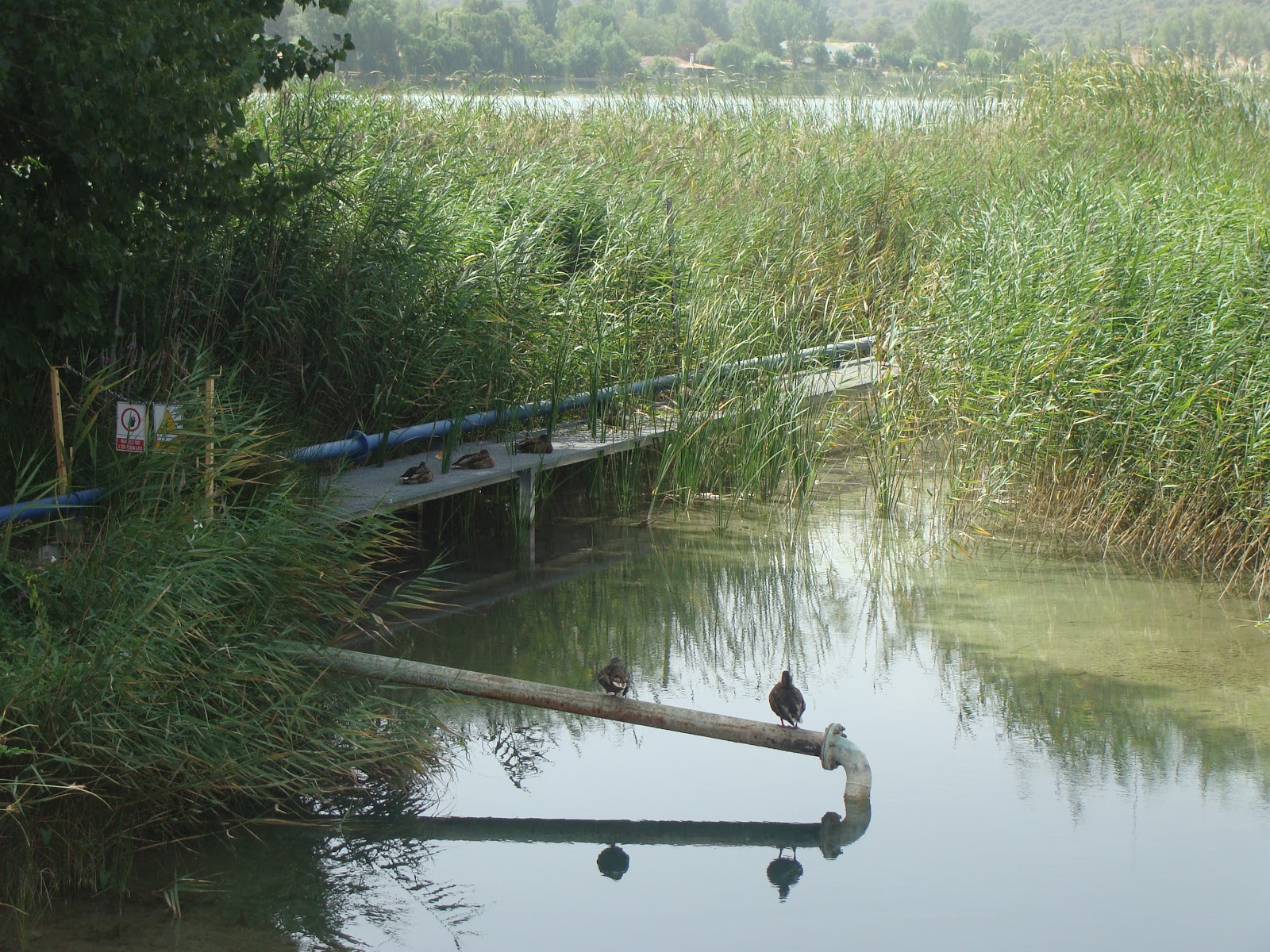
The lakes are quiet now. The weekend after the Assumption is the last big day of the summer. Now, midweek, the streets of the village echo under your feet, the roads are empty and at the bathing spots on the lakes there is almost no one. I saw maybe hald a dozen fishermen, mostly Rumanians, who seem to have an obsession with water, and three middle-aged ladies at one of the safer spots, idly dangling their feet in the water and wondering whether to swim. I expect they did eventually. In high summer that place is full, literally full, you couldn't get another towel on the ground or another table set up, and the water itself sometimes looks like the scene of a minor naval battle. The fish- large carp-like things a foot or so long- spend the daylight hours upstream, but now there were a dozen of them moving back and forth. No fishing just there.

At the other places a few stragglers sit and watch the water, and swim and play in the shallows. Families who couldn't get away until now, or who've been somewhere else where it rained, or are making the most of the opportunity, or who prefer it at this time of year, why not? Always families now, the young come from mid-July to mid-August, at fiesta time and when the weather is at its best. They don't have to argue dates with their boss or decide when to shut up the shop without losing too much money.

The summer isn't over, not at all. It's still 32º+ every afternoon, but there is cloud at times and storms in the evening. In high summer it never rains and you hardly see a cloud. people like certainty. And now that August is ending the feel here is that the work season begins again. Even people who don't work notice the difference, and those who rely on others to lift their spirits and provide their entertainment are aware that they've run out of choices.

The lakes haven't changed, though. The water is as high as ever and the sun still shines on them as it did. The places where the people don't go- because you can't get there by car, or there's nowhere to sit on the bank- look just as they did two weeks ago, and the beautiful places have not lost there beauty. They never do, not even in winter, until the water table in the mountains drops and they start to dry out. It'll be another year or two, but if it rains in the hills this winter the cycle will be longer still.

Mrs Hickory will soon be joining me on the bike, when the sun is not so hot, and we'll visit the lakes together, and swim at the places the tourists have left because they think it's too cold. Expect more photos.

Tuesday, July 19, 2011

Things to do at the Lakes

The system of lakes we have near the farm is not only an area of considerable beauty*, and there is nothing comparable in a couple of hundred miles, but also a place that inspires different people to do different things. Some of them involve moving.

It attracts people from a wide area, as there are good bathing spots and we’re a very long way from the beach. It’s cheap tourism mostly, campsites and rural pensions. After all, if you have money you drive to the beach and stay in a proper hotel. We may be inland but we’re not on Mars.

There are obvious things to do. Many people come to relax, to rest, to do as little as possible, so they lie on deckchairs, sunbeds or on the ground, on towels. There is a bit of earth in some places, in others it’s just stone. You take what you can get. Most will bathe from time to time to cool off, although some will just make a fuss about how cold the water is before dangling their legs in it and going off to the towel again. Swimming, in the sense of continued limb movements taking you over an appreciable distance, is not really possible at most of the good bathing spots, meaning you have to find somewhere else to enter the water, and bring your own beer. People do this. You occasionally see someone out in the middle of a lake, happily floating, or crossing to the other side, and perhaps wishing when they got there that they’d checked there was somewhere to get a foothold on the other bank.

The young of a certain age, about 18-20, tend to like boating, windsurfing, canoeing, diving, and if you can’t bring your own there’s a place that will provide equipment and tuition. The less adventurous prefer pedalos and unsinkable kayak-shaped tubes of plastic that you sit on waving a stick in the general direction of the water.

People eat and drink. It’s part of the point of it, or it is the whole point, or it passes the time, or you’ve been there for hours and you’re feeling a bit peckish, or you just always bring sandwiches and coffee and beer whenever you go anywhere.

There are good places to fish, and plenty of fishermen making the most of them. I assume the fishing is controlled to some extent, but no one seems too bothered. I’ve never got the point of fishing- as I’ve probably said before, it strikes me as the quantum unit of human activity; it’s impossible to do less than to fish- but a lot of people love it, especially Rumanians, who are crazy about water.

If you don’t do any of these things, you can always watch the fish, the birds, the water, or the people. Or you can cycle or walk around them, or invent your own activities. I saw a father and young daughter the other day paddling in the shallows on horseback.

My brother-in-law the almost-retired colonel regularly takes his kayak (very sinkable indeed, it’s like riding a bike with no hands) and paddles several miles up and down the lakes. My sister-in-law the biochemist prefers to visit one of the little-known spots on an out-of-the-way lake, to swim and catch frogs, or to try to throw her niece into the water from a pedal boat. The lakes inspire creativity in some, while others just take the chance to cool off and do nothing much for a while. Something for everyone.

*and it hasn’t so far been ruined by having great signs placed all over it telling us insistently how beautiful it is and how we mustn’t do anything whatsoever except shuffle through it in line with our heads down.

Thursday, July 14, 2011

Running by the River


One of the pleasures my old home town has to offer, one I discovered for the first time this year for various reasons, is running by the river.

The river runs below the old town, through the park and through and between a few more modern areas of houses. The most easily accessible bit for most people runs from one edge of the town to not quite the other, from an open bend in the river which was transformed into a natural swimming pool every summer, from the fifties to around the early seventies. I don’t remember it, but I have seen photos, and I know it was still there when I was a young boy. It has since been used by a rowing club, and for the last few years by a gym. A road bridge crosses it just at that point and at water level, in the brickwork, were the old changing rooms which have also served the later businesses which set up home there.

It runs from there, as I say, through an area now built on but until a couple of years ago green and quiet, among reeds and rushes with willows dangling their branches in the water. Swans still nest there, and in summer glide up and down in formation with the cygnets  between them, looking for anything edible and displaying themselves for the benefit of any casual photographer who happens to be passing.

Then it enters the park, near where the rye gate was in the Roman wall. At that point there’s a dam, which served a mill that was the last of a line that stretched back to Roman times. In the park the path is overhung by more willows, and runs past the cricket ground. The combination of these things produces a view which, at the right season and time of day, would have caused Orwell and Wodehouse to write poetry about the timeless joy of being English, and Evelyn Waugh to emigrate.

Thence it continues, flanked by meadows, used by ducks and moorfowl and coots and more swans, to another mill, by a lock below the east gate, that is used to control the level of water in the old port. The whole length from pool to lock is about two miles, and, although you can keep walking at either end for some miles, this section is the heart of the river to most people.

I have walked there many times, hundreds of times in fact, but I’d never run there until this year. It’s completely flat, which, after a week of walking in the mountains, was a great relief, and you get all of the lazy, natural beauty at a different pace. Every year I realize there are still new things to discover about the old place.

Thursday, June 23, 2011

Summer and the Road to Santiago

For Hickory the summer has arrived and we are off to the north, to walk the first part of the Road to Santiago, the Northern Path, which mostly follows the coast, usually along clifftop paths with the sea below you or visible off to one side. It goes through dozens of pretty fishing villages (and some not so pretty villages that are mostly factories) and is cooler and much more attractive than the more traditional route through Old Castille. We'll take about a week to do it, starting from Hondarribia, and we'll probably get just beyond Bilbao this year. We aren't in any hurry.

This post was going to be long and meandering, whimsically dwelling on the details of the trail and the reasons we have for doing it (we like the area and we like walking, to sum it up) but time has caught up with me, as usual.

Interest in, even knowledge off, the real world will be even smaller than usual for a few days. Now I have a Galaxy smartphone I can, in theory, read the papers and keep in touch with the world, even on the clifftops of Gipuzkoa, but I don't suppose I shall. I'll use it mostly as a GPS, to avoid getting lost to a philosophically unnecessary degree. I'll try to blog a little, just to report on progress and describe the places we see, and the things that happen. With photos. I love the modern world.

Saturday, April 9, 2011

A Regular Guy

I don't know if I'm one- sometimes I hope so, sometimes I hope not- but Steve Earle claims to be one, something I doubt is true, by the way. Anyhow, for those of you who were missing the upbeat Texan music, here is the man explaining how 'regular' he is.

Wednesday, February 23, 2011

More Old Times in Camden Town


There were a number of shops in Camden High Street that I remember for one reason or another. Not good reasons, most of them, not the right reasons, and probably not the right shops, but they are the ones I remember. I wish I had known then what I might want to remember now. I wish I had not forgotten.

There was Ryness, the stationer’s, where we sometimes bought supplies, though not very often, in my case. I think I preferred somewhere in or near Euston Station. I’d never heard of Ryness, and the real reason it sticks in the mind is that a friend of mine pronounced it in a memorable way. His /ai/ was an /oi/, and he had strange s’s, syllabic and palatal, a Shropshire thing, presumably.

The first time he said it I hadn’t even noticed there was a Ryness in the High Street, but I checked next time I passed. I probably went in once or twice. I’ve just looked it up, and it’s still there, except that it isn’t a stationer’s, it sells lighting appliances and associated things. I was confusing it with Rymans, which is odd because I have been in Rymans many times, and I look in to get their special notebooks when I'm in England, and I know it was called Rymans. All of which shows how reliable these reminiscences are likely to be.

There was a small baker’s, possibly called ‘The Little Baker’, which seems to ring a bell. If it is the same one, and I think it is, as it’s also where I remembered, and it is one of the survivors from back then, it is almost alone. The ones I actually remember are gone, and scanning the pictures at streetsensation jogs no memories. Not even the pubs are the same. The little bakery had fresh doughnuts, with just the right consistency and taste, and jam of just the right sweetness. I used to buy them regularly by the half dozen. They were dinner sometimes. It was easier that way.

This was a time when Spud-U-Like was the latest thing in fast food. At least it was food unlike what some of these junk joints turn out (I shan’t name them for legal reasons; insert your own pet hates here). It’s gone now, of course, though the company still exists and seems to be doing well. I didn’t go there much, scarcely at all in fact, despite my deep love of the humble spud in all its incarnations and presentations. Perhaps it’s the Irish blood, perhaps it’s just the way it is, but (many years from now, with a bit of luck) it is possible that the final, rambling sentences that fall from my pen before this blog is shut down for good due to the intellectual incapacity of your humble hedgehog, will be a paean to the potato.

However, returning to business. There was a bed shop called on a corner where the street dipped down abruptly, called ‘...and so to bed’, a name so horribly twee that I’ve never been able to expunge it from my mind. There is certainly no other reason I should remember it as, though I have nothing against beds, I am not inspired to write love-songs to them, and I never went in the shop. It’s long gone from that corner but, again, the company still exists and also seems to be buoyant. Ah well, into each life...

I was stopped late one night (Camden High Street is at its best late at night, or at least at its most atmospheric) by a young Japanese lad who was looking for a shop called Music Machine. We understood each other with some difficulty, but that was what he said and I had never heard of the place. Only now have I discovered that it's what the Camden Palace used to be called. The name changed before I got to Camden Town, and I didn't know.

The Palais is down by Mornington Crescent (which I was astounded to discover was a real place, shortly after I got to London, when I found myself in it), and is now called something else. Tuesday was gay night and they gave away free tickets to get people in, so that was when we dropped by. Music and beer, like a thousand other places. Nice façade, though.