Tuesday, July 28, 2009

Johnny Grainger

"A dark, bare, dirty room, a lodger’s room, the room of a young man with no money and no spirit. It was dark because they had made it that way, bare because they had taken the sofa, the rug, the television, and left only the narrow bed, the pinewood table, the rough armchair. It was dirty because it always was. They would have made it that way anyway. The window let in a little light from the street and the buildings nearby, blotching the floor and the walls, speckling the room with shifting patterns of sinister shapes that didn’t light anything. You can’t make out the edges, the corners, at all. The dimness becomes blackness before it gets there. Johnny was in the chair, sitting upright, rocking slightly, hands tight on the arms. You could see his face clearly. You had to. He looked ill. He looked nervous. He looked frightened. He didn’t look hopeless. Not yet.

There’s a bottle on the table. It’s empty. And a dirty glass beside it. He doesn’t look at them, he knows they’re finished. He hasn’t been drinking, not today. It’s yesterday’s bottle. He would have thrown it away, but then you wouldn’t know yet why he looks like that, and you need to know from the start. So it stayed there. You might think it’s mocking him, but it’s not. Empty bottles can’t mock. You can get rid of them, or if they have to stay, ignore them. Nearly empty, then they mock. Nearly empty when a flick of the wrist and a swallow is all they have left for you, almost nothing, but not quite. You still need them then. You can’t take your eyes off it. You can’t move. If you did you would pour and then there would be nothing, and the real fear would begin. The little it has to give is everything you have, all that stands between you and the fear; a tiny thing that you desperately need. And it knows it, and it mocks you. But an empty bottle can’t mock. Its power has gone. The one on the table has to be empty, or it would already be over.

He stood up, jerked upright by his body, his mind demanding change in the hope of release. He went to the window, and stood looking out. You could see his profile in the sullen light. It was dark already, but it was still early evening. You know that from the clock on the wall. It doesn’t look right, it’s too big and chunky, but you have to know the time. He stood a long time by the window, breathing heavily, letting his breath massage his tense muscles and then he turned back, crossed his arms tightly, and looked at the bottle. Again there is light on his face, and you see there the pain and the need, and some kind of ghost of strength, a desperate belief in something just below the panic. You can see it all in his face. You have to. There’s no one he can talk to yet, and you need to know it now.

He’ll go out soon, you know he must, he can’t sit there in that room all night, or stand at the window looking at things that aren’t there. He’s going to go out, but it won’t be for a while, there are things he can still do there. He’s going to go out, but he knows what you don’t; he knows what’s waiting for him. And the room is not exhausted yet.

There was a radio playing on the table, you had hardly noticed it till then, but he looked at it, moved towards it, turned it up. It was playing some kind of jazz, something soulful, mournful and slow. He listened, concentrating, tried to make his body move with it, but he couldn’t find the rhythm. He sat again in the armchair, and leaned back awkwardly against the cushion, returning to the shadows, only his face clearly visible. He lit a cigarette then, of course, taking a Woodbine and a single match from his breast pocket. He let the smoke curl slowly upward in the same light that fell on his face, and half-closed his eyes, tapping his feet languidly to the music. It couldn’t last, you knew it wouldn’t, not the length of a whole cigarette. After three puffs he stood and crushed it angrily into the already full ashtray, on the table, next to the bottle. That is not where it would really be, but it looks better, it works..."

Monday, July 27, 2009

Thoughts for Another Day

Quote of the day- from some trashy novel I saw over someone's shoulder: We have a saying in Ireland, 'Will the last person out of the country please switch of the politicians.'

Advice of the day: the best way to annoy canoeists is simply to hole their boat. Modern developments on fibreglass m,ake for a very tough hull so a 762 is recommended. Holding a bottle, reeling about and singing 'Row, row, row your boat, gently down the stream' at them loudly and tunelessly is quite annoying, too. On the other hand, a more subtle approach is to build a partial dam that stops three inches short of the surface of the water. This is very annoying indeed.

Weather news: it's been 37º for the last few days, And the real heat hasn't started yet. By the way, most of the fires we have over here every summer are started deliberately; there are in fact perfectly safe ways to burn stubble, even in this tinderbox.

Sports news: I am no longer depressed about the cricket. This may change, of course.

El Rollo del Infante

In an old house in an old part of the village there is a twenty-foot stone phallus. It wasn't intended to have any such symbolism, but it's the easiest way to describe it. And it wasn't always in that house, or even within the village.

When the village was even older than that house, in 1410 to be exact, Prince Enrique of Castille gave the village a royal charter as a town. This meant, in practical terms, that it could adminster many of its own affairs, including the collecting of taxes on incoming goods, and the administration of justice.

In honour of this event, and in order that anyone approaching the place would be aware of its status, the tradition in Castille in those days was to set up a 'rollo', the aforesaid phallus, as a symbol recognisable by all who might have legitimate business in the region. The site chosen was on the the bank of the stream, which strikes me as odd since the land rises sharply on both sides and it isn't the most visble spot, but there you are. About 40 of them are supposed to survive, though I have never seen another.

It has a cylindrical base consisting of three steps, and is itself cylindrical, tapering a little towards a rounded and divided top. Near the top are four short metal arms from which those who had fallen foul of the spanking new local justice could be hung from it, or part of them, depending on the nature of the offense.

Some centuries later the ancestors of Raimundo Cuerda wished to build a hous in the expanding town, and they chose that spot. The simbolism of the great stone had either been forgotten or had ceased to matter by that time, and so they simply built the corral around it, and there it stands to this day.

Oddly enough, none of Mrs Hickory's family knew anything about this.

Thursday, July 16, 2009

I Don't Do Gossip, But...

Nº 1: Imagine a dark night deep in the country. Paco, the gamekeeper, has been warned that someone is driving through a remote area of the farm in the early morning, to poach, or for who knows what other purpose. It is unlikely to be legal or harmless. Paco informs the boss, who decides they will wait together. It'll be like hunting wild boar- hours of waiting in silence, motionless, ready for any movement among the trees, patient and alert. At about 4 A.M. a car appears, without lights, and gets a lamp shone suddenly in its face. Brakes squeal, doors slam, confused shouting is heard, the lamp is switched off, and when it is turned back on Paco and his boss find that they have captured two men who have no right to be there and who are carrying a shotgun.

We take a fairly relaxed attitude to poaching down here, as long as it's strictly limited to rabbits and is done in a certain way. This is a bit different, but perhaps a strong warning would have done. But they find they have caught the nephew of the Potato Crisp- who is easily led astray- and the Little Moor, so called- and not affectionately- because he is a junior member of a family who are all known as the Moors. Not a pleasant character. None of them are.

And it so happens that the Little Moor lived for a while, in another town, with the rather wayward daughter of Paco. He did not treat her well and it ended very badly. And now Paco has the ex-boyfriend bang to rights.

The Little Moor is now a guest of the Civil Guard. Not for long I imagine, but it would appear he resisted arrest. That's Paco's story anyway, and he is very much enjoying telling it. It all happened not far from here.


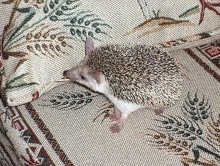
Nº 2: I have discovered that my spiny co-blogger has a secret. The sort that should remain untold, but it's too good to keep quiet and his shame is not my problem. He should have thought of that before.

The secret is this: my Atelid colleague has an underwear fetish. Used underwear, both male and female, which has for whatever reason dropped to the floor rather than staying in the basket, has disappeared, and later been found hidden in the places my prickly aler ego tends to secret food, toys and indeed, himself of a morning.

Why he should do this is not clear, but he is obviously more disturbed, or at least an altogether deeper character, than I imagined.

Wednesday, July 15, 2009

Watermelon Lunacy

'The man who can make two grains of corn grow where one grew before will have served mankind better than the whole race of politicians.'

I forget who said that (was it Jonathan Swift) but it is perfectly true. And in the last couple of centuries there have been quite a few of these people, to whom statues should be erected around the world. They are the inventors of pesticides, chemical fertilizers and mechanical sowing and harvesting machines. (I wish I could give a few names but I can't do the research here).

Now: Tomatoes grown on an allotment covered with sheep shit and tended by hand taste wonderful; far, far better than anything you'll find in the supermarket. They are also hellishly expensive to produce. They are a luxury for people who have time or money to spare and choose to spend it that way. You can't feed the world by throwing sheep shit around and then going out with your spade. We in the wealthy nations aren't used to thinking of food as a luxury, and there's a reason for that (see paragraph 2) but for many people it still is.

I have no objection to people spending their time and money as they wish, but certain things must be borne in mind. Basic things, like simple economics.

I hadn't realized until yesterday, while discussing the matter with my brother-in-law (the one who runs the farm) that organic farming is actually subsidized by the Spanish government. There is a programme to encourage farmers to sow only seed that has itself come from organiclly farmed crops, to use only manures from organically raised livestock, to spray nothing whatsoever on the soil or on the growing crop, and if they do all of this they get a hefty subsidy from the government (ie you and me- well, me anyway, and probably you too if you live in the EU).

I expect you're way ahead of me here, but let me have the pleasure of spelling it out- the government is deliberately encouraging farmers to triple (roughly) the production costs of food, and to reduce to a quarter or so the productivity of land. If they are successful we will all starve. This is complete madness.

Yes, I know we won't starve because Spain, while not quite on a level with Germany or France or the UK, is a wealthy country and the extra costs needed to keep ourselves fed will in fact be absorbed by other, less vital, sectors of the economy, which will experience a dramatic downturn. You can argue about the possible future benefits of windfarms and solar panels, but to deliberately triple (at least) the production costs of such an important industry, to tie a massive millstone around the neck of your economy (and by extension, the world's) for no reason whatsoever, is complete and utter madness. Since our government, despite its faults (Hickory passim) is not entire stupid, the only assumption I can make is that some eco-bunny has persuaded them that we are more likely to vote for them if they attempt to starve us than if they don't. And it's probably true.

Of course, if the scheme does become too popular they will stop the subsidies before too much damage is done, but that doesn't make it any less nuts, nor any less obviously naked, cynical populism. Does Britain do this as well?

How To See the Country

There are different ways of seeing the countryside. It is, of course, a very different thing to drive through it on the way somewhere, protected from all but the most immediate visual stimuli, than it is to live in it permanently or, as in my case, semi-permanently. It is quite different again to work in it, and have to struggle with it daily to earn a living for yourself and your employees, and generally make it profitable, which is, as people easily forget, the point of having a farm in the first place.

But assume you are in the country and have enough free time to take a good look at it; what's the best way to see it?

Well, there isn't a best way. One thing that is usually worth doing is to climb to the highest point you can find and have a good look at the whole area, or as much as possible, to gain an idea of what it is that is happening around you. You can see how much of it is sown, and with what, how much of it is woods, or scrub, or mountains, what birds fly over it and where the nearest villages are.

You also need to look at it at different levels, down to the close-up you get when looking for asparagus in the spring and you have to check beneath every tree, picking up leaves and spines, and spiders and other crawling things that live in the spaces you have to squeeze into.

During much of the day it's too hot for sensible animals to be out and about, so walking at or just before dawn, or near or even after sunset, if there's a good enough moon, will give you a much better idea of what lives around you. And you need to do it often. The real surprises are only for those who persevere, but you share your little bit of turf with far more things than you probably realize. And down here, some of them can kill you (particularly the millipedes, which are very nasty things. I had one up my trouser leg once, but for some reason it didn't sting).

And then there's means of locomotion. Walking is the most obvious choice, and in many ways the best one. You can go almost anywhere (see previous post), you don't have to pay attention to anything other than what strikes you at any moment, you are exposed to all the sights, sounds and smells without interference, and you can choose your rhythm, even stop or change tack whenever you see something interesting.

The bicycle is useful too. It's quicker, so you can go further, and it gives you a very good feel for the terrain- you notice every bump, every up-slope or down-slope, however slight, and your head is just a bit higher. On the other hand you can't respond so easily to stimuli, and you have to be constantly aware of rocks, ruts, small furry animals and bends in the path; on the road the demands on your attention are so great that it can be hard to see anything but the white line and the traffic.

I don't ride horses, but those who do point out that someone else is doing all the work, you have a much greater range of speeds to work with and, when decked out in morning dress with your head 9 feet up in the air, the sense of owning the three neighbouring provinces is quite exhilarating.

Don't forget the air. Not for everyday use, perhaps, unless you have a microlight, but the chance to see roads and railways as thin threads changing direction constantly for no apparent reason as they disappear off the edge of the world, and the land as a patchwork of all colours, shapes and sizes, and to move between places you thought were a long way apart by the merest movement of the eye muscles, should not be missed when it arises.

Choose your time and your vehicle (Shanks's pony for preference) and go and have a look. There is always something new.

Sunday, July 12, 2009

Conceptions of Private Property

There are some problems with living in the country, and one of them is that people seem to think that they are entitled to walk all over your property. People who also live in the country respect each other's land. The people who live in the nearby village do also (they often walk through the farm, to get somewhere or just for pleasure, but they don't damage anything and they know all about nesting partridges and when not to disturb them). No, it is city types who live in small houses with little bits of gardens and can't imagine why someone in the country should have so much more land than them (because we paid for it, that's why) or just because they want to go there and they have been told that the country belongs to everyone by office-bound bureaucrats and populist politicians who talk about 'opening up the countryside' when what they really mean is confiscating other people's property (they still make you pay for maintaining it, though, to the standards that the uninvited have been led to expect).

People who have a reason for needing to go through can go through, and people who want to enjoy it can do so, with certain obvious and understood conditions (I myself go all over the surrounding area, and I have never been told to leave, whether or not I was on a permitted path, only occasionally asked to take another route in the breeding or hunting season). That is not the problem, only the excuse used by those who delight in giving away what is not theirs.

There is another group who use private land as though it were their own, but they do it at night, to poach, sell drugs, get drunk or get their leg over. They can be a nuisance, too, if they come near the house.

And then almost everone seems to think that all convenient land is a rubbish dump. It's amazing what you find. Flyers, brochures, bumf in general that someone couldn't be bothered to give out, porn mags that have served their purpose, furniture and domestic appliances of all kinds, whole bathroom suites, cookers, fridges, the rubble produced from knocking something down or digging out foundations, trousers, paint pots, headstones, car parts, old bicycles, children's toys... it's all been dumped at one time, near an entrance from the road, usually, of course.

But it's still a good place to spend the summer, and right now the garden is smelling of rosemary.

And in other news: England storm to another miraculous not-quite-defeat, with a lot of help from the rain. And a top score of 89 on what must have been a feather-bed. The Aussies will be terrified. Still, they are defintely miffed, which is something, and there's time to remember how to play cricket before the next Test.