Friday, April 26, 2013

On Nudity

Update: In the comments, Vincent points out that this post is badly in nearly of illustration. Although I am told that it is possible to find pictures of naked women on the Internet, I have added some here to give artistic coherence to the post (Never Knowingly Artistically Incoherent, me).

A Quick Sketch

I have spent a couple of afternoons trying to find a nude to draw. I first looked at Greek statues and eventually decided that there was no actual nude that was what I was looking for. Then today I tried modern photos in diffetent styles. Again I found nothing that wanted me to draw it, but I was struck by the variety of results of applying imagination to the representation of the human form. Not for the first time, I fell to thinking about it all.

The Original
Flesh in Stone, by the Genius of Bernini
There is great beauty in the human body. And great possibility. Despite the great beauty and plasticity of many animals, there is much in the human body that is, or can be, superior to them. One reason is simply the lack of hair, which allows the details of flesh texture and muscle tone and form to be clearly seen even at rest. The ability to be conscious of one's own body, to control its movements in detail, to conceive them with knowledge of how observers will react to them and to present them in a specific context independent of the movements themselves. There is also the important point that the lack of hair allows the play of light and shadow to exist, to be refined and exploited. The animality of the human body is more clearly visible than in other animals.

Naked Flamenco
Then there is the fact that we know and understand the human body, its functions, sensations and responses, far better than those of other animals. And then there is sex. We don't think of want cheetahs sexually.

But sex is not necessarily an important part of this perceived beauty, or even any part of it. I can see beauty in the male as well as the female form. On the other hand, it does appear that the female form is intrinsically more beautiful than the male. Women who appreciate beauty seem to agree with men on this. A beautiful woman is a beautiful thing. A man's beauty cannot so easily be appreciated by other men. Nevertheless, the beauty of the human body is not limited to the female.

Roman, not Greek, but one of the best
Nor is it limited to the young and well-formed. In many kinds of dance the performers tend to be youngish and slimmish, but then many forms of dance are too demanding for the old and fat. Some forms do allow for this. Flamenco rhythms are often danced to by old women. When it is well done, with skill and duende, not only the dancing but the women themselves become beautiful.

I remember a story I once heard about Josemaría Escrivá de Balaguer, in which he cried because he had seen an artist capable of making a chaste Venus. The story was probably apocryphal, carefully crafted to illustrate a point, as so many of the stories he told were, but it means, at the very least, that he thought it could be done, and that it was important.

Looking at pictures of attractive naked women purely- as it were- as beautiful objects, or the subjects of beautiful images, rather than as objects of male enquiry, is very interesting and instructive. The curiosities of anatomy, the signs of life lived and suffered, the differences that exist between what you may think of, at first glance, as similar examples of the Standard Pretty Girl, the ways in which the human body can be twisted, distorted, lit up, perceived, conceived, expressed and impressed. Their is apparently unlimited potential for teh creative mind to find new and beautiful ways to show it to us. I like this fact.

It is possible that that drawing will never be made. These reflections will have to stand in its place.

Wednesday, April 24, 2013

Language is Communication, and Communication Will Never Die


Man as a species loves to communicate. Without more or less constant communication we would literally not be human. Language is primarily, overwhelmingly, used to create and maintain social relationships, day by day, minute by minute. It is what we do. Most, the enormous majority, of what we say to each other communicates no information that would be useful or recognisable to anyone outside the conversation. It exists to oil the cogs of the social machinery, which rust very quickly indeed without it.

It is not possible to say that language evolved through selective pressure on well-maintained social relations, but it was almost certainly important from the beginning.

Mr Facebook, Mr Twitter, Mr Google and others, including Mr Bell, not to mention the whole of Hollywood, have made a lot of money by betting that we would swallow anything that gave us something to talk about, however insignificant in itself, and any new means of talking.

Regular Facebook users can have hundreds of 'friends', many of whom they have never met, and with whom they do not share a common culture, country or native language. This blog and a million blogs and websites, are written for anyone who might want to read them.

The new possibilities for communicating with people of whose very existence we would not have been aware even 20 years ago is creating new problems with language... Which the great majority of us solve effortlessly. Because that is what humans are good at. To overcome barriers to communication, to successfully employ a strategic competence, as the theorists say, is as natural to us as beathing, and it is why apparent changes in the way a particular language is used are not going to stop us from talking to each other.

And in many cases it is in our economic interest to communicate well, or we have some other reason not directly related to the love of communication per se. We want to get on with someone, get to know them, impress at a job interview, keep a client, teach a class or give a speech well, calm someone down, win an argument, get permission to do something… All of this can be usefully done by using the skill we have in social communication. Yes, some are better than others, practice and experience make you better, but in general, we, as a species, are very good at this, and at learning to do it when we encounter a new situation.

Lovers of elegance, of balance, of that beauty of form and structure in language so hard to define but so easy for the discerning to recognise, lovers of specific forms of linguistic, prosodic, phonetic or cultural purity in language, lovers of a familiar idiolect, known from childhood and crafted by experience and study, will, no doubt, continue to be dissappointed by the great mass of humanity. But while we love to communicate, we live to communicate, language will only change; it will neither die nor decay.

Sunday, April 7, 2013

Sigüenza

Sigüenza is a city in the north of Guadalajara, on the banks of the Henares.  A strange city.

Guadalajara itself is a strange kind of place. The eponymous provincial capital is the sort of place that no one has ever been to, or comes from, and the province is now a part of the Autonomous Community of Castilla-La Mancha, despite having no historical connection to it. When Spain was carved up into Autonomous Communities with their own parliaments and the rest of it, in the late 70’s, the motivation was to recognise the historical identity of Galicia, Catalonia and the Basque Country. The rest of Spain wasn’t so easy to partition. Andalucia was fairly clear, and so was Valencia, I suppose, but there were lots of areas that didn’t have any obvious boundaries, or that appear to fit anywhere in particular.
 
León was put into Old Castille, Murcia and Cantabria were given their own identity, and no one had any idea what to do with the Alcarria. It would have been ridiculous to make it a community in its own right, Old Castille was quite big enough, and Madrid’s dignity required that it not be lumped in with another area, even though they are more closely linked historically speaking. On the other hand, the Alcarria is defined to a certain extent by not being Madrid. So the least absurd solution turned out to be to put it with Castilla-La Mancha. That, in any case, is what was done.

So I found myself last week in a city of only 3,000 inhabitants with a monumental Gothic Cathedral of a size and grandeur that comes quite a surprise, with a dozen or so side chapels and an impressive structure in the centre bounded by a rectangle of carved stone to the ceiling and panelled with sculpted wood, contained the barred high altar and the facing choir stalls, in the high mediaeval tradition. And this, despite being central to the history of Castille, is politically part of the same Community that I live in, 300 miles to the south.
 
The city/village of Sigënza has a castle on the top of the hill, a walled mass of mediaeval streets jus


t below it, and a complex of rundown Baroque streets nearer the river. It has five churches of varying age and architectural interest, two convents, one of which makes and sells excellent chocolate, and a modern area which is still growing. It also has a railway station because, in the late 19thC, it seemed that it was still a place that mattered.
 
Everything worth seeing there can be seen in a day, and our intention was to spend another couple of days walking in the hills and through the surrounding villages. There are several villages within a few miles, and I do mean villages, where only a few dozen people live, with castles and one with a mediaeval wall 20 feet high, for no apparent reason, as there’s really nothing to protect.

And a river valley with a burbling stream, with spring colours, overhanging rocks and eagles and vultures circling overhead. We were chased by dogs at one point, and if they ever get together with the birds there could be trouble.

A pleasant few days. It rained a bit, in fact it hailed twice, once just after we lost the dogs, but as I say to Mrs Hickory at such times, ‘Rain is a state of mind.’ She doesn’t always look convinced. Anyhow, photos.

Sunday, March 31, 2013

Poems to Remember the Past By


Byron

SO, we'll go no more a-roving 
  So late into the night, 
Though the heart be still as loving,
 And the moon be still as bright. 

For the sword outwears its sheath,
  And the soul wears out the breast, 
And the heart must pause to breathe, 
  And love itself have rest. 

Though the night was made for loving, 
  And the day returns too soon,
Yet we'll go no more a-roving 
  By the light of the moon.


Francis Thompson

* For the field is full of shades as I near a shadowy coast, 
* And a ghostly batsman plays to the bowling of a ghost, 
* And I look through my tears on a soundless-clapping host 
* As the run stealers flicker to and fro, 
* To and fro: 
* O my Hornby and my Barlow long ago !

 The story goes that “Not long before his death and long after he had watched Hornby and Barlow bat at Old Trafford, Thompson was invited to watch Lancashire play Middlesex at Lord's. As the day of the match grew closer, Thompson became increasingly nostalgic. At the end, he did not go for the match, but sat at home and wrote At Lord's. The original match in 1878 ended in a draw…”

I was reminded of both of these poems the other day (the second is a fragment of a longer poem) and remembered that I wanted to write about this. About the stark feeling of having done everything worthwhile that you are ever going to do. Good memories are good, but they shouldn't remind you too clearly that they are now only memories. These lines do.

There are many things I will never do again, or never do at all. And there are many things I will do, if I choose to or am lucky enough.  It is these last that are the future, that make the present worth prolonging, that cause optimism, happiness even. And memory is good, even memories of what is gone forever.

But there is a finality about these lines. The simplicity of the metres, the bareness of the images, the lack of any contrast with a worthwhile present, lead to a feeling that what is good is lost. And perhaps was never truly had.

Just poetry, and I like it. It provokes an emotional response, which is one of the things I like in writing. But don’t read them under the influence.

Friday, March 29, 2013

Easter in the South


Celebrating the Joy of Easter Morning
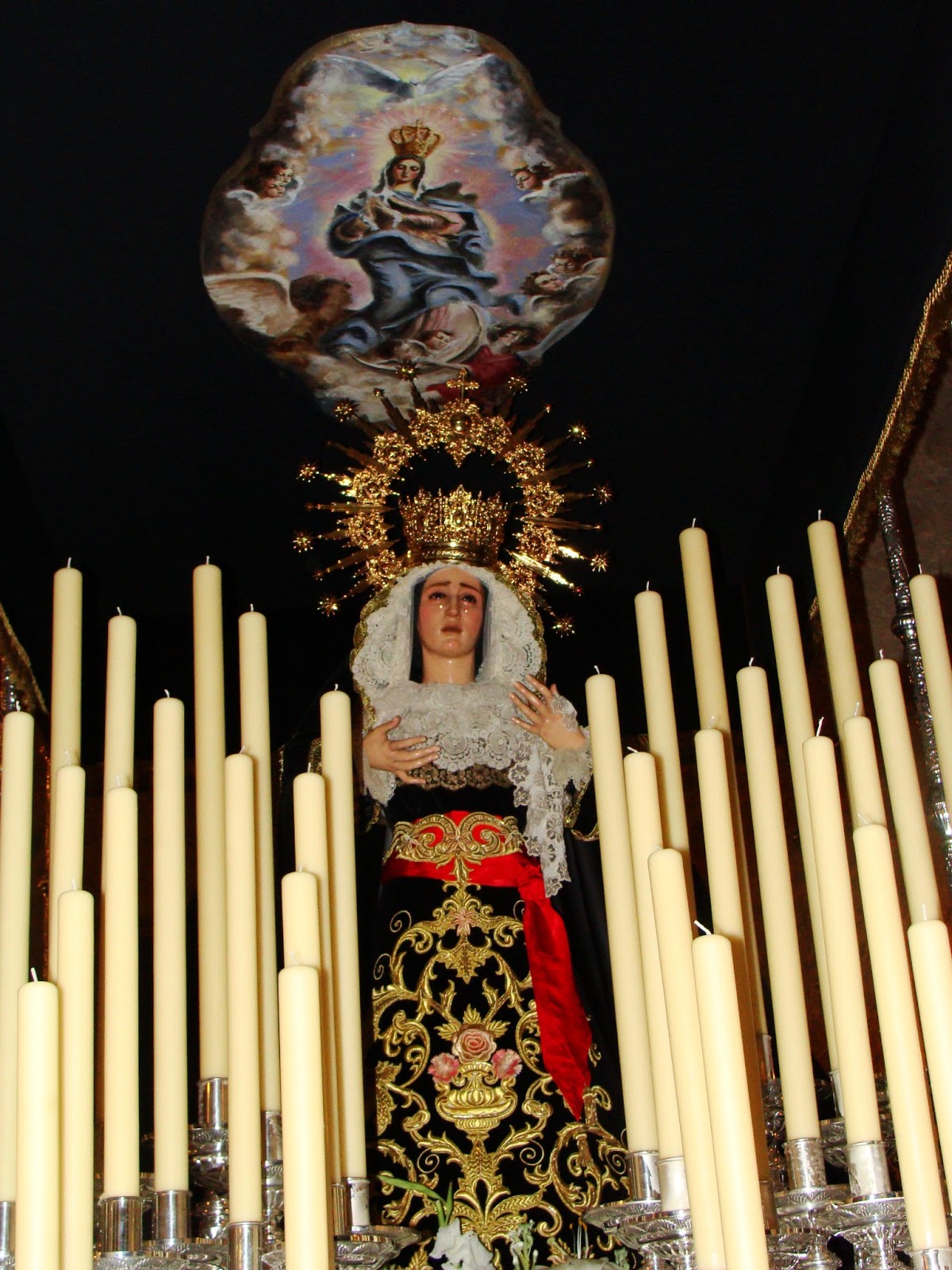
The Easter processions are not only one of the oldest traditions in many towns and cities of (primarily Southern) Spain, they are also one of the biggest public spectacles. The small city I live in has about two dozen ‘cofradías’, brotherhoods, which celebrate a particular aspect of the Passion of Christ either through the experience of the Virgin or a scene from the narrative.

Our Lady of
These scenes are figures, usually slightly more than life-size, made of wood and ceramic by expert specialists in the genre. They are ornately decorated with gowns, halos, garlands, flowers, silk handkerchiefs, candles, placed on a wooden float rigged with an ornate linen cover supported by posts at the corners, and transported through the street on the shoulders of strong young men. They are accompanied by the members of the ‘cofradía’, dressed in the garb of penitents, with gowns and pointed hoods in the colours of the group, and by a band, providing rhythm to the bearers and the walkers, and generally livening the whole thing up.

Jesus the Nazarene
It is a slow business, because they are very heavy, and the idea is to show them to the crowds, not to get it over with quickly. They stop to rest, they stop to listen to ‘saetas’, sung from balconies on the route, during which the bearers do not rest, at least not early on, but dance the platform in honour of the singer. It’s hard work. The bearers of the processions that go out on Good Friday are dispensed from the obligation of fasting and abstinence which binds other Catholics. Mrs Hickory’s Virgin is meant to go out tonight, as part of a complex of processions involving ten different images which meet and separate and meet again, then chase each other back to the Cathedral.

At one point the crucified Christ meets two versions of His mother in the Main Square and greets them in ritual fashion, bowing and dancing. Each of them, let me remind the reader, a life-sized statue on a billiard table with 40 second-row forwards underneath it. All of this takes time and energy.

The Last Supper
After some 4-5 hours of this, at about one in the morning, they arrive back at the Cathedral and take the statue in, backwards, on their knees, in the presence of a crowd that numbers in the low thousands.

This is not just a religious activity. It is not a handful of the devout doing inexplicable things, perplexing the majority of passers-by. It is a cultural and social event lasing a week, participated in directly by perhaps 1500 people in any given year (this in a city of some 80,000, and watched, with interest, respect and understanding by many thousands who line the streets to watch them pass, waiting hours to get a good place, clapping the more difficult manoeuvres of the bearers, remaining silent for the ‘saetas’, and staying up late into the night to watch the return of the images to their home church. Most of them probably don’t visit a church from one year to the next, it includes many teenagers who would normally be out in the streets or the bars with their friends, but it is a shared experience, a part of their culture and their hometown, which they want to continue to be part of.

It is very unlikely that the processions will be able to go out tonight, because of the rain, but the experience in other years of the reception of the Virgin by the crowds outside the Cathedral is remarkable in its intensity.

Friday, March 15, 2013

Idolatry of the Abstract


We need to group together to get our ideas heard, to express them with confidence, in order to clarify them in the first place, because. But once we entrust our belief to others it is no longer our own. It is dictated to us.

Any human organization, religious, cultural, sporting, political, government, whatever, will be controlled by those who love power, and it will demand that the primary faith, belief, loyalty, be to the structure and hierarchy of the organisation itself, not to the idea, ideal or purpose that it was originally created for, and certainly not to the people who created it to serve them. God, football, socialism, the taxpayer, whatever, is very much in second place.

Anyone who places the original purpose, God, say, in the case of a religious group, above the group itself will not be trusted, and will be sneered at by the leaders.

Idolatry of the abstract is what I, and doubtless many other people who are mystified that I should find any of this new, call the tendency to place the abstracted idea of a group of people above the individuals who make it up- who may have created the group specifically in order to benefit themselves- and even above the great majority taken together. The leaders will require, and often the members will not only accept but actively collaborate with the idea, that only the state, the game, the order, the party, the school, whatever it happens to be, matters, and the people who make it up can be dispensed with, disposed of, destroyed if necessary, all of them, in the name of the abstract that is supposed to belong to them.

Since there is one born every minute, and many people love simple abstract ideas that are easy to name, especially when they are designed to flatter them by being made fashionably good and easy to understand, many pseudo-religious, pseudo-political or pseudo-other organizations are created purely to take advantage of this factor. But many are created by the very people who later allow themselves to be controlled by them.

Sports associations are taken over by the people paid to run them, as soon as the game becomes economically or socially important enough. They talk about ‘bringing the game into disrepute’, ‘the game is bigger than all of us’, and are frequently in dispute with the people who supposedly employ them.

To a certain extent this exemplifies the principal/agent problem. In all such organizations, whether private or agencies of government, the people in charge of the money, of the rules, of deciding exactly what the whole point of the organization is, and however they acquired that power, will tend to run it in their own interests. Whether through corruption, ineptness, laziness or some combination of these and/or other reasons, this will happen. We know it will happen because it invariably does happen.

Tyrannical governments deliberately take advantage of organizations which already exist, and create abstracts such as ‘the state’, ‘the country’, the party’, the nation’, ‘the revolution’, the philosophy’, ‘the ideal’, ‘insert –ism here’, in order to justify everything up to and including the murder in the name of that ideal of the very people it is intended to serve, and indeed, in most cases, without whom it would not exist, and in all cases without whom it would have no meaning.

But you don’t have to go to Stalin to see this idolatry. The local golf club, choir or neighbourhood watch committee will happily sacrifice the people who created it to serve them, to some abstract ideal of itself, often with the willing acceptance of those sacrificed, who fail to see what has been done to them.

Monday, March 11, 2013

Government is Not Us


Some of the comments here are quite interesting. But among the usual misunderstandings is a very important one. Government as we understand is something outside society. It is perfectly possible for people to get together to protect their property from robbers. It doesn't have to be done individually. But that group which has pooled its resources and to a certain extent its freedom of action in order to obtain a solution at least acceptable to all members, and cheaper than it would otherwise be, never, however you stretch it and expand it, becomes a government. Even if it included every member of a given society, and did what we think governments do, efficiently and acceptably to its members, it would still be a collection of private individuals, not a government, because 'government' is above and outside the 'people'. This shows clearly that governments in the sense that most people use the word do not have to exist at all. They exist, not because the people need them, but because someone will also be willing and able to take power from others and stand outside the subject group. (Government and the state are the same thing here).

Some things, many things, are better done collectively, co-operatively. This does not mean they are better done by government. We are a social species, we do many things together. More usefully, many of the things that we do are a consequence of our being a social species, thus it is natural that many of the things that are important to us are better done together.

That absolutely does not mean that such things are better done by a group of people outside and above the main group, motivated by different desires, largely unaffected by the restrictions they impose on others, who can take money by force from their subjects, and who have no emotional interest, or social investment in the people they control. Socialism, statism presuppose these things, and collectivism assumes that co-operation will not be corrupted by those who love power over their fellows.