Saturday, December 19, 2009

Catalan Democracy

In Catalonia the regional Parliament has taken a step towards banning the bullfight in the region. They have approved for Parliamentary process a private initiative with 180,000 signatures. It still has a long way to go, and may not make it. Fan though I am of bullfighting, I am a much bigger fan of democracy, and if the elected representatives of the people are genuinely responding to the popular will then I would accord it a cautious welcome. But...

They probably aren't responding to anything of the kind, in fact. They are responding to a pressure group which has been very active in getting forms signed, but it is true that bullfighting has never been popular in Catalonia. Now there is only one active bullring in the whole region, a magnificent one, it's true, and it is only used a few times a year, but there has never been serious opposition, just lack of interest.

That this is all political manouevring and points-scoring is shown by the fact that it is the 'corridas' they are trying to ban, which, as I say, have little support in the region, and not the 'correbous', a local tradition involving bulls on ropes in the streets, goaded and attacked by the people, or thrown into the sea. That is a popular custom at festival time, and they daren't touch it, despite being at times genuinely cruel, which the bullfight really isn't.

No, the cause of this little rant is not the possible demise of bullfighting in Catalonia, but the disturbing fact that the Parliamentary vote was held in secret. That tells you all you need to know about democracy in Catalonia.

Sunday, December 13, 2009

Unusual Phonology

Many interjections, especially expressions used to express emotions with no further syntactic support, sometimes contain phonological features not present in the normal language (I say this apropos of nothing in particular, but I've been collecting examples and the subject strikes me as interesting):


Tsk- used to indicate disapproval, often ironically, contains no vowel and has a voiceless affricate not found in normal English, /ts^/, although it is common in some languages, for example Czech. The only affricates regularly found in English are the sounds of 'church' and 'judge', although some pronunciations of /tr/ and /dr/ are identified as affricates;


Uh-oh- to indicate that a problem has been spotted, exhibits tonality, since there must be a marked drop in pitch from the first to the second syllable in order to express the intended emotion; in fact the meaning may be said to be more in the tone than in the phonemes. Tonality is very common in the world's languages, and exists in the great majority of the languages of Asia and Africa. It is much less common in the Indo-European languages, especially in Europe, though Swedish exhibits some tonality;


Whew- to indicate relief, usually begins with a bilabial fricative not present in normal English;

Uhhr- to indicate horror, is often pronounced with an ingressive airstream, a method of phonation not found in normal English, and very rare indeed in any of the world’s languages. Nearly all sounds in nearly all languages are pulmonic egressive, which means that the air is pushed out of the mouth by the lungs, but several other ways of making sounds can be found here and there ;


Chkchk- to encourage a horse or express fondness for an animal, is a post-alveolar or palatal click, found only in the Khoisan and a few surrounding Bantu languages, and in Damin in Australia. Damin is a constructed ceremonial language spoken by initiated elders of the Lerdil tribe, who live on Mornington Island in the Gulf of Carpentaria. It is notable, remarkably so, for being the only language outside southern Africa to have click consonants;


Tut-tut- to indicate disapproval, is often pronounced as a dental or alveolar click.


As I say, hardly the pressing issue of the day, but there we are. All links are to Wikipedia, because it describes the phonemes pretty well.

Saturday, December 12, 2009

Faith, Belief and Climate Change

I am not qualified (very few people are) to assess the extent of our knowledge about the effect of industry on global climate or the changes which might occur over the next hundred years. I'm not going to pretend that I have a position, a conviction or some deep insight which those who understand these things have missed, and as it's easier to ask questions than answer them, that, after a few initial onservations, is what I'm going to do.

Everyone wants to have an opinion on this matter, and, in the absence of any real possibility of analysing the facts, most people have a position in which they like to place themselves with regard to what they perceive as the orthodoxy. They don't actually know in any sense. The politicians are doing what politicians do, the journalists are doing what journalists do, some scientists are doing things they shouldn't, and people are talking a great deal of nonsense, which is their right and privilege. But there is no black and white here, in fact it is as far from being black and white as it is possible to imagine.

If you read a site like Real Climate, it becomes clear that much of what is known is only tentatively proven, and what it might mean is very hard to interpret. Scientists collect data, and in this case the data are especially difficult to gather, and extremely hard to construct any meaningful interpretation from. It is known that only a few thousand years ago much of Europe was too cold to be habitable, and that this occurs in cycles of very sudden onset. It is also known that over the last few million years the Earth's atmosphere has at times been unbreathable by creatures like us. It is perhaps the fear that it could happen again on a short time-scale, and that very little is known about how these changes come about, that is behind the dramatic claims made by some, and the exaggerated and dangerous solutions proposed by our leaders. The motivation of the usual bunch of thugs who have travelled to Copenhagen to smash things and threaten people in the streets is not a mystery, of course.

There are believers and unbelievers, and most of them adopt a position of belief or unbelief in the same way that they choose a religion, or a football team, or an opinion on the philandering of Tiger Woods. They is, they do so almost arbitrarily, depending on who has told them what and how it made them feel. They will then defend that position passionately regardless of any evidence. They won't be swayed by facts because they didn't know or understand the facts in the first place, so new facts will also be ignored.

We like certainty, and we like to feel part of things. Likewise we don't understand most things, so we choose anyway. It is similar to the case of evolution vs. creationism. The vast majority of people who say they believe in evolution do so because they think they should, because they accept the authority of those who say it is so, or they don't want to be associated with the fundamentalist times that creationism seems to attract. But they don't believe in evolution because they understand the information gathered and how the theory was developed from and tested. Their belief is as much a matter of faith as that of the creationists. Richard Dawkins may view with satisfaction the figures that say that a great majority in Britain believe in evolution, but it is because he is a better seller of snake-oil than others, not because people have seen that his snake-oil is of better quality.

A woman called Aminatu Haidar has been on hunger strike at Lanzarote airport for nearly a month, since she was deported from Western Sahara. She is an activist for the independence of the region, which is administered by Morocco, a situation not generally accepted by the population, who seem to favour independence. (It genuinely seems to be a large majority that desires this, not just the self-appointed spokesmen of the Frente Polisario).

Haidar claims that she simply wishes to go home, but several solutions have been offered, and rejected by her. She appears to be prepared to die, and for her to die in Spain would be a serious problem for the Spanish government. her real motivation seems to be to cause the governments of Morocco and Spain to reach an agreement favourable to the independence of Western Sahara, and she is keeping herself and her country in the news until she achieves something.

The government, on the other hand, cannot suddenly change the nature of its relations and agreements with Morocco, which have social, political and commercial importance far beyond the life of this one woman, but she is old, and pacific, and wants to go home, and has the overwhelming support of the Spanish press and public, so ministers are tying themselves in knots trying to give the impression of acting decisively, but without actually doing anything which commits them to confronting Morocco. It's fun to watch.

People have chosen an opinion on this, strongly held, on the presentation of Haidar by the press, and possibly on the superficial rights and wrongs of the case, rather than on the wider truth, and the consequences of following their inclination. It is no different, in essence, from the other cases.

In Praise of Evil


"Mr Aloysius Crancey

23B Montmorency Terrace

London EC4

Mj Patrick Bromley

Rue de La Conche 12, 4ºA

Paris

12654 Cedex

12-12-05

Dear Mr Clancey,

I thank you for your recent letter, though I find it confusing and, in many ways, dispiriting. You ask my advice on certain matters, and in so doing you show that you will never understand them. I shall, however, attempt to explain my position. If you cannot yourself make use of it, and your manifest self-doubt suggests you cannot, you might be able to pass it on to others.

One does not seek evil, Mr Clancey, one is Evil. (Evil with upper-case E is noun, not adjective. I hope you understand the difference. I précis my leaflets here.) Ideas of the devil are a distraction. Those who pretend to worship a personification of Evil will never become Evil, though they might become evil. To seek it outside yourself is to waste yourself. It is to doubt your ability and your courage. Evil is in all of us. It only exists within us. It can only be found within us. To become Evil is to discover what is within oneself. It is very important to understand this. You Are Evil. But you reject yourself. You refuse to be Evil. I repeat, You Reject Yourself. Do not personify, do not compare yourself with others. That is the way of the worldly and the weak. It can never lead to satisfaction.

As to what Evil is, that can be called a theoretical matter, susceptible of being studied and learnt. In the end, however, it must be understood within us. It is not enough to internalize a series of definitions. They must cause the Evil within you to resonate and desire to express itself.

Dispense again with the idea of Evil as the opposite of good. Good is an invention of man to justify his cowardice. Nothing more. It is then turned into some form of force, or being. Again this ridiculous urge to personify. It is a typically stupid failing of common humanity. They could all rise above it of they wished, but they do not. Given the chance to be Men, they choose to be animals. There is no hope for most of them, they have determined the course of there life, and they prefer it to be empty of all purpose.

Dispense also with the idea that Evil is selfishness. Dispense, rather, with the term, and the importance that is given to it. The Evil consider self, certainly, but because to do otherwise is simply to cringe in fear of oneself, one’s weakness, and one’s mortality. (Mortality, incidentally, is an essential part of our humanity. We should celebrate ours and, especially, that of those who fear it. It is doubtful whether we could be Evil were we not mortal. This is a point on which I have not reached a definite conclusion, and which is, of course, irrelevant to us, but I rather think not.)

...

Evil, then, is nothing more than the use of our will, our courage, and our character to the highest possible extent, free of the limits man imposes on himself, free of fear and weakness, free of the inventions of irrational cowards, designed to serve those weaknesses, free of the customs they let themselves become used to and accept as absolute laws. The greatest exponents of Evil, those who have come closest to complete understanding of themselves, rarely commit acts at all. When you exist almost entirely as pure Evil, there is no need to express Evil externally. Such people, I am not yet of that number, do not share themselves even to the extent of doing Evil to others. They have no such need.

You further ask why Evil should be considered the purpose of our existence. Here you show more promise, in that one who asks the question is on the way to understanding the answer. Existence is suffering. The possession of a body and a mind, of senses and emotions, means that most things will be unpleasant. Most people do not know how to limit suffering, but can only complain and hope it will not become unbearable, as they fear death so much. If there is so much suffering in the world it is necessary that there be those who inflict it, and to make the conscious choice to cause suffering of all kinds, to reduce as far as possible the pleasure someone can take from life, is to control suffering, including one’s own. To despise the suffering of others is to give value to one’s own life. To cause suffering enhances that value and the understanding of that value, and reduces the suffering we experience ourselves. It is the only way to give ourselves purpose. Real purpose, that is.

I say reduce the pleasure others take from existence as far as possible, because there is a limit. We do not want them to value death more than life, for then they would cease to suffer, unless, once that state is reached, we can deprive them of death, while perpetuating in them the desire to die. This requires great skill, and, except on occasions, in individual cases, is usually best not attempted. And so, I repeat, there is a limit to the practice of Evil. To the attainment of Evil within ourselves, however, there is no limit. This is why the greatest of us refrain from action altogether..."

Sunday, December 6, 2009

Idle Thoughts from the Mountains

Monday and Tuesday are holidays here, making a nice long weekend. Regular readers won't be surprised to learn that I'm in the country, with a group of friends. It's very cold at this time of year, especially at night, being at around 1000 metres up and completely isolated, and heated by a fire in the kitchen and another in the living room, which is fine as long as you keep them burning nicely and don't move more than about 8 feet away from them. There was a thick fog yesterday morning, which rolled in and out again today, and there was frost on the ground, meaning that there aren't any mushrooms worth searching for.

The beer is cold, the company excellent, the country crying out to be walked through and become part of, we had bread crumbs for lunch (cooked over the fire with a little oil and mixed with fried peppers, 'chorizo', which is a kind of spicy sausage, 'morcilla' which is dried blood stuffed into the intestines, something like black pudding or haggis, and pork with the skin still on. Some people add grapes, pomegranate seeds or other fruit. If it all sounds rather hard to digest, it is, but there's nom need to go anywhere in a hurry.

In the circumstances it's difficult to care much about politics and politicians, civil liberties, education, stupidity or any of the other things I like to rant about here. I offer you therefore, a small selection of names that, for different reasons, I would rather like to have been called.

- In first place, without doubt, is the Spittal of Glenshee. Not having done the research, I can't say who he is or what it means, all I can say is that it's a Scottish noble title of clannish origin. The pleasure of being able to introduce yourself as the Spittal of Glenshee is surely worth all the ribbing you would have to take at school.

- Then there is Markhtoum al Markhtoum. He's the brother of Sheik Mohammed of Dubai, and like him, very big in horseracing as well as in oil. He has a name which has always struck me as being so majestically sonorous as to virtually finish, by itself, any conversation into which it is introduced. I'm sure you could win a lot of arguments just by saying, 'I am Markhtoum al Markhtoum' with sufficient finality.

- In third place is Lt-Col Sir Ethelred Dimwitty-Smythe. I speak from memory, but I recall that Bill Edrich claims to have bowled to this chap regularly in the member's nets when he was a lad on the ground staff at Lords. It is, perhaps, a name you could tire of, but there is undoubtedly something wonderful about it.

Just a little sampling of something completely frivolous which I allow my mind to play around with from time to time. Normal ranting will be resumed around Wednesday.

Wednesday, December 2, 2009

Hedghog Origami

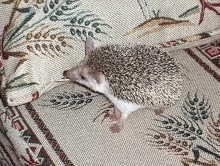
My spiny alter ego's underwear fetish is becoming distinctly worrying. He used to pinch the odd item that had fallen to the floor, to line his nest or because he finds the smell comforting (I've never liked to ask) but now he tries to steal socks directly off the foot, which means late at night you have to hop up and down and run about while a crazed erinacid tries to bite your toes. It's all part of the great tapestry of hedgehog co-existence, I suppose, but they didn't warn me about that bit.

In broader hedgehog news, a Frenchman called Eric Joisel makes hedgehog origami. The link shows the result, and gives a not very good description of how to fail to make it. His own site does a better job, but I imagine its not easy to replicate. I'm not goint to try, just admire a man who can spend much of his life working out ways to represent shapes in folded paper, and presumably think it time well spent.

Tuesday, December 1, 2009

What Should Children be Taught?

So what should children be taught, then?

The answer depends very much on what the purpose of education is, of course. Governments think that that purpose is to drill into them the tenets of fashionable orthodoxy, deprive them of the tools for independent thought, and prepare them for the role that the state thinks they should perform in society, I have argued that the state should limit its role to providing the means whereby children who could not otherwise have a proper education can achieve it, and leave the doing to others.

Education should be concerned with the individual, not with the construction of a given model of society. As such, children need to learn many things, understand why they are so, how we know them to be so, and the wider context in which their truth becomes important and related to other things. A generation of young people who have been allowed to learn to think, to understand the world about them and to develop a deep desire to be more than they are and a sense of how to bring it about would not only stand a much better chance of being successful, fulfilled and happy, but would also be likely to create a much wealthier and more successful society around them (although not necessarily the one that our great political thinkers believe they should create).

I suggest they should learn (and by that I mean be helped to understand, not just waffled at) the following as a starting point:

- That the world is a tough place, and their life will largely be what they make of it. They need to know that and to know how to make something of it.

- Numeracy, to a high level, including statistical analysis.

- Literacy, to a high level, to be able to acquire and process information easily, and to formulate and express a wide and complex range of ideas. And to enjoy what other people have cretaed.

- History/geography/biology, with the purpose of understanding the world they live in.

- Mathematics, not only for its own sake but as an essential tool of thought.

- Philosophy, not a history of ideas but an understanding of the reasoning that led to them. Another system of thought, which helps them to recognise when they are being fooled, or are fooling themselves into believing something which may not be true.

- Plumbing, electrics and bricklaying because they are very useful, save money and give a practical understanding of another part of life.

- Sport, both team and individual, because unless they learn not only what discipline is but also the practical benefits of it, they will not have the strength of will to do what they want to do.

This is, as I say, just a starting point, and I welcome further ideas. Chikldren waste years of their lives in schoold. If that time were properly used, in a few hours a day they could, by the age of 15 or so, be far better prepared for life- their own life- than 99% of what comes out of our schools today. And not as automata, but as happy, self-confident, productive people, fully prepared to take on the world. The rest, of course, would be up to them.

It is obviously important to stop trying to make education compulsory. Trying to force people who don't want to be there to turn up at school from time to time does nothing for them whatsoever other than to label them as delinquents, waste a huge amount of resources, waste the time of those who do want to make the most of their chances, and the energy and enthusiasm of the teachers who might have helped them to do it. Yes, it would probably create another kind of social problem, but in that case we should address that new problem when it arises, not pretend that ruining everyone else's educational opportunities is any kind of solution.