Monday, June 11, 2018

3 Real Life


Tom was not concerned then with a purpose. The world consisted largely of himself, its purpose was to contain him, and his purpose was to do the things he did. He didn’t think about it at that stage of his life. There seemed to be no need. In the absence of knowledge or understanding of death, or change of any kind, or differences from his own direct experience there was no intellectual possibility of asking why he had been brought into being. That would come later.

His idea of ‘good’ and ‘bad’ was very incomplete, and had no moral content at all. It was a pair of lists, one containing what he was allowed to do, the other what would cause punishment. The items were arbitrary, determined by his parents and his teachers from motives he did not attempt to evaluate. He was annoyed, even one could say unhappy, when he was punished, but only by the assault on his freedom, not from any sense of having voluntarily reduced his humanity. Usually the penalty was being sent to his room, which he was careful to hide was where he would have been anyway through choice, or being deprived of some activity he had not wanted to do in the first place. Adults had a very limited idea of what he liked to do. They decided what he should like and assumed they were right. Their observations of him, of his expressions and reactions, were insufficient to tell them when they were wrong. Nor would they listen if he told them. So sometimes being ‘bad’ brought a prize, and sometimes a punishment. He had not developed the ability to guess what the result of incorrect behaviour would be, and he was not naturally rebellious, not outwardly, and he tried to do what was expected of him. The opprobrium of either of his parents was unpleasant, in any case, and to be avoided.

These things bothered him little. The time had not yet come to seek meaning in it all. At that age he merely knew that there were aspects of the life they tried to force him to live that he did not like. He accepted them, as he accepted everything. He had yet to learn that things need not be as they are.

He spent most of his time on the lake, and in his room he could go there freely, without explanation.

His parents were Methodists; both having been brought up in that faith they helped each other to keep it and to transmit it to Tom. They had met at a church social occasion and felt they owed it to their religion to keep it alive. They were not strict about it, they attended service most Sundays and used its teachings as a reference for their own behaviour and their son’s when they felt they needed guidance. The minister was quite easy to understand, and Tom was not always bored in church. He did not always have to visit the lake during service. He found the ideas he heard clear and fairly sensible, and the moral authority of the minister was most convincing. Tom could not see how any of it had to do with him, though, nor why it was really better to behave that way than any other. The ultimate authority of God was far beyond his experience and the words of the minister on that subject held no meaning. He could neither love nor fear God. It made no sense.

What he most enjoyed, when he wasn’t on the lake, was playing with Jeremy at break-times at school, and on Saturdays when one often went to the other’s house. If the weather was good and his mother had time to take him they would meet in the park, where the shiny green grass and the bright blue sky contrasted with the faded reds and yellows of the swings and the roundabout, and they imagined themselves to be explorers in the long grass or pirates on ships that swung and rocked beneath them, or policeman or soldiers, or they imagined nothing, but were just little boys having fun.

Tom looked forward to all this, because it made school and the company of his classmates, and the torture of sitting still and listening to his teacher buzzing in the distance, a little more bearable. It was something to look forward to, and the importance of this was not yet fully clear to him, but he liked to think that soon they would be playing their games. Unless it rained, of course, and they had to stay in class. Jeremy wasn’t very good at the sort of games that didn’t involve running about and making noise, and he was no good at all at any pastime that wasn’t a game.

At times he thought he would like an older brother- he had seen younger brothers and they were a considerably nuisance- who would look after him and show him things, like Jeremy’s brother did. But they weren’t all like that, and he would have to come second in everything and would be made to do a lot of things he didn’t want to. He certainly didn’t want a sister, as he had seen enough of those to know they weren’t worth the trouble. Except perhaps a very small one, a baby one. That might be fun. A brother he was unsure about. It didn’t seem likely he was ever going to have one, his parents never spoke of it, but some people had them, and his mind could have one if it decided to. It just hadn’t made itself up yet, and probably never would.
º

Thursday, June 7, 2018

The Wildlife about Us

We saw a fox this morning, golden-brown, a long tail bushy at the end,  loping along through the low green wheat, bound who-knows-where.

There are many wild boar. They aren’t easy to see, as they hide in the hills during the day and come out mostly at night, but they are there. You can see the fresh marks every morning where they have been digging up the fields looking for roots and worms. They add a certain rugged glamour to the place, but they also do a lot of damage in large numbers and so the season has just been opened on them. Hunting wild boar in the mountains involves sitting up for hours at night at specific spots where you know they come through, without moving, smoking or making noise, until, if you’re lucky, you might get one shot. Miss, and that’s that. It’s a solitary, apparently dreary business, like fishing, I suppose, suitable for misanthropes and poets.

There are great bustards about. They are, I believe, the biggest of all flying birds, and we get a lot of them here in the summer. A couple flew languidly, with surprising elegance, across my path yesterday. When you come upon a group in a field, suddenly, close by, as when you come out of trees or over a rise, and they turn to look before deciding whether to take flight or just to walk away disdainfully as though they were going to anyway, they are startlingly big. For a moment you think you’ve scattered a herd of ostrich.

A lot of lizards about, too. The green and blue ones, very bright, sparkling colours, about a foot long, sometimes more, regularly cross the paths in front of you. We have two living in a crevice under a broken stone jar adorning a parterre just outside our door. They take the sun near us as we read or write (or paint, in the case of Mrs Hickory) in the garden, and sometimes gaze at us quizzically, wondering of we’ll drop any more bits of cured meat.

There are many crows at the end of the driveway, why just there I’m not sure, but they fly away as you approach and return when you go. There’s probably a reason for that which would spoil the tenor of the tale, so let’s just assume they like meeting there. Such a group is called a parliament, after all.

And the eagles, lazily circling above, pinging out a regular cry. And the smaller hawks, always flying about, looking for food on the wing. And the little owls that nest up on the roof and sing from the chimney pots every evening.

Tuesday, June 5, 2018

The Beauty of Water

I mentioned in passing that the lakes are full and the animals fairly chipper. It occurs to me that I should now expand on those remarks, as they are things which mark very vividly the character of the area, and so greatly affect the ascetic enjoyment of those of us lucky enough to be idle in the midst of it.

The lakes come and go over an irregular cycle lasting some years, as they are fed by an underground aquifer that collects water mainly from the mountains well to the east. When it doesn’t rain there for some time, and it doesn’t rain much in this part of the world, the lakes begin to dry up. Some of them disappear completely, others shrink to a pool or a channel near the middle, and huge expanses of dried mud, which people use as beaches, and the many feet of karstic formations are completely revealed. This is interesting but not attractive, and it means the usual bathing areas become unusable, and the people whose livelihood depends on selling beer to the tourists begin to contemplate the sacrifice of their first born.

Then it rains, and it all begins to change. This spring it has rained a lot, on and on it went, week after week. We love rain here, because it’s an agricultural region (wheat, barley, olives, grapes mostly) and the ground can become barren very quickly without it, and even drinking water can get scarce at times, but there’s only so much rejoicing you can do when you’re beginning to wonder why you bothered leaving England.

Anyhow, it rained a lot this spring (we don’t usually have spring as such, it just shifts from winter to summer over the course of a few days), and when we arrived here, expecting to see some improvement on last year, we found flowing waterfalls, brimming lakes teeming with fish, crystalline currents rushing, turning into crashing white-foamed arcs digging out holes in other great swirling pools. All bathed in bright sunlight (until the evening when storms arrive) and full of people, of course. I ask again the eternal tourist's question, ‘Do other people have to enjoy this, too?’

The land is green. There is a short period of the year, that very short spring, when the land is green, not quite the bright green of northern Europe, or even northern Spain, the green of places that have a lot of rain, and vegetation that can make the most of that rain, but definitely green. Spotted, in places carpeted, with red poppies, blue rosemary, purple lavender, and yellow things of various kinds. It’s as varied and as colourful as it ever gets here, and you learn to enjoy it until it all goes dry and brown again in a few weeks.

Monday, June 4, 2018

On Attempting to Smuggle Hedgehogs


Thursday was rather fraught, or rather, the morning was. It's a holiday here and we've taken a long weekend, so we're at the farm.

It's warm and quiet and the lakes are nearby, and I looked forward to some cycling around them and possibly some swimming in them. Also some eating  involving barbecues and cake, and the drinking of beer.

If you think all that sounds highly relaxing and generally free of fraughtness, you are, of course, quite right.

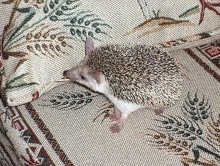
The problem was the hedgehog. We were going by train and were concerned that the x-ray machines at the station would either fry her or, at least, detect her. There's a certain greyness surrounding the laws on hedgehog transportation, so we didn't want to just say 'look, she's a hedgehog, and not even a sharp one'. And transporting animals in general tends to be a complicated business involving conditions and paperwork and other bureaucratic headaches. You have to put bags and coats through the machine, but there are no metal detectors for the person. All of which suggests that they don’t really care, and know there is no threat, but there is a kind of gleeful inertia about making people’ lives more difficult, and these pointless nuisances never seem to go away.  In all, it seemed best just to slip her into Mrs. Hickory’s trouser pocket and look relaxed and nonchalant.

I don’t know if you’ve tried looking relaxed and nonchalant with a hedgehog in the pocket of your trousers, but it isn’t easy. Especially when you know that getting caught will mean, at the very least, having to find some other way to make the journey, and possibly having to give explanations to people in uniform who might decide that they needed to confiscate the spiny stowaway.

It was with considerable relief that we discovered there is no security control for that kind of train, and so our possibly ill-conceived plan to distract the security men with the sheer strength of our nonchalance was never put into practice. The fraughtness of the morning thus ending, we were able to proceed to the country, where we are now enjoying all the things we usually do here.

The lakes are full, after all the rain in the mountains this spring, the waterfalls are gushing playfully, and wildlife seems fairly happy about it all, there are two large green lizards in the garden who have already learnt that we are a reliable source of cured meats, and now I am idly wondering whether I shall be able to avoid burning the barbecue this evening. Sometimes I do, sometimes I don’t. It doesn’t seem to matter much. The hedgehog is safely transported, we’re not going to worry about the sausages.

Sunday, June 3, 2018

2 Other House

Tom lived, that is, his body lived, in a normal sort of house in a normal sort of street. A quiet residential street, and a house that his mother was quite proud of, though she would have liked something a little bigger. That might have been why Tom thought the house was small; his mother often said it was. And he father said there was no need to move, but he too seemed to accept the house was small. Tom had little experience of other people’s houses, but he knew there were bigger ones, much bigger sometimes, even nearby. He saw them when they drove past. That might have been where his mother got the idea, seeing almost every day those houses that were bigger than her own.

He also knew his house was small because they were always in each other’s way, always bumping into each other, they never seemed to be alone. A house of the right size should have room for everyone to be by himself most of the time. What, after all, did they all want to be together for? The things he liked were not the things they liked. With his parents it was mostly boredom, dull chatter, being told what to do and what not to do and how not to do it. But he had to be with them much of the time because there didn’t seem to be enough rooms in the house.

Another proof that the house was small was that he knew every corner of it perfectly. It was impossible for that house to surprise him, there was no space for secrets. Not only the house on the lake, but the houses of his family and his friends, when he visited them, had secrets that they revealed slowly, but surely. Every time he went to one of those houses he discovered something new. That could only happen if they were big enough.

None of this really mattered to Tom. Things were as they were. He lived comfortably. He imagined no other way to live. He heard talk of poor people, starving people, people with diseases of a deadliness that did not exist in his world, sufferings that only existed in the speech of adults and seemed to refer to nothing real, but rather to images on the television, pictures coming from places so far away he could hardly be expected to believe they truly existed. These things, he assumed, were not actual lies, but a form of allegory, designed to show how lucky he was to have what he had, and as a form of warning of the divine punishment he could expect if he failed to be ‘good.’ Even as such they didn’t work well, or indeed at all, as he was unable to imagine anything of that sort happening to him, however bad he was. He was sometimes ‘bad’ and was punished, but not in a way that threatened his comfort, or that involved large numbers of people or that would make good television. So he could not understand why they created these images. It was one more thing that he did not understand, and he didn’t worry about it, either.

Monday, May 28, 2018

The Art of Street Communication


There was a group of people in the main square this morning, shouting and waving flags. There often are. This was supposedly about an ongoing industrial dispute, workers and their company not seeing eye-to-eye.

I wonder, as I often do, who they were expecting to listen to them. I have not followed the details of the dispute, but there is one and they may well be right, or at least, entitled to take action, negotiate, strike, make their case to other people, ask for backing.

But who was listening? Certainly not the people they need to talk to, or anyone who can help them. It is likely they were fooled by union leaders who said this would be useful. It will be, but not to the workers. It might get the union chap in the papers, and help justify his existence and his salary.

So who are they talking to? They were surrounded by anti-democratic symbols, communist flags, anarchist flags, republican flags, waved by the usual hairy layabouts who want to be given other people’s money because it’s easier than working (this is a small place, and I know who many of them are). No normal person is going to be drawn to sympathise, or even to learn more about the dispute, which, as I say, may be legitimate, because of the company they keep. ‘They’ are not talking to anyone.

This is a failure of communication, because the message they want to get across is not the one they are in fact delivering. They have not analysed the context sufficiently and so have allowed other people to deliver a message which will do nothing for the workers. The other big question in communication, after ‘What do you have to say?’ is ‘Who do you want to say it to?’ The workers, the ones with a problem that they are trying to solve, did not seem to have worked it out.

This being La Mancha, the shouting and waving finished at 1.30 and they all went off to drink beer. We are civilised people, after all.

Sunday, May 27, 2018

1 Lake


The boy’s mind lived on a lake. In a big house on a lake. He didn’t see the house as near or next to the lake, but on it. Not floating, just on it. People lived on lakes, after all. Not people like him, to be sure, but people in stories, or people you heard talked about. Pliny had lived on Lake Como. He wanted to live on a lake. And you had to live in a house, everybody did, so the house had to be on the lake. So his mind lived in a big house on a lake.

At the age of seven Tom was almost entirely mind. He had a body, he was a normal boy, and lived a normal boy’s life, but it was only his mind he was aware of. His mind could do what it liked, and the life his mind lived was by far the most interesting thing about him, even to Tom himself.

He knew the lake intimately. He moved about with confidence. He knew where the waves were, where to find shallow and deep water, where the fish always congregated. He knew the greenness of its borders, the part with rushes, the long grass, the worn place where a boat he never saw had been let down and drawn up over and over again.

It was not an especially large lake. It was as big as it had to be. Oddly enough, despite his detailed knowledge of it, he could not have said exactly how large it was. It didn’t seem to matter. It was very roughly circular, but flattened a little one side, indented on another, and the banks were full of imperfections which Tom thought of as perfections. He was used to talk of imperfections, in paintings mostly, but he always misheard the word and assumed it meant the little things which made something even better.

Usually his mind explored the lake from above, soaring high, at times skimming the surface to dip his hair into the crests of the waves. He rested on it too, and watched the birds in the distance trying to drink without getting their feathers wet, or the reflections of the clouds shimmering and breaking up and reforming in different patterns. The sky was always blue, but there were clouds in the water.

It wasn’t really a swimming lake. He swam when it was hot or he was annoyed about something. His favourite place for swimming was in the shallow water near the bank with the short, soft grass, because then he could lie in it to dry. But sometimes he swam in the deep water right in the middle, just to show it didn’t bother him. Swimming in pools, or in the sea when they went on holiday, he didn’t like very much. His body felt heavy and the water powerful. In the lake it didn’t matter.

He fished sometimes because there were fish to catch. No one else ever came to the lake to fish, or for anything else, so someone had to catch the fish. Tom didn’t use a rod and line, he didn’t know how to. He fished with his mind, relieving the lake of its piscine excess and passing the time happily, being part of it all. He couldn’t have given a name to the fish, they were just fish. Silver things about eight to ten inches long. Shiny, attractive creatures, with a bit of life about the eyes, moving languorously together in a group that never took any form but always seemed about to. The colours changed too, when they turned sideways and the lighter belly was visible. At times they all did it together, and it was as though a lamp had been shone on the water.

He didn’t eat the fish. He didn’t do anything with them exactly. He fished with his mind and they stayed there until they were forgotten. They went wherever fish do go when the fishermen have finished with them.

He knew the house well, too. It wasn’t important, but since there had to be a house he was glad it was a good house, a big one. His body had to live in a house that was much too small, and he didn’t like it at all. There were only the three of them and they kept falling over each other. And there were always visitors, as well. His mother loved guests.

So he liked the house on the lake because it was big and empty. Only his mind lived there, and no one ever came to visit, but the house was always clean and warm, and there was always roast beef and buttered buns whenever he wanted them. It was more or less a low box of light grey stone, with a lot of rooms he didn’t use but liked going into, especially the upper ones which were full of chests overflowing with wonderful objects that you could play with, dress up in or just look at for the sheer pleasure of having them. He found old dolls and cricket bats, lace bonnets and leather trousers, yellowed railway tickets to towns he had never heard of, notes and coins from faraway countries some of which he was sure no longer existed, ornate lamps for hanging on brackets or standing on tables, woollen blankets with initials sewn into them, pocket watches that still ticked if you shook them, hourglasses, single earrings, little tin boxes with pictures on the lid, cases made of calfskin and rubber for keeping things that had now been lost, wooden games that children played with long ago and still had most of the pieces, marbles and conkers, rock cakes so hard they were like real rocks, wigs and false moustaches, dried-up paints and tiny mirrors, plastic binoculars and metal knives with blades for doing a hundred different things, books with stories, magazines with pictures, albums half-filled with stamps or cartoons or newspaper clippings or scribblings in unreadable writing. There was always more to be found, always another passageway, a hidden door, and more treasure beyond.

All the rooms had large windows and a view of the lake. Most had the same view, his favourite one; the foreground speckled with water so close he could see the individual drops, giving way to a more even surface, then just a suggestion of silver-grey and in the background the lively green of the long grass that the birds loved to swoop over and which was always in the sun.

He had tried to explain this, once. To tell them where his mind lived and what this place was like. He had already learnt that it wasn’t a good idea. And it wasn’t just adults who wouldn’t listen; his school friends thought he was strange, too. So now he told no one. People didn’t like to hear things they weren’t expecting, things they had to think hard about to understand. They preferred to believe that they weren’t true.

At that age Tom never questioned the truth of things. Things were or were not. There was nothing to consider, to question, to argue, puzzle or worry about. People did, of course, but he knew that adults were rarely sure of things and were always worried about whether they were right. He knew they doubted themselves from the way they insisted so often that they had behaved correctly, as distinct from whoever they were talking about, who had invariably behaved badly. And they didn’t seem to convince anyone, even themselves. He wondered why this was, and whether he would become like it himself. He hoped he would not, and that he would never forget how to distinguish the truth. The truth is what is. The rest is false.

He didn’t question things but he knew others did not understand even the simplest things, and could not see what was, when it was in front of them, or someone was telling it to them. It was so much easier just to know, but adults liked to complicate things for reasons of their own, and they didn’t listen properly. Other children, children his age, real people, were usually afraid, and didn’t want to listen. So in the end he told no one and his mind shared its house with no one. He found it was better that way. He liked it more. He had wanted to share the house with his mother; he thought she would like it; it was big and probably difficult to keep clean but he would tell her he didn’t mind if it was untidy and a bit dusty. It would have been very agreeable to swim with her in the shallower water where she wouldn’t be afraid, and to fish with her for hours, resting above the water, moving only the eyes until they caught a flash of colour or the streak of motion, then the swift, effortless glide to collect the trophy by the pure exercise of desire.

But he had accepted that it could not be. His mother did not understand, and would never be able to join him. It was a disappointment but one that he had stopped thinking about. He had wondered if his friend Jeremy would share it with him, if only sometimes, but Jeremy had thought it was a game, and had tried to play it. Completely hopeless. Tom had become exasperated and had given up. He still played with Jeremy, in the places his body went, but they could not share the dwellings of their minds. He wondered where Jeremy’s mind lived, and assumed he could never know, any more that Jeremy could know the lake, where now his mind lived alone, and was happy that way.

He took little notice of his body, which was just something he had to carry round with him. He had little need to attend to it since others invariably did. He sometimes felt like eating, but he was never hungry as he was always fed before the feeling became uncomfortable. He was sometimes tired, but he was regularly sent to bed just as his eyes began to close. He was occasionally ill but that didn’t matter because everything stopped then, until he was better. He was used to those who complained all the time about their aches and pains, their likes and dislikes, their whims and appetites as though they expected other people to be interested in these things. Perhaps they were; adults seemed to talk about little else, and they were constantly absorbed in these conversations. Perhaps that was what conversation was; Tom himself had never found any particular use for speech; perhaps he would have to learn to talk about dull matters of no importance all the time, in order to become a proper adult; perhaps he could be a different sort, a better sort, of adult, a new kind. Perhaps he would never be one. He had been a child for ever so long, for as long as he could remember, for ever. He had never seen a child turn into an adult, such a change was outside his experience. Sometimes people spoke of ‘when you grow up,’ usually in respect of some fault they had seen in him which would have to be removed by some mysterious means before he reached that state. Or at times it was to ask ‘what he wanted to be when he grew up.’ He knew this referred to a job. He always said he wanted to be a surveyor, like his father, though he had no idea what his father did, except that when he talked about it it sounded very boring. In any case he didn’t want to grow up and he didn’t want to have to do anything. He had learnt, in this too, not to attempt to tell the truth. He had once said he wanted to be a fisherman, as in the only thing he liked doing that adults did for money. A thousand questions had followed, questions that showed incomprehension, horror, misdirected curiosity, and the inevitable urge to persuade him he was wrong. There was talk, which didn’t include him but didn’t explicitly exclude him either, of finding out what was behind it, of how it was just a phase, of how he would grow out of it, or would respond to reason. Tom understood none of this; only that he had given the wrong answer, and to seek to tell the truth was a serious mistake. So he said his magic word, almost meaningless, in response to this question, and everyone seemed happy with it and no one asked questions.

He disliked being spoken to, partly for this reason. You rarely knew what they expected you to say- to give the wrong answer was to become the centre of all kinds of attention, the wrong kinds. You couldn’t know the right answer, except to the questions that were constantly repeated, and which you learnt to answer through experience. The truth was no guide. They didn’t like the truth. He didn’t understand why this was, because they always demanded the truth, reminded him that good boys told the truth, but it was very clear that they did not want to hear the truth. You had to learn the answer to every question, a complicated task he hoped he could avoid for a long time. His mind was happy on the lake. No one tried to trick him with questions, or with lies.

Saturday, May 26, 2018

On the Supposed Fatness of Spaniards


I have just remembered that blogging involves reading the Guardian.

Thisarticle says that Mediterraneans are the fattest people in Europe, naming Spain specifically. I find this very odd, because I don’t know where all these fat people are.

Not only do I live in the south of Spain, but I interact daily with large numbers of teenagers and young people (I was very bad in a previous life, I suspect) and very few of them are fat. Casting an eye over the groups I was teaching this morning, sizing them up as it were, I don’t think one in ten, one in twenty, could even be described as slightly fat, let alone obese. Chatting breezily with colleagues, the number of children we might refer to as ‘that fat one’, is very small indeed. In the street, also, by way of experiment, I tried applying the first adjective that came to mind to those I passed, and ‘fat’ crossed my mind very rarely.

I also know that, to my students, eating fruit is a natural and enjoyable thing, we have conversations about which are their favourites, which is hard to imagine with English children, and most of them play some kind of spot regularly, again, it is a natural thing to do.

On the other hand, I visit England most summers and I am always struck by how big people (and dogs) are. Bulging thighs and upper arms, flabby stomachs and wobbly jowls seem to be everywhere you look.

South Americans and gypsies tend to be big and flabby around the backside and the midriff, but there have always been gypsies here, and I doubt if the recent increase in South Americans is large enough to skew the figures that much.

So I declare myself non-plussed, but I offer these observations from the theatre of action anyway. Perhaps someone can shed some light.

Friday, May 25, 2018

In Which I Roll up my Sleeves


Well, I’ve been wiping the dust off this thing and generally sweeping up a bit, replacing old tubes and so on, winding the cobwebs round a dried-out quill I found in the corner and feeding the fresher parts of the dead rats to the hedgehogs, with some vague idea of casting my thoughts into the ether once more.

Why, you may ask? And it’s a good question. One of the ways I keep body and soul together is, essentially, by teaching people to communicate. I teach them how to speak English, but at the higher levels it’s largely a question of training them to speak in public, to write transactional letters of different kinds, to use English in real life for important purposes. In other words, to communicate.

At these levels, the problems I encounter are more to do with poor communication skills than poor English skills. One of the things I impress upon them, and it’s surprising how hard this can be for young people to understand, is that when you open your mouth it’s quite useful to have something to say.

I have convinced myself I have, once more, things to say to the world (at least, to that very specific and select corner of it that drops by here.

There will be ranting, there will be sport, there will aperçu, there will be education and politics, there will be pedestrian philosophy and abject self-promotion. Oh, and there will be hedgehogs, naturally.

Monday, February 15, 2016

Learn a language in 2016, Britons are urged


The British Council has urged people to learn a new language in 2016. Fair enough, it’s a good idea in itself, and such promotion is part of what the BC does. But is it really a good idea for most people? What do they gain from it?

As pointed out in the article, it can make holidays more fun, enabling you to interact with the world around you rather than simply observe it. The advantages of this range from simply asking where the bathroom is or buying a ticket at the railway station, to the less practical but far more interesting ability to read the local newspapers and hear what people are talking about. Understanding what is going on around you and learning what matters to people are a far better way of getting to know a place than just reading the guide book and staring at churches.

A language is a route into a culture, the literature is has produced, the way it is currently moving, how it thinks and behaves, its moral values and personal assumptions. All of this can be quite fascinating and instructive.

A language is an unusual addition to a CV in England, and so can be attractive to an employer. Attractiveness to employers is a very good thing indeed.

There has long been a kind of understanding among English people that any foreigner worth talking to already speaks English. This is true up to a point, but not much of a point. English is the lingua franca of business, culture, politics, communications, and most things that matter to people around the world, but there are a lot of things going on in other languages that we miss, and might not want to miss.

Learning languages is, then, in my opinion, an excellent thing. I make my living helping people to do it, after all. But there is another side to the question.

Learning a language talks a very long time. Several months of immersion, or years of classroom study, to acquire basic competence, and basic competence is rarely enough for anything more than a tourist. As I frequently have to point out, half a language is no use to anyone, so unless you can achieve the right level of competence you are unfortunately wasting your time.

In Spain, professionals and aspiring professionals know that they must have a high level of communicative competence in English, and they work hard to achieve it, and their parents spend a lot of money to help them achieve it. The Spanish education system only aims at providing a B1 level, which is not an independent user level, and is no use to an employer. It might just do for a traveller. In any case, it usually fails to provide even that, which is great for my business, but not so great for the average Spanish student, who can’t afford private tuition over a period of years, or may not realize until it’s too late that what he’s been promised by his high school is not enough.

For a Spanish teenager with ambition, or for their parents, the effort and the investment are certainly worth making. For a young English person, possibly not, unless you have a very specific professional goal in mind, such as diplomacy.


So do listen to the British Council and learn a language this year. You really will be opening up all the possibilities that they offer, but be aware of the time and effort, and money, it will involve. Also, once you learn one language, and open up a culture you were barely aware of, you won’t want to stop.

But that, I imagine, is where the real fun lies.

Sunday, February 14, 2016

Murray Dreamed a Dream


O Henry was one of the greatest craftsmen of a particular type of short story. He almost invented the type, in fact, and did it so well that no one has quite been able to copy it. You know an O Henry story when you see it, and you read it because it's his. When he died he left this story incomplete. He had written the opening, and left a few notes about how it should continue and finish. I don't know that anyone has tried to finish it before, so I've had a go. The result, for what it's worth, is below. The first half, roughly, is O Henry's. The rest is mine. My apologies to the shade of the great man for taking the liberty:

Both psychology and science grope when they would explain to us the strange adventures of our immaterial selves when wandering in the realm of "Death's twin brother, Sleep." This story will not attempt to be illuminative; it is no more than a record of Murray's dream. One of the most puzzling phases of that strange waking sleep is that dreams which seem to cover months or even years may take place within a few seconds or minutes.

Murray was waiting in his cell in the ward of the condemned. An electric arc light in the ceiling of the corridor shone brightly upon his table. On a sheet of white paper an ant crawled wildly here and there as Murray blocked its way with an envelope. The electrocution was set for eight o'clock in the evening. Murray smiled at the antics of the wisest of insects.

There were seven other condemned men in the chamber. Since he had been there Murray had seen three taken out to their fate; one gone mad and fighting like a wolf caught in a trap; one, no less mad, offering up a sanctimonious lip-service to Heaven; the third, a weakling, collapsed and strapped to a board. He wondered with what credit to himself his own heart, foot, and face would meet his punishment; for this was his evening. He thought it must be nearly eight o'clock.

Opposite his own in the two rows of cells was the cage of Bonifacio, the Sicilian slayer of his betrothed and of two officers who came to arrest him. With him Murray had played checkers many a long hour, each calling his move to his unseen opponent across the corridor. Bonifacio's great booming voice with its indestructible singing quality called out: "Eh, Meestro Murray; how you feel--all-a right--yes?" "All right, Bonifacio," said Murray steadily, as he allowed the ant to crawl upon the envelope and then dumped it gently on the stone floor.

"Dat's good-a, Meestro Murray. Men like us, we must-a die like-a men. My time come nex'-a week. All-a right. Remember, Meestro Murray, I beat-a you dat las' game of de check. Maybe we play again some-a time. I don'-a know. Maybe we have to call-a de move damn-a loud to play de check where dey goin' send us."

Bonifacio's hardened philosophy, followed closely by his deafening, musical peal of laughter, warmed rather than chilled Murray's numbed heart. Yet, Bonifacio had until next week to live. The cell-dwellers heard the familiar, loud click of the steel bolts as the door at the end of the corridor was opened. Three men came to Murray's cell and unlocked it. Two were prison guards; the other was "Len"--no; that was in the old days; now the Reverend Leonard Winston, a friend and neighbor from their barefoot days. "I got them to let me take the prison chaplain's place," he said, as he gave Murray's hand one short, strong grip.

In his left hand he held a small Bible, with his forefinger marking a page. Murray smiled slightly and arranged two or three books and some penholders orderly on his small table. He would have spoken, but no appropriate words seemed to present themselves to his mind. The prisoners had christened this cellhouse, eighty feet long, twenty-eight feet wide, Limbo Lane. The regular guard of Limbo Lane, an immense, rough, kindly man, drew a pint bottle of whiskey from his pocket and offered it to Murray, saying: "It's the regular thing, you know. All has it who feel like they need a bracer. No danger of it becoming a habit with 'em, you see." Murray drank deep into the bottle. "That's the boy!" said the guard. "Just a little nerve tonic, and everything goes smooth as silk."

They stepped into the corridor, and each one of the doomed seven knew. Limbo Lane is a world on the outside of the world; but it had learned, when deprived of one or more of the five senses, to make another sense supply the deficiency. Each one knew that it was nearly eight, and that Murray was to go to the chair at eight. There is also in the many Limbo Lanes an aristocracy of crime. The man who kills in the open, who beats his enemy or pursuer down, flushed by the primitive emotions and the ardor of combat, holds in contempt the human rat, the spider, and the snake. So, of the seven condemned only three called their farewells to Murray as he marched down the corridor between the two guards--Bonifacio, Marvin, who had killed a guard while trying to escape from the prison, and Bassett, the train-robber, who was driven to it because the express-messenger wouldn't raise his hands when ordered to do so. The remaining four smoldered, silent, in their cells, no doubt feeling their social ostracism in Limbo Lane society more keenly than they did the memory of their less picturesque offences against the law.

Murray wondered at his own calmness and nearly indifference. In the execution room were about twenty men, a congregation made up of prison officers, newspaper reporters, and lookers-on who had succeeded in getting permission to make sure Murray got the end that had been ordered for him. They had their own reasons, some of them. Others had none beyond curiosity.

Murray took in the prison warden, the doctor, an anonymous man who he knew would be the one to throw the switch. Some other time he would have found the face interesting, it surely had much to say, but now it meant nothing. The man had a job to do, no more. He thought he recognised some of Ginny’s folks. Not her mother. Poor woman, she had got old very suddenly, but she didn’t hate Murray enough to be there. He wondered if she wanted to hate, for the hate to give her courage so she could watch how it ended. For a moment it stopped him thinking about her father and that brother of hers who would likely be where Murray was some day. They were there, and Murray wondered if he should greet them. He smiled at himself.

The chair was to his left. They turned him and guided him towards it. It was a long time since he’d done anything of his own free will. As he was gently led he accepted the chair as part of all this. His life, the good times, when it all went wrong, what he had done to the girl, Len, Bonifacio, the man who came this way yesterday and whose name he had forgotten, the things that seemed so distant, and the games he had played in the prison, the conversations with those he was allowed to be around, empty talk it was now, meaning nothing; it all led up to this. It all made sense. His life was meant to come here.

Yet suddenly he was filled with horror. No, it should not be this way. He took in again the people and the events around him, he understood what they were doing, but it was not for him. It couldn’t be. He wasn’t the man they wanted. He dimly felt the straps being fastened. This was wrong, thought Murray. He understood that he had done nothing. He should not be there. The scene faded and he no longer saw the guards nor felt the straps nor smelt the old burnt wires within the machine that was meant to kill him. He saw what should have been, what was.

His life was suddenly before him. There had been no fight, no killing, no trial. There was no chair, no straps. He was in a brightly-lit room, where the sun shone on cheerful yellow walls, a warm carpet and wooden furniture he had made himself after his neighbour Pete had patiently taught him how to handle hickory. There are two paintings on the walls, small, framed landscapes, and a series of photos, portraits of men and women looking uncomfortable in clothes they weren’t used to wearing. His family and his wife’s, of course.

Through a curtained window is a garden with a lawn and a resplendent flowerbed, immaculately kept, and beyond it a wood filled with colour. The beauty of the scene was arresting, breathtaking even, and for a moment Murray couldn’t take his eyes from it. The room, the house, surrounded by that garden and that patch of nature, made a picture so idyllic he could hardly bear to believe it was real. And yet it surely was. It was his house. Murray felt a wonderful calm, a great peace. This was his house and his life, and it was as perfect as he could have imagined. Looking about him he could see his father-in-law’s photo, the tie badly tied because he had lost patience with the photographer. Murray smiled as he remembered that moment. There was a mark on the side of the kitchen table where the saw had kept sticking and even a plane and a lot of coarse sandpaper couldn’t smooth it away. They had left it that way and they laughed about how Murray had made his mark on his house. He would run his fingers across it as they sat down to eat.

There was a woman in a rocking-chair under the window, letting the sun play on the face of the baby she held. He greeted her and she addressed him as ‘darling’. She raised the baby’s hand as though to wave to him. She was Murray’s wife, the child was his child. He felt the joy that it caused him to see them and to know that they were his family. He knew that he had always felt and would always feel that same joy. She rose and came towards him. He took them both in his arms and kissed them.

At that moment the warden gave the sign and the current shocked through him. Murray had dreamed the wrong dream.

Saturday, February 13, 2016

Teaching Huckleberry Finn

There is a specific problem with teaching this book. There is a word in it that some people don’t like. (Most people, in fact). It’s a fine book, a borderline classic. It would be a great shame if people stopped reading it for fear of a word. Is it better to change the word ‘nigger’, where it occurs, to stop publishing the book, remove it from libraries, stop worrying about it, or when encouraging children to read it, explain why it uses that word, and its significance in that context?

Banning books is not civilized, and is almost impossible in practice, anyway.

Changing the word to something else is possible, and has been done before, but it’s a matter for the publisher. The book is out of copyright and freely available in electronic form, and I can’t see Gutenberg or Amazon or anyone else bothering to make that change. Many books have things in them that a lot of people don’t like.

I don’t believe the bad word should be forcibly removed, and the idea of Bowdlerization of any sort does not much appeal. The author wrote what he wrote and he did so for reasons which we cannot always understand, or even know. In the case of Huck Finn, the word is largely used by Huck himself, is not usually derogatory in any way, and it is certainly not an expression of hate.

I have never used the book in class, but I was thinking about it, partly because of some discussion I saw about this very matter. If I did, the word could be used as one of many internal devices for interpreting the internal and external context of the book.


This is great in theory, but the theory would clash rather badly with reality if that reality were a black student in the classroom. There aren’t many here, hardly any in fact, and the word doesn’t have the same cultural implications, but in the English-speaking world, to try to explain that an expression that  a black student has been told all his life means that someone hates you, and that he may well have experienced as such on a number of occasions, that he'll just have to lump it because that's what Twain wrote, is not quite so easy as it sounds.

I imagine it could be handled by asking the students what they think, negotiating among several options. Treating students as responsible, mature people is a good way of helping them to act like it, and to become like it. It would depend on the nature of the class. It's easy for a teacher to conclude that it's not worth the trouble, there are plenty of good books to read. I understand that position, but it can very instructive to work out a way of introducing difficult stuff in the classroom. It invariably means communicating with individuals, which is why it's rewarding for everyone, and why making some blanket policy, or talking in vacuo, doesn't work.

As a result of these idle ponderings I am about to read the book again. My thoughts may appear here in a few days.

Wednesday, January 6, 2016

Assumptions and Motivations

There is an assumption, a set of related assumptions in fact, behind all of these observations, comments, criticisms and proposed solutions, an assumption that may not be shared by all readers. The assumption is that the purpose, the only important purpose, of education, is to prepare young people to make the most of their future in the world.  This view is certainly not shared by most of the people who create and maintain our systems of education. The main aim of this work is to encourage people to consider and come to share that assumption, but those who do not initially share it may well be rather mystified by much of what I have to say.

That assumption, so easily and regularly forgotten, is something I can never forget, because of the other major motivation of this blog, which is not theoretical but personal and practical:

I benefitted enormously, to a degree that can scarcely be overstated, by having parents who understood that hard work brings a better life, and transmitted this idea by their daily example (which is the only way that actually works). This combined with the luck of having a decentish brain, and going to very good schools (in the case of my primary school because we were Catholics, and the Grammar school because it still existed and I found a way through the 11+).

A lot of luck, yes, but that combination of circumstances should be, and could be, much more readily available than it is. Even the example, which cannot always, or even often, come from parents, but there are other people who could give that example. I have seen now a generation of children come and go, and the majority have had to settle for far less than they might have had, for reasons that do not need to exist, and without ever really understanding that things could be different.

John Steinbeck, who I quoted a few days ago, and who came to understand the art of teaching (which most teachers do not possess) said that good teachers do not tell, they catalyze a burning desire to know. An education system should not process and control children, it should inspire them, most of them, to desire and demand a future and an intellectual life which can turn them into something they never imagined they could be.


I have spent many years observing a number of different forms and systems of education, in two different countries, and reading a great deal about others, that once existed, and that exist now in other countries. In the course of those years I have identified many failings, deficiencies so great, so damaging to the people whose lives they affect, that they must be solved, and yet I have seen little or no understanding of that imperative need, or will to seek solutions, in those who are involved and in a position to do something about them.

Monday, January 4, 2016

What should not be taught in schools


The use of schools to solve other social problems that arise when children cannot easily or comfortably be supervised by their parents, causes many more problems in the schools themselves. The need to fill a complete timetable, and to follow to some degree the model of the public boarding schools, coupled, naturally enough, with the desire of government to control growing minds, led fairly quickly to the creation of subjects which should not be taught in schools at all. If they were removed from the timetable, the school day would be much more reasonable, could address its real aims more clearly, and some activities which children learn to hate could be understood as fun.

Much of what schools do is unnecessary. Many subjects should not be taught, some because they are simply a waste of time, like religion, ethics, ciudadanía and the other ways of telling people how they should behave according to some fashion or other, and some because they are far better provided in another way. Churches are always willing to instruct the young in their beliefs and codes, and sport and the plastic arts are far more enjoyable if done freely at a municipal or private facility rather than under the full disciplinary structure of a school as they now are. Within useful subjects, a great deal of time is wasted with unnecessary material and in attempting to measure knowledge, rather than provide it and teach how to use it. And of course, the biggest problem of all is that many of the people who are forced to be there are not in fact going to benefit from it, but their presence will prevent others from benefiting.

There is no reason for schools to teach religion, unless that is one of the specific purposes of the school. Otherwise, it is a waste of time. Parents who want their children instructed in their own faith, or in some other, will find plenty of people willing and able to do it for them, freeing children two or three hours a week.

Likewise sport and art, which should be enjoyable activities done for pleasure. If there were places children could go, and choose the activities that attracted them, they would enjoy them much more, and schools, and the taxpayer, would save a fortune on all the facilities that have to be replicated unnecessarily in every school in the country.

I am not, of course, suggesting that children should not study their parents' religion, or that they should not do sport or learn art. The point is that schools are a bad place to do it.

Saturday, January 2, 2016

Conversation with the Natives


In their constant struggle to improve the quality of education in this country, the relevant authorities forever miss the very point of it, create obstacles when they mean to smooth progress, ignore the people who actually know what needs to be done and how to do it, pay scrupulous attention to the interests of everyone but the children, for whose benefit the system is supposed to exist, and generally create more and more regulation and paperwork to less and less effect.

So it’s quite unusual for someone in government to say something intelligent on the subject. The surprising news in this case is that President Rajoy has suggested that there should be conversation classes with native speakers in schools, to improve the level of English. This is a good idea. If anything comes of it, it will be done badly, ineffectively and at unnecessary expense, but the idea is sound.

First, some background. The focus in Spanish schools is on grammar and vocabulary, because those who decide these things lack imagination and experience, it’s much easier to justify the marks you give if they come from written exams, and it’s difficult to do useful oral activities with groups of 30 or so pupils. Some would see these as problems to be solved. In fact, they tend to be seen as excuses not to try to do things better.

The aim of the recent Education Law is that pupils who leave High School at 18 should have a B1 level of English. For those of you who understand these things, that is Cambridge Pet level, and you will recognize the problem. It is not an independent user level. It is half a language, which is no good. You can’t actually do anything with it that a company, a University, or you yourself, can use. A B1 level does not allow you to answer the interview question ‘Do you speak English?’ with a ‘Yes.’

Also, needless to say, the aspirations of government when they wave their hands about and create these documents are not always fulfilled. Most children don’t even reach the low level that is set as the target. The result is that the great majority of Spanish youngsters leave school with a very limited knowledge of English, a bit of useless baggage that has cost them thousands of hours of wasted time, and doubtless many arguments and punishments along the way. This is not the way to do things.

The idea, though, that the purpose of language is communication, is not really recognized by the system in use. Anything that changes that perception is good. It really is like riding a bike. You are more likely to reach your destination if you actually have somewhere you want to go.

Conversation with Natives

Just to clarify:

Conversation (communication) classes with a native teacher are an important part of the process of learning a foreign language. In the case of younger (preschool or primary) children, this is because the naturalness of the accent* and the prosody (primarily intonation, and this is often underestimated or not understood) contributes greatly to the way the foundation of learning is built. They will mostly be hearing native speakers in the resources used to back up the class, and on the television and in the songs they hear and sing, and the natural rhythms of a native speaker reinforce the memory and the ease of use.

For older students this is much less important, but a native speaker, one who grew up in a cultures where the language was part of life, can provide a much more interesting background to the conversation, which adds a lot to motivation, and leads to real communication.
When I say native teacher, of course, I do mean teacher, not some random unemployed graduate found on the streets of London or Dublin or San Francisco. Teaching is not nuclear physics, but it requires competence and experience.


*it doesn’t matter all that much where it’s from, or what kind of education it denotes, as long as it’s something that most of the English speaking world would understand and accept

Friday, January 1, 2016

To Dub or not to Dub…


It was suggested recently by the President of Spain that TV should stop dubbing films and series into Spanish, as this would help improve the level of English of young Spaniards.

Even though this is almost certainly true, and the experience over many decades in countries like Sweden, Norway, Holland and Germany is that exposure to English in TV programmes from a very early age is one of the reasons for the extremely high depth and breadth of competence in English, the government is obviously not “mulling” a ban on dubbing, nor would it be right to do so.

I doubt it has any authority to do it, for a start, but there are other reasons it’s a bad idea.

There is a very good dubbing industry in Spain, and many of the voice actors are better than the Hollywood people they replace. (For some reason Hollywood doesn’t require its stars to be able to communicate like normal human beings, let alone like performers). I often prefer to watch in Spanish because they do it better, and they turn down the background noise, too. “Let’s annoy the luvvies by stopping them working” is not usually seen as good politics, especially when they are actually doing a good job.

Also, although it might benefit, undoubtedly would benefit, suitably motivated youngsters, older people would probably be a little miffed at suddenly not being able to watch the TV because the government has said so.

Another point is that the key is motivation. If you don’t find a way to motivate the young to want to learn, playing around with what’s on the telly is only going to annoy people, and achieve nothing. That motivation is one of the major failings of government in regard to Education.

And another important point is that they are far too late. With digital television and polychannel platforms it has been possible for at least 13 years to watch hundreds of different series on dozens of different channels, in the original version- which almost invariably means English- if you so choose. Some choose to, some don’t. I encourage them to do so if they find they can still enjoy the programme that way, and explain why. Government meddling would cause a lot of harm and would, in practice, change nothing.


The fact that they are thinking about such things, however, and understand something about how the desired results might be achieved, is a step in the right direction.

Thursday, December 31, 2015

Why do Spaniards not Speak English

It is perfectly possible to teach young Spaniards to speak English to a good enough level to study or work abroad, or work in Spain in one of the many professional fields that require high competence in English (most jobs worth doing, these days). That means B2-C1 level, for those of you who understand these things.

I know it is possible because I have been doing it successfully for years. I know why schools fail to do it, and I know why that isn’t going to change, probably for decades.

The technical probably with teaching here is that it doesn’t focus on communication. Mixed groups of 30 children, the need to justify marks, which dictates the kind of exams to be used and the material to be examined, the interests of powerful Unions that take precedence over those of children, the monumental lack of imagination and the general ignorance of those who make the laws and design the system.

It is widely recognised that proficiency in English is a basic skill, but the state system is quite unable to provide the means to gain that skill. It is not even capable of transmitting the idea it is possible to learn English well, let alone of transmitting the motivation required to do it.


As I frequently point out, not always to universal understanding, in England even the village idiot speaks English. It really isn’t so hard, but in the absence of saturation, it takes a lot of work. But it can be done, and I’m not the only one who knows how to do it. The problem is that those who think they should have a monopoly on Education, don’t know how to do it, and are not trying to find out.

Wednesday, December 30, 2015

Steinbeck on Teaching


"On Teachingby John Steinbeck

      It is customary for adults to forget how hard and dull school is. The learning by memory all the basic things one must know is the most incredible and unending effort. Learning to read is probably the most difficult and revolutionary thing that happens to the human brain and if you don't believe that watch an illiterate adult try to do it. School is not so easy and it is not for the most part very fun, but then, if you are very lucky, you may find a teacher. Three real teachers in a lifetime is the very best of luck. I have come to believe that a great teacher is a great artist and that there are as few as there are any other great artists. Teaching might even be the greatest of the arts since the medium is the human mind and spirit.
      My three had these things in common. They all loved what they were doing. They did not tell - the catalyzed a burning desire to know. Under their influence, the horizons sprung wide and fear went away and the unknown became knowable. But most important of all, the truth, that dangerous stuff, became beautiful and precious.

Teaching, good teaching that is, is indeed an art, both a creative art and a performing art. It is one of the situations in life which turns human interaction into an art form. The teacher needs to attract and hold the attention of the student, provide, at all times, an answer to the question, 'Why am I sitting here listening to this bloke?' You have to be worth listening to. And you have to find ways to communicate something difficult to understand to someone who has no particular reason to want to understand it. If you can't do that you shouldn't be teaching.

The reality of good teaching that Steinbeck remembers is a long way from 'sit down, shut up, study chapter 5, the exam's on Friday, don't look at me, teach yourself or there'll be trouble' which is the idea a lot of teachers have, and a lot of children, as they've never known anything else.

If the teacher doesn't know why the children should learn what he's teaching them, they won't learn it. Learning should be cooperation, not attrition, not conflict, not the ticking of boxes, not getting through the day. Give me children who want to learn, who are keen and sharp and have enthusiasm for life, the present and the future, who understand the importance of learning not in a dry, theoretical sense, nor a profound, mature, analytic way, but in an immediate, unreflecting, this-clearly-matters-now kind of way. Where to find such children? Give me good teachers, and I'll make them for you.


Sunday, September 28, 2014

A New Alcuin

It's been a bit quiet around here lately. The urge to write about the strange mishmash of things which occupy my mind at different times and to share the results with the world seems to have died. It could return, but I don't know when.

I have just started another blog, about education, the problems that exist, the causes of then and how they might be addressed, possibly solved. It cannot be what I would like it to be, as I don't have the time (and probably not the competence) to do the research and organization that would be necessary. So it will be a series of presentations of my ideas about large and small points related to education and teaching, comments on relevant news items, attempts to attract the interest of people who can change things, occasional ranting, both generalized and specific, and the odd piece about hedgehogs.

If you want to join in, please head over to A New Alcuin (there's a link on the blogroll, too) and agree, argue, correct, set straight, clarify, exemplify, add important detail, be it broadening or widening, or just give encouragement. Because education matters, and I can't change the world on my own.