Monday, January 28, 2013

Hedgehog News


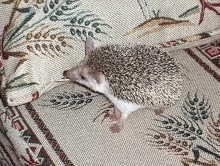
I am fairly sure he’s enjoying this as much as he seems to be. Crispulito doesn’t get blow-dried, in fact, because by the time we’ve finished with the bath we are both in the mood for a little of that absence which makes the heart grow fonder. Water is not his thing. He is from the desert, after all. And he only gets washed in the summer, so we let him run around outside for a while and he dries naturally.

A few years ago one of the hamsters, in the course of an exploratory trip around the kitchen, fell into a pan of oil. I showered her carefully with hypoallergenic shampoo (that isn’t advice, by the way, it’s just what occurred to me at the time- see the old joke about the man whose cow fell down a hole) and blow-dried her at some length. She thought this was terrific fun, and was most put out when we finished. She stretched and preened in the warm air like a supermodel on a beach pretending she hasn’t noticed the cameraman.

In further news, it might interest readers to know about the sonic hedgehog homolog. There is, in the human genome, a bit that is known as the hedgehog protein, because the absence of it in Drosophila causes them to be shrivelled and prickly. There are a number of variant homologs in man, known as the desert hedgehog, Indian hedgehog and sonic hedgehog homologs (DHH, IHH and SHH). They seem to have some role in the transmission and processing of signals by the nervous system. We erinacidae turn up in very unexpected places.

Sunday, January 20, 2013

Seeking the Sun

Like many birds, retired people and, in the old days, sheep*, I go south for the winter, despite being none of those things. In my case it’s little more than a symbolic few days in the New Year, what with work and real life and that kind of thing getting in the way, but we always do it. Despite the heat of summer here, the winters are cold, and it breaks the tedium of frosty mornings and overcoats.

This year, like last year, we only got as far as Málaga. It’s easy to get to, and it’s far enough for the purpose of thawing out the limbs and getting the blood to return to the tip of the nose, one of the many little annoyances of winter. Málaga has beaches, mountains, restaurants and… well, do we need anything else? Oh, and a bit of history as well, having been founded by the Carthaginians and occupied by the Moors for centuries. They left a great fortress overlooking the city and the sea which is worth climbing up to if you’ve never done it before. A good way to earn your beer and grilled fish, too.

We spent the days running on the front, walking along the beach, eating in the beach restaurants where the sardines are grilled on spits in little boats, and watching the world go by. It takes some curious shapes down there. After all, if you were a tramp or a backpacker or a squatter or a traveller in search of truth and spiritual freedom, where would you spend the winter?

We went one day to walk in the Torcal, which is an extensive area, about 5 sq miles, of karstic formations 4,000ft up near Antequera. It’s a very tricky place to scramble around, and easy to lose your footing and break an ankle or bang your head, but the extraordinary landscape of rocks, the colours of the vegetation, the clearness of the air and the agility of the goats make it a good way to spend the day. We made it back without accident and allowed a few cobwebs to be blown from the mind. On the way down there are a number of home-style restaurants where the tissues may be restored at a reasonable price. So we did.
During those days I rediscovered the writer Saki, who I had more or less forgotten existed. I read his Chronicles of Clovis, and they are fun, fresh, clever and he cares nothing for the sensibilities of the reader. If you don’t like him you can put the book down but he isn’t going to be nice just to keep your custom. He clearly influenced Wodehouse, in style, though not in the brashness of his repartee. I tried to collect a few quotes to illustrate what I mean, and why you should read him, but out of context they seem to lose their shine. In any case, I offer some snippets to tempt the reader:

Constance is one of those strapping florid girls that go so well with autumn scenery or Christmas decorations in church. "

Constance shuddered. 'Do you think the poor little thing suffered much?' [of a child eaten by a hyena] came another of her futile questions. "'The indications were all that way,' I said; 'on the other hand, of course, it may have been crying from sheer temper. Children sometimes do.'

There's nothing in Christianity or Buddhism that quite matches the sympathetic unselfishness of an oyster. Do you like my new waistcoat? I'm wearing it for the first time to-night."

My mother is thinking of getting married." "Again!" "It's the first time." "Of course, you ought to know. I was under the impression that she'd been married once or twice at least." "Three times, to be mathematically exact. I meant that it was the first time she'd thought about getting married; the other times she did it without thinking. As a matter of fact, it's really I who am doing the thinking for her in this case. You see, it's quite two years since her last husband died." "You evidently think that brevity is the soul of widowhood."

"Well, it struck me that she was getting moped, and beginning to settle down, which wouldn't suit her a bit. The first symptom that I noticed was when she began to complain that we were living beyond our income. All decent people live beyond their incomes nowadays, and those who aren't respectable live beyond other people’s. A few gifted individuals manage to do both."

[I] was eighteen on my last birthday." "On your last two birthdays, to be mathematically exact." "Oh, well, that's not my fault. I'm not going to arrive at nineteen as long as my mother remains at thirty-seven. One must have some regard for appearances."

And I especially recommend MRS. PACKLETIDE'S TIGER.


*The history of transhumancia is one of the lesser-known tales of the past of Spain. For centuries, and into living memory, though not mine, thousands of shepherds drove flocks of sheep hundreds of miles south in the winter and north in the spring, following the pastures and the markets. They slept many months a year in the open, or in makeshift tents and shacks, barely ever washing and never changing their clothes. If Hollywood were in Spain they would have turned them into heroes, and we would all sing songs about them, and want to be them when we played games as children. Now it has gone for good, and good riddance. It was a very tough way to live, but seen from a distance, there is romance and beauty in it.

Tuesday, January 1, 2013

In Which I Exhort the Reader in Latin


New Year's Day.  Nunc coepit, as I learnt to say regularly years ago. A moment for taking a deep breath and starting to  do things better. There are always things you want to do, to feel better, to earn more, to give satisfaction, to learn, to make more of this brief time that is life. It is always a good moment to begin again, to do things better, to try harder, but today it is easier to do it properly. Many people seem to have difficulty doing it at all, and use today as a moment to create yet another monument to failed ambition, or rather unfulfilled desire. Well, I shall try, at least, not to be like them.

Will is not something you have, it is something you do. If you want things to happen you have to go out and do them. Wanting, wishing, hoping, idly thinking how great it would be if such and such occured, by magic presumably, is not going to achieve anything at all, except frustration and the continuation of the same situations you dislike.

have said many times that the greatest secret in the world is that (almost) anything is possible if you go out and do it. The kind of people who have wait for a particular day in order to find the courage
To act are unlikely to achieve much. Any day, any moment is a good one. Happy New Year to all who drop by. Nunc coepit is a great incantation. So is carpe diem. Use them often and well.

Monday, December 24, 2012

Surely it's not Christmas again?

I like Christmas. I always have. Wherever I have been and whoever I have celebrated it with I have always found an atmosphere of genuine goodwill, happiness and the desire for peace. My good fortune, no doubt. Others will have less happy experiences to tell of, but for me Christmas brings the expectation of human warmth in the depth of winter, and as such I look forward to it and enjoy it like a child.

So whether you will be celebrating the birth of Christ, just having a day off with your family around you, or quaffing Scotch and muttering 'bah, humbug' to yourself and random passer-by, I wish you the very best, and I hope you will enjoy these days as I intend to.

To help the enjoyment along I offer a selection of songs about Him who will be born this night. First a confused attempt to reconcile faith with alcoholism, resulting in a sore head and increased existential angst.


Then, on a happier note, we have Bobby Bare with the definitive Christian football waltz (a limited genre, but a fine one nonetheless) requesting that Jesus 'drop kick him through the goalposts of life


And finally, Terry Allen picks up a divine hitchhiker late one night. As they say in Hollywood, it doesn't turn out as planned... The line at 3:18 is a classic that still makes me laugh out loud.


Hope you enjoyed that. Once again to all who have taken time to read any of my ramblings, and especially to those who have commented on them, all the best for a very Happy Christmas.

Saturday, December 22, 2012

Crowd Control and Self-Fulfilling Fears


Up  to the minute as ever, I’ve been wondering about the enquiry into the deaths at Hillsborough stadium in 1989, and the context in which it happened. To pick the enquiry and the report to bits would take a great deal of time and effort, so it’s a good thing for me that it isn’t my intention to do it. It would be both lazy and cynical to think that, just as at the time, and in the prevailing mood, it was easiest to blame the fans, now, when the public mood has changed, and everyone in a position of responsibility that day is dead or retired, it is easiest to blame the police. Lazy, cynical and possible false.

It is likely that none of those who died that day were directly responsible for the events that led to their deaths. It is not my intention to suggest otherwise. But one day it was going to happen, because of the culture in which football was played, and to a certain extent still is.

Football fans had for decades been accustomed to behaving like animals. The more they behaved like animals, the more they were treated like animals, and the more they were treated like animals, the more they behaved like animals.

I used to go to Highbury in the mid-eighties, and I saw the fans herded like wild dogs from the station to the ground, between lines of police, screaming abuse and making threatening gestures at passers-by. I saw them howling like crazed apes at opposing players, opposing fans, and each other, even when not much was happening. We ignored the lines and walked like human beings towards the gate, were greeted with a ‘good afternoon, sir’, which we returned, showed out tickets, allowed ourselves to be apologised to for having our pockets patted, and were invited to go in and enjoy the game. The police took no notice of us. Because we did not invite them to treat us as animals.

The cages that caused the deaths at Hillsborough were still there in part as a result of the brutish, sub-human thuggery of Liverpool fans at the Heysel stadium in 1985, who caused the deaths of 39 Italian fans simply because they realized that they could.

The decision to open the gate at Hillsborough was taken by the police to prevent a mob forming outside the ground, because they knew very well what a mob like that was capable of. I repeat, one day it was going to happen. In this the clubs and the league are no different from the trades’ unions and other organizations that call violent gangs out onto the streets in the knowledge that there will be trouble, and then wash their hands and pretend it’s someone else’s problem.

It should have been dealt with decades before. Grounds should have been shut, points deducted, clubs relegated even, when the fans didn’t behave. It would have meant legal battles, some clubs, the unlucky ones or those that didn’t take their responsibilities seriously, would have gone to the wall, the press and the public would have been against them, calling it an over-reaction. It would have taken courage, political and commercial courage, which is why the politicians and the FA were never going to do it.

I’m a teacher, and perhaps I see things differently from many people, but the idea of treating people as inhuman, even when that is how they see themselves, is disagreeable to me. The intention should have been to rescue the humanity of the fans, from themselves, rather than accept them at their own estimation, as wild animals. Football could have become what other sports are, entertainment, fun, rather than tribal warfare.

Tuesday, December 18, 2012

On Freedom Again (Part 3)


We use force all the time. We shout others down, we intimidate and cow them, we create authority for ourselves and exploit it. We take advantage of our size, strength, intelligence, obnoxiousness or whatever. It’s how we get on in the world. It’s how the world works. It’s how we are here at all. If we can’t do it we pretend that it’s a bad thing and try to get others to stop doing it. But we try to place limits on our use of force, and to reach collective agreement about how it can and cannot be used.

In Britain, and to a certain extent in these countries mentioned, and to a much greater extent in many of the miserable polities that still exist around the world, our freedom of ideas and expression are at the mercy and whim of others. In many places those in power will simply decide a posterior if they will let us get away with something or not, a decision which will depend on how they consider it might affect the solidity of their power. In Britain it will depend on the current interests of politicians, the need to hide something else, the desire to make an example, simple stupidity, and, of course, the size of the hysteria whipped up by the press for its own ends.

We should not imagine we have any solid defence against an accusation for something we said. The law does not protect us, and is not intended to protect us, not in Britain. It is intended to be flexible. Indeed, not just flexible but malleable, ductile, and slippery. It cannot be known in advance who may have to be thrown to the wolves, and who may need to be appeased, so you can’t tie your hands too much.

The irritating thing about this is that as often as not you end up defending the right of a bunch of shits to show themselves for what they are. But that is the price of freedom. You have to let other people have it, too.

Freedom of thought, opinion and speech are not the natural state of man. Our instinct is to prevent people from doing things we don’t like or understand, or from saying things we don’t want to hear. The fact that it is better for all of us to let the people we don’t want to hear speak, is a lesson learned slowly, and only by some of us. Those of us who value the right to have our own ideas, and not have to hide them from the government, recognise also that other people must be allowed the same privilege or it can’t function at all. It takes constant vigilance and constant effort to defend a situation which some of us understand to be good. 

Friday, December 14, 2012

On Freedom Again (Part 2)


We assume that the law is based on principles that do not exist, in the sense that they are not generally accepted by society as the basis of law, and are rarely if ever directly acknowledged in law (the first amendment to the US Constitution is unusual not only because it exists, but also because it is still interpreted by courts to mean what it appears to say. Perhaps because this is so well known in the free world, people in other countries tend to assume that their governments recognise and respect that right, and that the law in these areas takes it into account as a basic principle. Most do no such thing. In Britain there is no such principle governing the law, and no such principle has ever existed socially or culturally.

The Lisbon Treaty (The EU Constitution forced upon us to replace the one they couldn’t make us swallow) incorporates the Charter of Rights of the EU, which says this:

Article 11
Freedom of expression and information
1. Everyone has the right to freedom of expression. This right shall include freedom to hold opinions and to receive and impart information and ideas without interference by public authority and regardless of frontiers.


Which seems clear-except the last part- but is routinely ignored, and is no guarantee of anything.

The Spanish Constitution says:

Art. 20. 1. Se reconocen y protegen los derechos:
a) A expresar y difundir libremente los pensamientos, ideas y opiniones
mediante la palabra, el escrito o cualquier otro medio de reproducción.
b) A la producción y creación literaria, artística, científica y técnica.
c) A la libertad de cátedra.
d) A comunicar o recibir libremente información veraz por cualquier
medio de difusión. La ley regulará el derecho a la cláusula de
conciencia y al secreto profesional en el ejercicio de estas libertades.
2. El ejercicio de estos derechos no puede restringirse mediante ningún
tipo de censura previa.

4. Estas libertades tienen su límite en el respeto a los derechos
reconocidos en este Título, en los preceptos de las leyes que lo
desarrollen y, especialmente, en el derecho al honor, a la intimidad, a
la propia imagen y a la protección de la juventud y de la infancia.

Which is fine, but has it ever been truly tested? In fact, I can’t think- offhand- of any case here like those which are regularly highlighted in England, where people are jailed for making tasteless jokes or wearing t-shirts or unfashionable opinion on facebook.

The point is that in Spain the principle is recognised in the Constitution, and is respected by the courts and governments (yes, Lord Copper, your friend’s qualification is appropriate). While in Britain there is no law and no social agreement on the matter, and the EU despises freedom and ignores its own rules on the subject.

Having said that, one of the things I often argue about with people here is the illegalization of the Basque separatist party Herri Batasuna/Euskal Herritarok/Batasuna. They are, more or less, the Sinn Fein of the Basque Country (except that it has always seemed to me that Adams and co. are the dog, whereas Batasuna are the tail). This group is, among other things, the voice of Eta, and most of its leaders, and quite a few of its supporters, clearly take pleasure in the murder of innocent people that is done in the name of their ideas. But it is the murderers you lock up, and possibly those who deliberately make the murders possible, but not those who support their ideas without committing crimes. Left-wing supporters of Basque independence, even those who treat the lives of their opponents with contempt, are entitled to hold, express and defend their opinions, to associate with others who share them, vote for representatives who share them and attempt to persuade others to share them, as is anyone else.

When I am supreme ruler and universal tyrant, there will be no freedom but mine, because I shan't need other people's freedom. Until that moment arrives, I will defend their freedom as I defend my own, because their freedom is my freedom.