Sunday, March 31, 2013

Poems to Remember the Past By


Byron

SO, we'll go no more a-roving 
  So late into the night, 
Though the heart be still as loving,
 And the moon be still as bright. 

For the sword outwears its sheath,
  And the soul wears out the breast, 
And the heart must pause to breathe, 
  And love itself have rest. 

Though the night was made for loving, 
  And the day returns too soon,
Yet we'll go no more a-roving 
  By the light of the moon.


Francis Thompson

* For the field is full of shades as I near a shadowy coast, 
* And a ghostly batsman plays to the bowling of a ghost, 
* And I look through my tears on a soundless-clapping host 
* As the run stealers flicker to and fro, 
* To and fro: 
* O my Hornby and my Barlow long ago !

 The story goes that “Not long before his death and long after he had watched Hornby and Barlow bat at Old Trafford, Thompson was invited to watch Lancashire play Middlesex at Lord's. As the day of the match grew closer, Thompson became increasingly nostalgic. At the end, he did not go for the match, but sat at home and wrote At Lord's. The original match in 1878 ended in a draw…”

I was reminded of both of these poems the other day (the second is a fragment of a longer poem) and remembered that I wanted to write about this. About the stark feeling of having done everything worthwhile that you are ever going to do. Good memories are good, but they shouldn't remind you too clearly that they are now only memories. These lines do.

There are many things I will never do again, or never do at all. And there are many things I will do, if I choose to or am lucky enough.  It is these last that are the future, that make the present worth prolonging, that cause optimism, happiness even. And memory is good, even memories of what is gone forever.

But there is a finality about these lines. The simplicity of the metres, the bareness of the images, the lack of any contrast with a worthwhile present, lead to a feeling that what is good is lost. And perhaps was never truly had.

Just poetry, and I like it. It provokes an emotional response, which is one of the things I like in writing. But don’t read them under the influence.

Friday, March 29, 2013

Easter in the South


Celebrating the Joy of Easter Morning
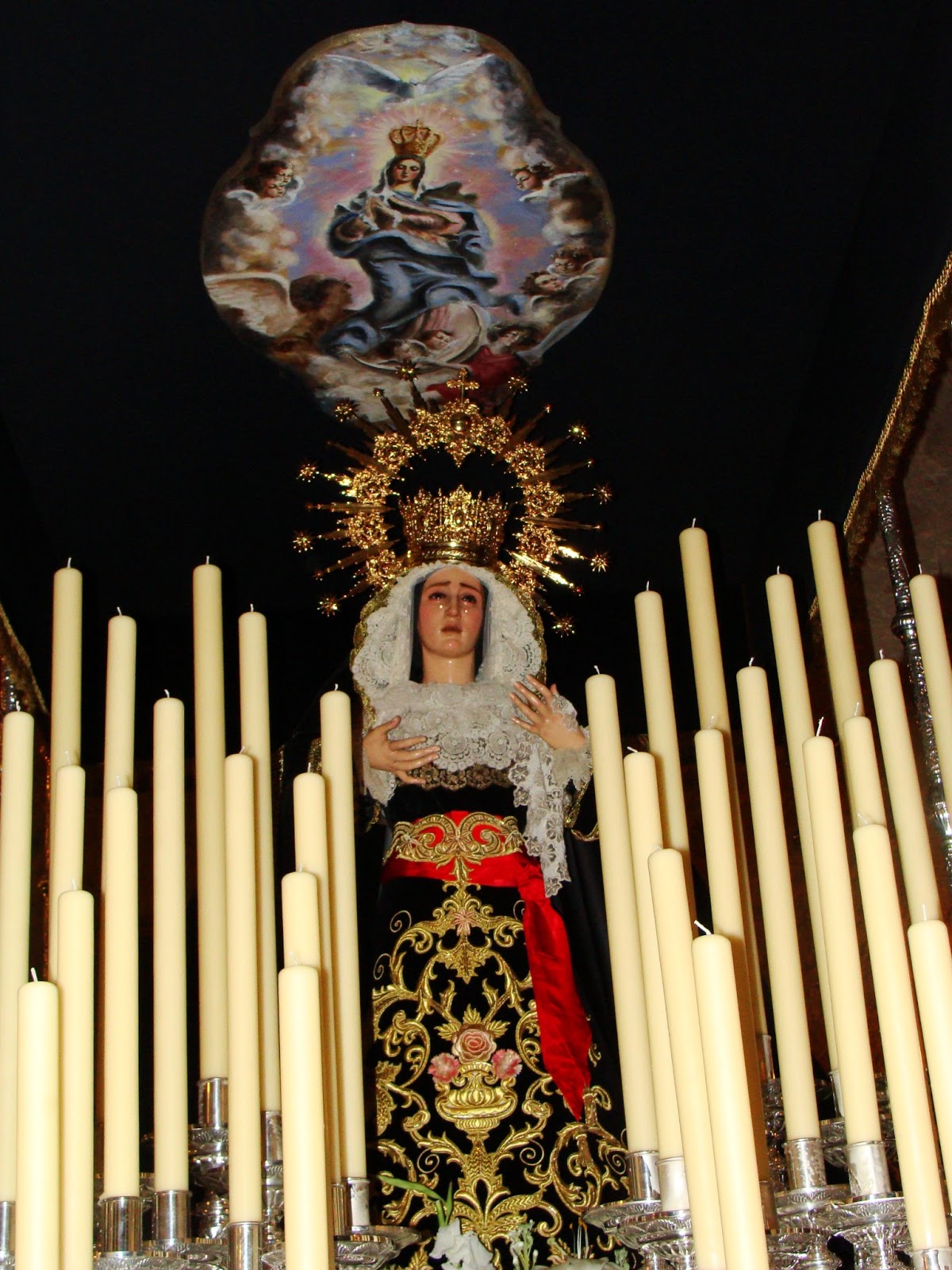
The Easter processions are not only one of the oldest traditions in many towns and cities of (primarily Southern) Spain, they are also one of the biggest public spectacles. The small city I live in has about two dozen ‘cofradías’, brotherhoods, which celebrate a particular aspect of the Passion of Christ either through the experience of the Virgin or a scene from the narrative.

Our Lady of
These scenes are figures, usually slightly more than life-size, made of wood and ceramic by expert specialists in the genre. They are ornately decorated with gowns, halos, garlands, flowers, silk handkerchiefs, candles, placed on a wooden float rigged with an ornate linen cover supported by posts at the corners, and transported through the street on the shoulders of strong young men. They are accompanied by the members of the ‘cofradía’, dressed in the garb of penitents, with gowns and pointed hoods in the colours of the group, and by a band, providing rhythm to the bearers and the walkers, and generally livening the whole thing up.

Jesus the Nazarene
It is a slow business, because they are very heavy, and the idea is to show them to the crowds, not to get it over with quickly. They stop to rest, they stop to listen to ‘saetas’, sung from balconies on the route, during which the bearers do not rest, at least not early on, but dance the platform in honour of the singer. It’s hard work. The bearers of the processions that go out on Good Friday are dispensed from the obligation of fasting and abstinence which binds other Catholics. Mrs Hickory’s Virgin is meant to go out tonight, as part of a complex of processions involving ten different images which meet and separate and meet again, then chase each other back to the Cathedral.

At one point the crucified Christ meets two versions of His mother in the Main Square and greets them in ritual fashion, bowing and dancing. Each of them, let me remind the reader, a life-sized statue on a billiard table with 40 second-row forwards underneath it. All of this takes time and energy.

The Last Supper
After some 4-5 hours of this, at about one in the morning, they arrive back at the Cathedral and take the statue in, backwards, on their knees, in the presence of a crowd that numbers in the low thousands.

This is not just a religious activity. It is not a handful of the devout doing inexplicable things, perplexing the majority of passers-by. It is a cultural and social event lasing a week, participated in directly by perhaps 1500 people in any given year (this in a city of some 80,000, and watched, with interest, respect and understanding by many thousands who line the streets to watch them pass, waiting hours to get a good place, clapping the more difficult manoeuvres of the bearers, remaining silent for the ‘saetas’, and staying up late into the night to watch the return of the images to their home church. Most of them probably don’t visit a church from one year to the next, it includes many teenagers who would normally be out in the streets or the bars with their friends, but it is a shared experience, a part of their culture and their hometown, which they want to continue to be part of.

It is very unlikely that the processions will be able to go out tonight, because of the rain, but the experience in other years of the reception of the Virgin by the crowds outside the Cathedral is remarkable in its intensity.

Friday, March 15, 2013

Idolatry of the Abstract


We need to group together to get our ideas heard, to express them with confidence, in order to clarify them in the first place, because. But once we entrust our belief to others it is no longer our own. It is dictated to us.

Any human organization, religious, cultural, sporting, political, government, whatever, will be controlled by those who love power, and it will demand that the primary faith, belief, loyalty, be to the structure and hierarchy of the organisation itself, not to the idea, ideal or purpose that it was originally created for, and certainly not to the people who created it to serve them. God, football, socialism, the taxpayer, whatever, is very much in second place.

Anyone who places the original purpose, God, say, in the case of a religious group, above the group itself will not be trusted, and will be sneered at by the leaders.

Idolatry of the abstract is what I, and doubtless many other people who are mystified that I should find any of this new, call the tendency to place the abstracted idea of a group of people above the individuals who make it up- who may have created the group specifically in order to benefit themselves- and even above the great majority taken together. The leaders will require, and often the members will not only accept but actively collaborate with the idea, that only the state, the game, the order, the party, the school, whatever it happens to be, matters, and the people who make it up can be dispensed with, disposed of, destroyed if necessary, all of them, in the name of the abstract that is supposed to belong to them.

Since there is one born every minute, and many people love simple abstract ideas that are easy to name, especially when they are designed to flatter them by being made fashionably good and easy to understand, many pseudo-religious, pseudo-political or pseudo-other organizations are created purely to take advantage of this factor. But many are created by the very people who later allow themselves to be controlled by them.

Sports associations are taken over by the people paid to run them, as soon as the game becomes economically or socially important enough. They talk about ‘bringing the game into disrepute’, ‘the game is bigger than all of us’, and are frequently in dispute with the people who supposedly employ them.

To a certain extent this exemplifies the principal/agent problem. In all such organizations, whether private or agencies of government, the people in charge of the money, of the rules, of deciding exactly what the whole point of the organization is, and however they acquired that power, will tend to run it in their own interests. Whether through corruption, ineptness, laziness or some combination of these and/or other reasons, this will happen. We know it will happen because it invariably does happen.

Tyrannical governments deliberately take advantage of organizations which already exist, and create abstracts such as ‘the state’, ‘the country’, the party’, the nation’, ‘the revolution’, the philosophy’, ‘the ideal’, ‘insert –ism here’, in order to justify everything up to and including the murder in the name of that ideal of the very people it is intended to serve, and indeed, in most cases, without whom it would not exist, and in all cases without whom it would have no meaning.

But you don’t have to go to Stalin to see this idolatry. The local golf club, choir or neighbourhood watch committee will happily sacrifice the people who created it to serve them, to some abstract ideal of itself, often with the willing acceptance of those sacrificed, who fail to see what has been done to them.

Monday, March 11, 2013

Government is Not Us


Some of the comments here are quite interesting. But among the usual misunderstandings is a very important one. Government as we understand is something outside society. It is perfectly possible for people to get together to protect their property from robbers. It doesn't have to be done individually. But that group which has pooled its resources and to a certain extent its freedom of action in order to obtain a solution at least acceptable to all members, and cheaper than it would otherwise be, never, however you stretch it and expand it, becomes a government. Even if it included every member of a given society, and did what we think governments do, efficiently and acceptably to its members, it would still be a collection of private individuals, not a government, because 'government' is above and outside the 'people'. This shows clearly that governments in the sense that most people use the word do not have to exist at all. They exist, not because the people need them, but because someone will also be willing and able to take power from others and stand outside the subject group. (Government and the state are the same thing here).

Some things, many things, are better done collectively, co-operatively. This does not mean they are better done by government. We are a social species, we do many things together. More usefully, many of the things that we do are a consequence of our being a social species, thus it is natural that many of the things that are important to us are better done together.

That absolutely does not mean that such things are better done by a group of people outside and above the main group, motivated by different desires, largely unaffected by the restrictions they impose on others, who can take money by force from their subjects, and who have no emotional interest, or social investment in the people they control. Socialism, statism presuppose these things, and collectivism assumes that co-operation will not be corrupted by those who love power over their fellows.

Saturday, March 9, 2013

Some Thoughts on Freedom


Polygamy is illegal because it is against the doctrines of Christianity. In a culturally Christian culture we still haven’t got as far as challenging that particular bit of orthodoxy. Its time will come. In any case, it no longer matters much. Marriage has become, as it should be, a private arrangement, which people enter into how they wish and when they wish. It is only if you want to be recognised by the state that it will take any notice of you at all, but if you wish to share your life with someone of the opposite sex, or the same sex, or several of each, or three men and a goat, the state will not bother you much. It is one of the very few areas where state interference has decreased in recent years. It is true that you will not get official permission except for some of these arrangements, but it matters little. It mattered when the government and your neighbours would make your life a misery if your lifestyle wasn’t sanctioned by the right paperwork, but that is now no longer the case in Britain. Therefore polygamy is not illegal. It’s true there is no form for it, but there is nothing to stop you living with as many people as you want, in whatever sexual and social arrangement you choose. Some of your neighbours might still purse their lips, and the Daily Mail will encourage them to throw manure at you, but they won’t dare, as they no longer feel courage in numbers.

Similar considerations apply to business hours, particularly Sunday trading. Hours of commerce are restricted for reasons which have largely been forgotten, but it is still difficult to change the rigidly followed traditions. Trade, fortunately, is flexible, and the trader has found ways to give his customers what they want when they want it, even if the Vicar or the Councillor are not happy about it.

I made similar remarks when Theodore Dalrymple stated tangentially that we are quite right to forbid public necrophilia. I don't know whether we do in fact forbid it, it's quite possible no one has ever thought to make it illegal. But if it is illegal it is not because we are right to ban it but because there is no one who cares about it. If there were an underground interest in it, growing slowly, taking advantage maybe of increasing public and institutional acceptance of sex, we would be having a quite different argument. And we probably would be wrong to ban it, though ban it we certainly would.

The prohibition of the burqa/niqab is a matter of freedom or oppression depending on what its prohibition is intended to achieve, or will in fact achieve. If Muslim women in Britain are forced to wear it against their will, by their husbands, then a prohibition will make it much harder for men to force women to hide from life and the world. If, on the other hand, Muslim women choose freely to express/obey the tenets of their faith/culture, then a prohibition restricts their freedom for no reason and so is wrong. The question, then, is how do we know what we are trying to respond to, and how do we establish numbers, percentages, proportions, and sort out the mess of overlapping desires/beliefs/decrees/impositions to arrive at something fair and just?

I think the answer is we don’t. If a woman who does not want to cover her face is forced to do so by her husband, she has the same recourse in law as other abused women, if she so considers herself. If there are cultural difficulties which make it unusually difficult for her to take advantage of those laws, there are people who could work to overcome those obstacles. To prohibit women from wearing a particular kind of dress is, it would appear, wrong.

The assumption always seems to be that no woman would wear a niqab/burqa if she were not forced to do so, but this is almost certainly not true.

Religious freedom is not a special kind of freedom that only religious people have, it is just freedom. Freedom of religion is freedom of belief, is freedom of opinion, is freedom of speech, is freedom full stop. They are all the same thing, and we all want to have them.

It annoys me when people defend the freedom of others to hold and profess their own beliefs, and then have to add, ‘however absurd/irrational’. It is a little tick which betrays an unreflecting sense of the superiority of their own reason to that of people who don’t agree with them. It is not unnatural, of course. Most of us believe that being right, according to our own lights, makes us better than those who are wrong, but the middle of an argument in defence of freedom is the wrong place to express that feeling. A small point, but there you are.

Puritans always follow the orthodoxy. What makes them feel good is knowing the crowd is behind them as they stop other people having fun, or freedom. The exact same types who are now trying to ban tobacco, alcohol, food, sugar were using the same arguments to attack homosexuals fifty years ago. Certainly some people find the smell of tobacco unbearably unpleasant or the presence of drunk people frightening or they have seen their brother die a horrible death after smoking forty a day for twenty years, but most seem to be are motivated largely by the desire to stop other people from doing what they want.

Thursday, March 7, 2013

On Acting and Hypocrisy*


ABC has published this amusing and instructive article, about the wealth and business methods of the performers who apparently went through their routine of denouncing capitalism at the Goya awards last week. They include Javier Bardem and Willy Toledo, who I have spoken about before, and Maribel Verdú and Penelope Cruz, who are worse hypocrites than I had realized. That they are ignorant and say whatever they people want to hear is not a new discovery, nor is the extent of their hypocrisy in most cases. It is unusual to see it so clearly exposed by the press, which usually prefers to use them to sell papers or adverts and to kiss their feet. Apparently at the Oscars there was less of this than usual.

I suppose we should expect people who live by their image to construct and perpetuate a false image of themselves. Perhaps they realize that the people who pay to watch them could easily find out the truth if they wanted, but they prefer to believe the lies. I just wish I had a platform like that for my own ideas. So, my moaning is just jealousy, really.

The development of prestige among actors is a curious social phenomenom, one which has, I imagine, been carefully researched by competent social historians. Lack of time constrains me to sketch a few lines based on memories from things I have read or seen over the years:

In Greek theatre the actors were not important. Playwrights who won major prizes became famous, and could become wealthy, and their Mecenas also acquired prestige, but I have never heard a reference to any social role or recognition for the performers. Not even a name seems to have survived. They didn't matter, is the conclusion. They were not craftsmen, much less artists; they were just workmen.

In mediaeval Europe the theatre was a very different matter. A popular entertainment at courts and in the square, no one involved in it had any prestige, although some of the poems have survived and are acknowledged now. At a later stage actresses were often prostitutes, and travelling players would scrape a few pence from any crowd they could find before being thrown out of town by the authorities.

In the 19thC there were some famous actors, with social pretige, but mainly because they had the patronage of some wealthy figure in society. At the start of the motion picture the actors were simply fodder for the camera. The pioneers of the medium discovered there was money to be made from magic lantern shows as there was from other shows. They also discovered, some time later, that with many more people watching the same show than could watch a live performance, milage could be made out of the general public's love of gossip. By giving greater prominence to the names and faces of the performers, and by manipulating information about alleged events in their lives, a whole secondary industry was derived from film, probably more lucrative than the films themselves, and it has grown ever since, as have the egos of those involved. From there to performers telling everyone else how to run the world is not a particularly long journey.

*Or as I saw in a comment at the Guardian the other day- Hippocracy. I think Jonathon Swift wrote about that.

Tuesday, March 5, 2013

The Beauty of Sanskrit


Sanskrit is a beautiful language. It is mellifluous, endlessly plastic, elegant in its complexity, and has created possibly the finest collection of narrative poetry in the world. An explanation of the language from two and a half thousand years ago is a work of such analytical and aesthetic wonder that both the erstwhile mathematician and the amateur linguist in me can still hardly believe it is real.

Sir William Jones, a man of great culture and intelligence, famously observed, over two hundred years ago, that Sanskrit is ‘more copious than the Latin, more perfect than the Greek, [and] more exquisitely refined than either.’

Even the script has a specific kind of beauty. Devanagari is a Bhramanic script, approximately alphabetic (of a type known as an abugida, where vowels are indicated by secondary marks rather than the more complete letters than express consonants) and rigorously phonetic, to the point that letters are written differently when the phonetic environment causes the sound that is actually spoken to change. And it isn’t done to make things easier, but to increase the perceived perfection of the form.

The Clay Sanskrit Library is a series of annotated, bilingual Sanskrit-English texts in pocket hardback on the model of the Loeb Greek Library.  A terrific idea and, like the Loeb, very good to have on your shelves and very useful to the learner (which I still am and probably always will be). However…

They decided to publish the English texts in Roman transliteration rather than in Devanagari. They explain their reasons for this: the script originally used to write down the earlier texts is unknown, but it certainly wasn’t Devanagari which was only created centuries later; the Roman is easier to print, and easier to read for those who don’t want to learn a new script; but… Devanagari has beauty. Even if you don’t understand it is has plastic beauty, and when you read it and respond to the way it conveys sound and meaning, there is a beauty in the elegant, coherent way in which it performs its function.

1 स ताां ऩुष्करयण ां गत्वा ऩद्मॊत्ऩरझषाकुराभ याभः सौमभत्रिसहहतॊ ववरराऩाकुरेन्द्रिमः
2 तस्म दृष््वैव ताां हषााद इन्द्रिमाणण चकन्द्पऩये स काभवशभ आऩरनः सौमभत्रिभ इदभ अब्रव त 3 सौमभिे ऩश्म ऩपऩामाः काननां शुबदशानभ मि याजन्द्रत शैराबा दरुभाः समशखया इव
4 भाां तु शॊकामबसांतप्तभ आधमः ऩ डमन्द्रत वै बयतस्म च दुःखेन वैदेह्मा हयणेन च


Compare it to the Roman form, which communicates effectively but is irredeemably ugly.

 1 sa tāṃ puṣkariṇīṃ gatvā padmotpalajhaṣākulām rāmaḥ saumitrisahito vilalāpākulendriyaḥ
2 tasya dṛṣṭvaiva tāṃ harṣād indriyāṇi cakampire sa kāmavaśam āpannaḥ saumitrim idam abravīt
3 saumitre paśya pampāyāḥ kānanaṃ śubhadarśanam yatra rājanti śailābhā drumāḥ saśikharā iva
4 māṃ tu śokābhisaṃtaptam ādhayaḥ pīḍayanti vai bharatasya ca duḥkhena vaidehyā haraṇena ca


Many people learn the Greek script without learning the language, for the pleasure of feeling the sound son their tongue as they read them. I recommend a similar exercise for Sanskrit.